Shrub · Aquifoliaceae
Winterberry Holly
Ilex verticillata
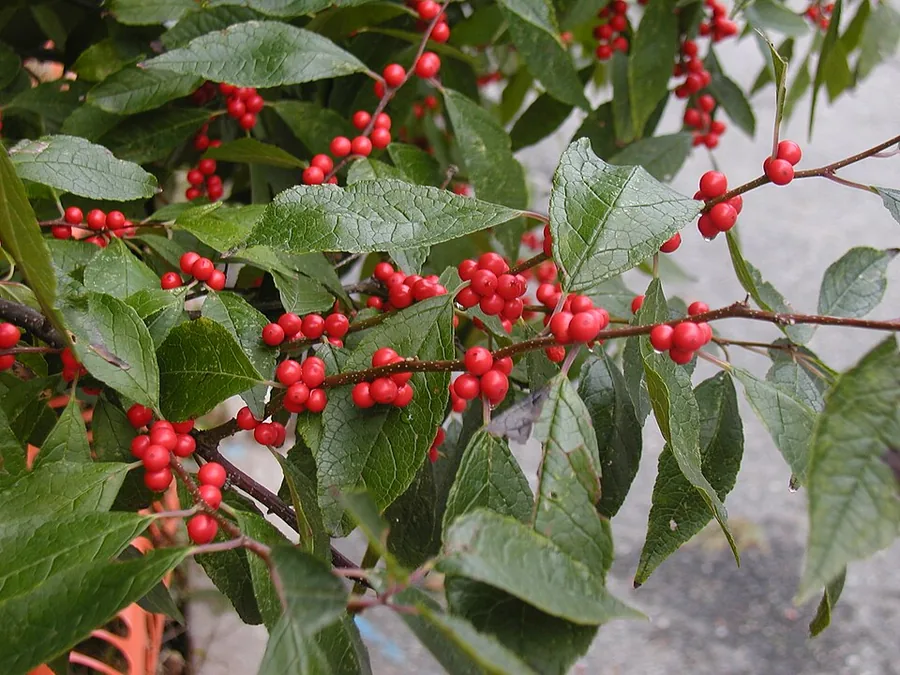
Once the leaves drop, winterberry lines its bare gray stems with beads of scarlet fruit.
Full sun
Every 3–7 days
USDA 3–9
3–15 ft · 0.9–4.6 m
Overview
Winterberry holly wears different faces across the year. Through summer it reads as a plain green shrub, easy to walk past, but when fall arrives the leaves let go and the branches stand bare. What remains is the reason to look closely: stems studded tight with round, glossy scarlet berries that ride the bare twigs like beads threaded on a wire.
Look for the flowers and you will nearly miss them. They open small and greenish-white and inconspicuous, tucked along the stems from spring into early summer, more curiosity than display. The berries that follow are the real spectacle, ripening from late summer into a hard, shining red that clings to the bare wood deep into winter.
The plant grows from the wet ground of eastern North America, and it takes on the loose, twiggy shape of a shrub raised at swamp edges and in low woods. On a female with a male nearby, every stem can carry a dense sleeve of red; on a lone or male plant, the same branches leaf out green and stay empty of fruit.
Care
The short version: full sun to part shade and steadily moist, acidic soil that never dries out, with at least one male shrub near the females so the bare winter stems fill with red berries.
Light
Winterberry grows from full sun to full shade, but the sun is what loads the stems. At least a half day of direct light packs the branches with the densest, reddest fruit; in deep shade the same shrub stays green and healthy but sets a thinner scatter of berries.
Water
This is a shrub of soaked ground, happiest where the soil stays steadily moist and never bone dry. Its roots take even boggy, poorly drained spots that would rot most plants. Give it water through the first season and in any dry stretch as it settles.
Soil
Winterberry wants moist to wet, acidic soil, ideally a pH of 4.5 to 6.0 and dark with organic matter. It roots into clay or sand alike as long as the ground stays damp, and it is that acidity that keeps the leaves a deep, even green.
Temperature
The wood is remarkably hardy, unbothered from -40°F to 100°F (-40°C to 38°C). That span covers zones 3 through 9, so the bare winter stems and their berries ride out cold that would break other hollies.
Humidity
Outdoors the air is whatever the season brings, and winterberry pays it no mind. Airflow around the stems matters more than moisture in the air, since the minor leaf fungi spot and film the foliage most in crowded, still plantings.
Feeding
One spring feeding of an acidic, slow-release fertilizer made for acid-loving plants is all the shrub takes. A single seasonal feed suits so plain a grower, and it keeps the soil on the acid side that holds the leaves green.
Pruning
Winterberry needs little cutting. Shape the stems in early spring before new growth breaks, since the flowers form on new wood, and take out any dead or crossing branches while the shrub is bare and easy to read.
Repotting
As a ground shrub, winterberry rarely sees a pot. In a container, move it up only when roots circle the sides, water runs straight through, or the growth stalls despite good care.
Size & spacing
Winterberry ranges by cultivar from 3 to 15 feet (91 cm to 4.5 m) tall, its twiggy frame spreading about as wide. Give each shrub room for its full width, and keep a male within about 50 feet of the females so the stems fill with fruit.
When to plant
Winterberry moves through a clear yearly sequence. New leaves and the tiny greenish-white flowers arrive from spring into early summer, the small green fruit swells and reddens through late summer, and by fall the leaves drop to leave the red-beaded bare stems that hold their color through winter. Set young plants out in spring or fall.
Northern hemisphere
Southern hemisphere
Typical months for a temperate climate: start earlier in warm zones, later where spring frosts linger.
- Plant: Spring or fall
- Harvest: Inconspicuous greenish-white flowers April to July; bright red berries August to December persisting through winter
Hardiness
USDA hardiness zones: 3–9
Temperature: down to -40°C
Troubleshooting
Winterberry is an easy shrub, and its troubles show plainly on the plant itself. A fading of color in the newest leaves or a season of bare, berryless stems is usually the first thing you notice. Match what you see below, then treat the cause behind it.
New leaves gone pale while the veins stay green
This is chlorosis, the plant's own signal that the soil has climbed too high on the pH scale for an acid lover. On neutral or alkaline ground the roots cannot pull up the iron and manganese the leaves need, so the newest growth blanches to yellow-green while the fine veins hold their color and stand out against it. Lower the pH with elemental sulfur or an acidifying fertilizer, lay down pine bark mulch, and reach for chelated iron when a fast fix helps.
Fix:
- Lower soil pH using elemental sulfur or an acidifying fertilizer
- Apply chelated iron as a temporary correction
- Mulch with acidic organic matter such as pine bark
A female shrub whose bare stems carry no red
Bare wood without berries almost always means no partner. Winterberry shrubs are male or female, and a female colors up only when a compatible male flowers nearby at the same time. Set one male such as 'Jim Dandy' or 'Southern Gentleman' for every 6 to 20 females within about 50 feet, line its bloom time up with the females, and give pollinators a clear path to the small flowers, and the fruit will set.
Fix:
- Plant one male cultivar such as 'Jim Dandy' or 'Southern Gentleman' per 6 to 20 females within 50 feet
- Match the male's bloom time to the female cultivars
- Ensure pollinators have access during bloom
Dark spots or a fine white dust on the leaves
These marks are fungal leaf spot and powdery mildew, dark blotches and a pale powdery film that spread most across humid, crowded foliage, though neither harms a healthy shrub. Thin the stems so air moves through, clear away the spotted leaves, and keep water off the foliage, and the shrub carries on.
Fix:
- Improve air circulation by thinning and proper spacing
- Remove and dispose of affected foliage
- Avoid overhead watering
Toxicity
Winterberry holly is only mildly toxic, but the fruit is the part that tempts. Those hard, shining red berries carry saponins and caffeine-like compounds, and the leaves hold them too, enough to bring on vomiting, diarrhea, and drooling if eaten. The berries are what catch a small hand or a curious mouth, so keep cut branches and any that drop away from pets and children.
Toxic to
Cats · Dogs · Horses · Rabbits · Livestock · Birds · People
Cats Mild
A cat that mouths a leaf or, more often, one of the round red berries usually drools and brings up its food, with loose stools and a flat, subdued mood after. The saponins and caffeine-like compounds in the fruit and foliage are the irritants, and most cases stay mild.
Dogs Mild
Dogs are the ones most likely to gulp a mouthful of the fallen red berries, and that brings on vomiting, diarrhea, and thick drooling. The stiff, spiny leaves can scratch the mouth on the way down. The signs usually pass on their own, though a big helping is worth a vet call.
Horses Mild
A horse cannot vomit, so the same berries and leaves bring on diarrhea, dullness, and colicky discomfort instead. Grazing animals seldom single the plant out, and a small taste rarely comes to more than a passing upset.
Rabbits Mild
The saponins in the leaves and bright fruit irritate a rabbit's delicate gut, so keep both well out of reach. Even a little can leave a rabbit off its feed with soft droppings.
Livestock Mild
Cattle, goats, and sheep can take a digestive knock from the foliage and berries, showing as drooling and loose manure. The plant is unpalatable enough that serious cases stay uncommon.
Birds Caution
Wild songbirds strip the ripe red berries through winter without harm, and the fruit is a key cold-season food for them. Pet birds are another matter, so do not offer holly to a parrot or finch.
People Caution
The berries are not food, however edible their bright red looks, and a child who eats a handful can end up with vomiting, diarrhea, and stomach cramps. A berry or two rarely causes much, but keep cut branches and fallen fruit away from small children.
Keep cut berried branches and fallen berries away from pets and small children; berries are the most likely part to be ingested.
Helpline numbers

United States
ASPCA Animal Poison Control: (888) 426-4435 (fee applies)
Poison Control: (800) 222-1222



Canada
Poison Centres: 1-844-764-7669
Varieties
Named winterberries part into female fruiters and the males that pollinate them, and the females differ most in the color and size of the fruit they set. These are the ones you will meet most often.
Winter Red
A heavy female whose bare stems disappear under glossy red berries that keep their shine and color long into winter.
Red Sprite
A compact female dwarf of only about 3 to 5 feet, its short branches carrying berries that look large against the small frame.
Jim Dandy
An early-blooming male that scatters pollen for the early females yet never colors a berry of its own.
Southern Gentleman
A late-blooming male whose flowers open in step with the mid- to late-season females.
Winter Gold
A female that sets soft pinkish-gold to orange fruit rather than the usual hard red.
Companions
Winterberry pairs best with the male shrub that fruits it and with other plants that love the same wet, acidic ground.
Plant near
Jim Dandy winterberry (male): Provides early-season pollen needed for female winterberry shrubs to set fruit.
Red osier dogwood: Shares moist, acidic site preferences and pairs well in rain gardens and native plantings.
Cinnamon fern: Thrives in the same wet, acidic shade conditions for a layered native moist-soil planting.
How to propagate
You can raise more winterberry from cuttings or from seed. Cuttings copy a known plant down to the color of its fruit, while seed leaves both the plant's sex and its berries a mystery until it flowers.
Stem cuttingsModerate
Late spring to summer · 6 to 12 weeks to root, then transplant the following season
Cuttings copy the plant exactly, fruit color and all. Take softwood to semi-hardwood lengths of the current season's growth from late spring into summer, dust the cut ends with rooting hormone, and most strike roots in 6 to 12 weeks, ready to move on the following season. A cutting off a female stays female, and its bare stems will redden once a male grows nearby.
SeedDemanding
Fall sowing of cleaned seed · Slow; seeds require warm then cold stratification and may take more than a year to germinate
Seed is the slow, uncertain path. Sow cleaned seed in fall and wait, since it needs a warm spell followed by a cold one and can sit more than a year before a green sprout shows. The seedling hides its sex and its berry color until it flowers, which is why cuttings win when you want a known, fruiting female or a named cultivar.
Myths
Every winterberry shrub grows its own red berries.
Winterberry plants come in separate sexes, and only the females ever redden. A female sets her berries only when a compatible male with an overlapping bloom time grows close by, so a lone shrub or a male keeps bare, empty stems, however well it is grown.
Winterberry holly stays green through winter like other hollies.
This holly is deciduous, not evergreen, so the leaves do not last. Every one drops in fall, and the shrub then stands as bare stems studded with red berries through the cold months, which is the whole picture you plant it for.