Shrub · Aquifoliaceae
Yaupon Holly
Ilex vomitoria
Small-leaved, red-berried, and the one North American holly you can brew, yaupon holds its evergreen sheen through drought, salt, and shade.
Full sun
Every 7–14 days
USDA 7–9
10–25 ft · 3–7.6 m
Overview
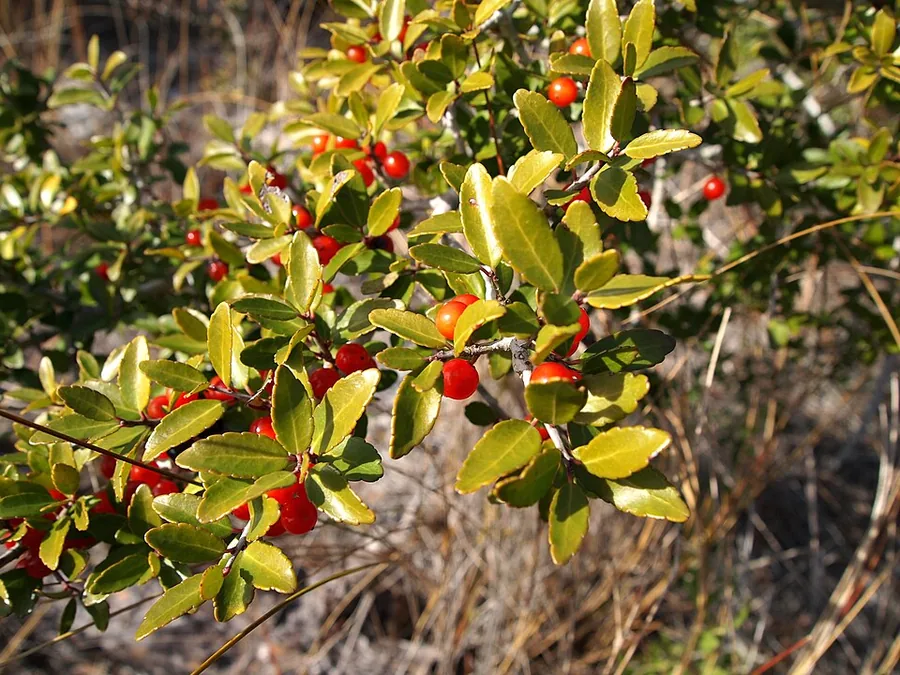
Yaupon holly is a tough, evergreen native of the southeastern United States clothed in small, oval leaves that are smooth to the touch, edged with soft rounded teeth, and set close along gray, densely branched stems. There is no prickle to catch a finger, so the whole plant can be handled bare-handed. Hardy through zones 7 to 9, it keeps that fine-textured evergreen coat from full sun to deep shade and holds it through drought, salt spray, and stretches of soggy ground.
Those unassuming leaves carry caffeine, the highest of any plant native to North America, and have been brewed into a stimulating tea for centuries. The plant is dioecious, its male and female flowers borne on separate individuals, and only the females ripen the small, translucent red berries that stud the bare winter twigs like beads of glass.
Give it space and it fills out into a dense, small-leaved mass with very little asked in return. The one habit to watch is the thin shoots it pushes up from the roots, which lace into a thicket if left alone. Keep those in check and yaupon holds the garden as a fine-textured, year-round green presence through every season.
Care
The short version: yaupon settles into almost any well-drained soil from sun to shade, wants water through the first season and little after, and needs its root suckers cut two or three times a year to keep its dense, small-leaved form clean.
Light
Yaupon keeps its dense, small-leaved coat anywhere from full sun to full shade, a rare span for a fruiting shrub. It grows thickest and sets the most berries in 6 or more hours of sun, though a shaded plant still holds full, even foliage and a tight silhouette.
Water
Water it steadily through the first growing season to drive the roots down, then let the top half of the soil dry between drinks. Once rooted it is strongly drought tolerant and needs water only through a long dry stretch. It shrugs off the odd flooding too, so wet ground leaves no lasting mark.
Soil
Few shrubs settle into ground this easily. Clay, loam, or sand all suit it as long as the drainage runs free, and it takes soil from occasionally wet to bone dry. Its comfortable pH spans wide, from 5.0 to 8.0.
Temperature
Yaupon is hardy from about 5°F to 100°F (-15°C to 38°C), holding its green through hot southern summers and the frost of zone 7 winters. That wide range is why it keeps a year-round evergreen face across so much of the Southeast.
Humidity
Plain outdoor humidity suits it, with no figure to hit. Moving air matters more than moisture around the leaves, since crowded, still foliage is what picks up the occasional leaf spot.
Feeding
A balanced slow-release shrub or tree fertilizer in spring is plenty, and only seasonally. A settled plant in reasonable soil needs little to no feeding at all, so keep a light hand.
Pruning
The small leaves and dense twigs take heavy shearing and hold a crisp line, shaping into hedges, screens, or topiary. The cut that matters most is taking the root suckers at ground level two or three times a year, or the thin shoots knit into a thicket.
Repotting
A container yaupon moves up every 2 to 3 years. Repot when roots coil around the pot or reach out the drainage holes, when water runs straight through, or when growth slows and the leaves wilt fast between waterings.
Size & spacing
118–299 in (300–760 cm) tall
When to plant
Yaupon goes in during spring or fall, when the soil holds warmth for rooting but the heat has softened. Tiny greenish-white flowers open and fade quietly in spring, around March to May, and on female plants the small red berries that follow ripen in fall to a translucent shine that lingers deep into winter.
Northern hemisphere
Southern hemisphere
Typical months for a temperate climate: start earlier in warm zones, later where spring frosts linger.
- Plant: Spring or fall
- Harvest: Inconspicuous greenish-white flowers in spring (March-May); translucent red berries on female plants mature in fall and persist into winter
Hardiness
USDA hardiness zones: 7–9
Temperature: down to -18°C
Troubleshooting
Yaupon holly is one of the easiest shrubs to grow, and nearly every issue it shows is a surface blemish rather than real harm. The usual puzzles are bare twigs where berries should sit or a few marked leaves. Match what your eye lands on below, and the remedy is almost always a simple one.
Bare branches with no red berries on a mature plant
When the branch tips stay green and empty where beads of red should sit, the reason is the plant's sex. Yaupon is dioecious, so a plant is either male or female, only the females carry fruit, and even a female stays bare unless a male blooms within reach. A male, a solitary female with no partner, or a cultivar that never fruits all leave the twigs without berries. For those glassy red drupes, set a proven female such as 'Jewel' or 'Pride of Houston' beside a male that flowers at the same time.
Fix:
- Plant at least one male yaupon near female plants to ensure pollination
- Select a known fruiting female cultivar such as 'Jewel' or 'Pride of Houston'
Freckled, bronze-cast leaves with webbing and a sticky sheen
Leaves flecked with pale pinprick dots, tinged bronze, and strung with fine webbing, their surface tacky under a dark, sooty film, mark sap-feeding pests such as spider mites, scale, or leaf miners, the sooty mold clinging to the sticky honeydew they leave. Turn a leaf over and run a hand lens along the underside and stems, or tap the foliage above a white sheet and watch for crawling specks. A hard jet of water strips them off, horticultural oil or insecticidal soap coats the undersides, and the worst stems get cut away. On yaupon these pests seldom go past a blemish.
Fix:
- Hose off foliage with a strong stream of water
- Treat with horticultural oil or insecticidal soap, covering leaf undersides
- Prune out heavily infested stems
Dark-spotted, blotched leaves with a scatter of leaf drop
Rounded spots, raised black tar-like blots, or a chalky white bloom dusting the leaf surface mark fungal leaf spot or powdery mildew, the pair that settles in where damp, unmoving air hangs among the foliage. Pick up and bin the fallen spotted leaves, open the plant by thinning and spacing so air slides through, and pour water at the base rather than over the crown. With sharp drainage and a plant in strong leaf, these stay shallow marks, cosmetic and no more.
Fix:
- Remove and dispose of fallen infected leaves
- Improve air circulation by thinning and spacing plants
- Avoid overhead watering and water at the base
Toxicity
Yaupon holds two natures in one plant. Its small, smooth leaves brew into a safe, mild caffeinated tea long drunk by people, while the glossy red berries carry saponins and turn mildly toxic if eaten. Keep the fallen fruit away from pets and small children, since the concern lives in the berries alone and passes on its own.
Toxic to
Cats · Dogs · Horses · Rabbits · Livestock · Birds · People
Cats Mild
A cat that mouths a few of the small, glassy red berries usually drools, vomits, passes loose stool, and slumps into a lower gear. The saponins concentrate in that bright fruit rather than the leaves, so the berries are the part to watch.
Dogs Mild
A dog that crunches the berries tends to vomit and loosen up, sometimes drooling and turning quiet and dull for a spell. The signs stay mild and pass, though a large mouthful is worth a call to the vet.
Horses Mild
The saponins packed in the fruit can loosen a horse's gut and leave it dull and listless. The little a horse would take of the bitter berries keeps the upset mild.
Rabbits Mild
The saponins in the beadlike berries unsettle a rabbit's delicate gut, bringing soft stool and a shrinking appetite. Keep the dropped fruit out of reach and offer none of it.
Livestock Mild
Cattle, goats, and sheep rarely mouth the bitter red berries, but the saponins can stir a mild gut upset if the fruit is grazed. Browsing the small, smooth leaves is no notable concern.
Birds Caution
Many wild birds strip the translucent red berries through winter without harm and scatter the seed, so the fruit is a natural part of their diet. A caged pet bird calls for more care, since its smaller body makes any saponin dose count for more.
People Berries mildly toxic
The small, smooth leaves are the one caffeinated North American holly and brew into a safe, mild tea, so the plant itself is not off limits to people. The glossy red berries are the exception, holding saponins that bring on vomiting and diarrhea if eaten, so keep them away from young children.
Keep fallen berries away from pets and small children; toxicity is generally mild and limited to ingestion of the fruit.
Helpline numbers

United States
ASPCA Animal Poison Control: (888) 426-4435 (fee applies)
Poison Control: (800) 222-1222



Canada
Poison Centres: 1-844-764-7669
Varieties
Yaupon takes many shapes, from low green cushions to long weeping strands, so the right one depends on whether you want a dense hedge, a specimen with line, or branches heavy with red fruit. A few forms come up again and again.
'Nana' (Dwarf Yaupon)
A compact, mounding dwarf that swells into a dense green cushion about 3 to 5 feet tall and wide, a non-fruiting male.
'Pendula' (Weeping Yaupon)
A weeping form whose branches spill downward in long strands to 15 to 20 feet and, on a female, hang thick with red fruit.
'Folsom's Weeping'
A weeping selection whose branches drape in the same cascading lines as 'Pendula'.
'Jewel'
A female cultivar loaded with dense clusters of glossy red berries.
'Pride of Houston'
A medium-sized female thickly and reliably studded with red fruit.
'Will Fleming'
A male cultivar drawn into a slim, upright column that rises straight up like a green exclamation point.
How to propagate
Because yaupon is dioecious, the way you propagate it decides whether the twigs will ever bead up with red fruit. Cuttings give you a known male or female, while seed leaves the sex hidden.
Stem cuttingsModerate
Take semi-hardwood cuttings in summer · 6-12 weeks to root; one or more seasons to establish
Cuttings are the dependable route because yaupon is dioecious, and drawing them from a known male and a known female hands you both sexes for fruit. Snip firm, half-ripened semi-hardwood stems in summer, and they push roots in roughly 6 to 12 weeks before taking a season or more to settle. A male must stand near the females for any berries to form.
SeedDemanding
Collect ripe fruit in fall · Often 1-3 years; seed has a hard, dormant coat and germinates slowly and erratically
Seed is the slow, uncertain path. Gather the ripe red fruit in fall, then wait out a hard, dormant seed coat that stalls germination across 1 to 3 years in ragged, uneven starts. A seedling hides its sex until it flowers, so most growers turn to cuttings when they want a known male or female.
Myths
The name vomitoria means yaupon leaves make you vomit, so the plant is poisonous to brew.
Yaupon leaves are not emetic at all. They hold caffeine and were brewed for centuries into a stimulating tea, the ceremonial black drink, and the vomiting in those rituals came from downing huge volumes while fasting, not from the plant. The species name is a misnomer, and yaupon tea is safe in moderation.
All hollies have sharp, spiny leaves.
Yaupon breaks the pattern with small, smooth, round-toothed leaves whose edges roll gently instead of biting into spines. Unlike English or American holly, you can handle it without gloves.