Shrub · Aquifoliaceae
Sky Pencil Holly
Ilex crenata
A tight column of small, glossy evergreen leaves on stiff upright stems, kept going by acidic soil and winter protection.
Full sun
Every 5–10 days
USDA 5–8
4–10 ft · 1.2–3 m
Overview
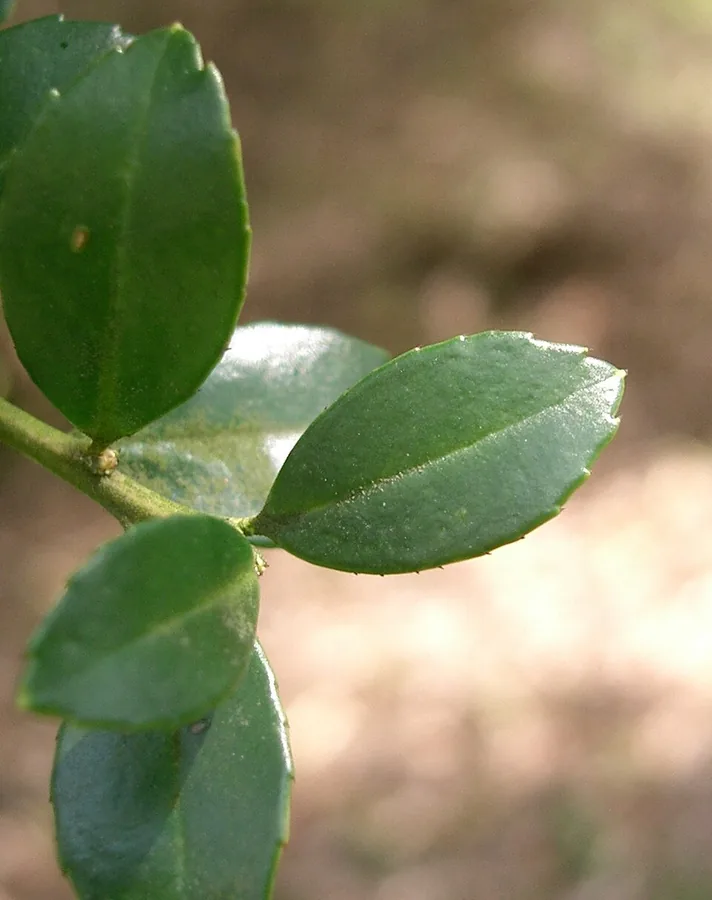
Up close, Sky Pencil Holly is a single narrow spire of stiff, upright stems pressed tightly together. It stands 4 to 10 feet (1.2 to 3 m) tall yet measures only 1 to 3 feet (30 to 90 cm) across, so the whole plant reads as one clean vertical line rather than a spreading bush. The stems climb almost straight up, giving the column its pencil-thin outline.
The leaves are small and closely set, each one glossy and deep green, and they clothe the stems densely from base to tip. Because the plant grows slow, that leafy surface stays even and unbroken, with no gaps opening up along the column. This is an all-female cultivar, so the only fruit it carries is a scatter of small black berries, and those show up only when a male holly stands close by.
The deep green holds through winter, when cold, drying wind can brown patches of the foliage and heavy snow can bend the slim stems out of their tight line. Its color comes from glossy, evergreen leaves that stay on the plant all year, over ground best kept acidic and well-drained. In zones 5 to 8 it takes cold down to about -9°F (-23°C) without dropping its leaves.
Care
The short version: it wants full sun to part shade, acidic and free-draining soil that stays evenly moist, one feeding in early spring, and its stiff stems drawn together with a loose tie before winter so the tight column keeps its form.
Light
In full sun the leaves sit tight and the column stays firm and packed. Under partial shade the same plant grows more open, its stems spacing out and its outline softening.
Water
Give the roots evenly moist soil, a watering about every 5 to 10 days as the weather runs hot or wet. A short drought shows in dulled, tired leaves, and waterlogged soil is worse, rotting the roots out of sight below the surface.
Soil
It roots best in light, acidic, well-drained soil around a pH of 5.0 to 6.5. It holds in clay or sand, but on alkaline ground the green drains from the leaves and they pale to yellow.
Temperature
The foliage holds its green across a wide span, from about -9°F to 95°F (-23°C to 35°C). Through zone 5 to 8 winters the leaves stay on, but a dry, cold wind can scorch them a dull brown.
Humidity
Plain outdoor air suits the plant, so there is no humidity figure attached to it. Good airflow moving through the dense column helps it far more than any level of moisture in the air.
Feeding
A single feeding of balanced, acid-forming shrub fertilizer in early spring keeps the new leaves coming. Its slow pace means one feeding carries the whole plant through the season.
Pruning
The tight column forms on its own, so the shears rarely come out. A light trim in spring evens any stray growth, and a loose tie before winter keeps snow and ice from prying the stems apart.
Repotting
Potted, it goes up a size every 2 to 3 years, or once roots wind around the rootball and edge out the drainage holes. Fresh, acidic potting mix and a slightly larger pot revive it once its growth eases or water runs straight through.
Size & spacing
A grown plant is a narrow shaft 4 to 10 feet (1.2 to 3 m) tall and just 1 to 3 feet (30 to 90 cm) through. That slender width lets several stand close, their columns merging into a thin green wall.
When to plant
As an evergreen, it never drops into a bare, harvest-time state, so timing is only about planting. Put it in the ground in spring or fall, while the air stays mild and the roots take hold before summer heat or a hard freeze. Small flowers open in May and June, and the little black berries follow only where a male holly grows within reach.
Northern hemisphere
Southern hemisphere
Typical months for a temperate climate: start earlier in warm zones, later where spring frosts linger.
- Plant: spring or fall
- Harvest: May to June
Hardiness
USDA hardiness zones: 5–8
Temperature: down to -29°C
Troubleshooting
Kept in the right place, this holly stays a solid green column, but a wet root run or a harsh winter can mark it. The signs show first in the leaves and the upright stems, where a close look catches them early. Find the symptom that matches and deal with it before the damage sets.
Yellowing leaves and dieback, worst in wet ground
Yellowing leaves, thinning growth, and dying twig tips over soggy soil point to Phytophthora or black root rot. Lift the base and the roots show dark brown to black, soft, and decayed, worse the wetter the ground sits. Sharper drainage and lighter watering pull it back, and on a stubbornly wet spot the plant is set high on a raised bed. One rotted through is best taken out so it does not carry the rot along.
Fix:
- Improve drainage and stop overwatering
- Avoid planting too deeply or over-mulching
- Use raised beds in heavy or wet soils
- Remove severely affected plants
Fine pale flecks, a bronze sheen, and thin webbing
Look closely and the pale flecks, the bronze sheen over the leaves, and the thin webbing give away spider mites, usually the southern red mite, thickest in hot, dry weather. Held over white paper, a tapped branch drops tiny moving specks you can see. A hard jet of water strips most away, and insecticidal soap or horticultural oil coating the leaf undersides takes the rest, repeated about a week later while any hold on.
Fix:
- Apply strong water sprays to dislodge mites
- Treat with insecticidal soap or horticultural oil, covering lower leaf surfaces
- Repeat treatment in 7 to 10 days while mites are present
Browned foliage and stems fanned out of line
After a cold, dry wind, the outer leaves brown into winter burn, and a heavy fall of snow or ice can fan the packed stems out of their line. Snow lifted off the stems soon after a storm keeps them from bowing. Drawing the stems together before winter, behind a windbreak and over a mulched base, holds the column true.
Fix:
- Gently brush snow off stems after storms
- Tie stems loosely together for winter support
- Provide a windbreak and winter mulch
Every leaf faded to a flat, pale yellow
When every leaf drifts to the same flat, pale yellow, the trouble is chlorosis from soil turned too alkaline. The high pH keeps iron from reaching the leaves, and without it they cannot build their green. A soil test, a move back toward acidic, and a dose of chelated iron bring the color back as the balance returns.
Fix:
- Test soil pH
- Amend soil to lower pH toward acidic range
- Apply chelated iron if needed
Toxicity
This holly is mildly toxic rather than dangerous. Its small black berries and glossy leaves both hold saponins, and since the berries are the bright, tempting part, they are the piece to watch. A taste tends to bring a brief stomach upset, so swept-up berries are best kept from pets and young children.
Toxic to
Cats · Dogs · Horses · Rabbits · Livestock · Birds · People
Cats Mild
A cat that mouths a leaf or crushes a berry usually ends up queasy, drooling, and bringing up a little or passing loose stools. It rights itself before long, but a cat that has swallowed several berries earns a check from the vet.
Dogs Mild
Dogs go for the small, shiny berries most of all, and the saponins soon have them drooling and skipping meals for a day. Expect a little vomiting or a soft stool, no more.
Horses Mild
A horse seldom bothers with holly, but a mouthful of the stiff leaves or berries can leave it with a colicky, aching gut and a dull, flat look.
Rabbits Mild
A rabbit's fragile gut cannot handle the saponins, so its trimmings and dropped berries should stay well outside the hutch.
Livestock Mild
Cattle and other grazers pass the bitter leaves by, but a goat or sheep that strips a stem may finish with a mild churn of digestive upset.
Birds Caution
Wild birds pick the black berries clean through winter and take no harm, yet the very same fruit can sicken pet birds, so a caged bird belongs away from the plant.
People Caution
This holly is not food; none of it should ever be swallowed. A berry or two brings little more than a sore stomach, but several push it to vomiting and diarrhea, so the fruit belongs out of small children's reach.
Keep fallen berries away from pets and children; the spiny evergreen foliage is otherwise low risk.
Helpline numbers

United States
ASPCA Animal Poison Control: (888) 426-4435 (fee applies)
Poison Control: (800) 222-1222



Canada
Poison Centres: 1-844-764-7669
Varieties
Sky Pencil sits with a few other slim, upright Japanese hollies. These are the ones you will most often see side by side with it.
Sky Pencil
The narrowest form, a female cultivar rising 4 to 10 feet on a stem width of just 1 to 3 feet, a single upright green line.
Sky Pointer
An upright Ilex crenata selection that forms almost the same slim, packed column.
Glow Stick
An Ilex crenata cultivar whose leaves come in a bright golden yellow instead of green.
How to propagate
To keep the same tight, narrow column, Sky Pencil is grown from cuttings rather than seed. It is slow work, though it asks for little skill.
Stem cuttingsModerate
Summer, using semi-hardwood cuttings · 6 to 10 weeks to root
New plants come from semi-hardwood cuttings cut in summer, the one path that carries the narrow, packed column over to the next plant. Set in a moist, free-draining medium, the cut stems put out roots across 6 to 10 weeks. From seed the slim outline is lost, so every plant sold is a clone of the last.
Myths
Holly can be no danger to pets when it is such a familiar garden shrub.
Being a familiar shrub in the garden has nothing to do with what is safe to swallow. Holly holds saponins, and its berries turn cats and dogs drooly and sick, with vomiting or diarrhea to follow. The poison is mild but real, so those glossy berries are no snack.
Sky Pencil Holly will set berries no matter what.
It is an all-female cultivar, so it cannot set fruit alone. The small black berries form only after a male holly nearby drops pollen onto its flowers.