Shrub · Apocynaceae
Asiatic Jasmine
Trachelospermum asiaticum
Small, glossy leaves packed into a dense evergreen mat, happy in sun or deep shade, with new shoots that flush coppery before they green.
Full sun
Every 7–14 days
USDA 7–11
6–24 in · 15–61 cm
Overview
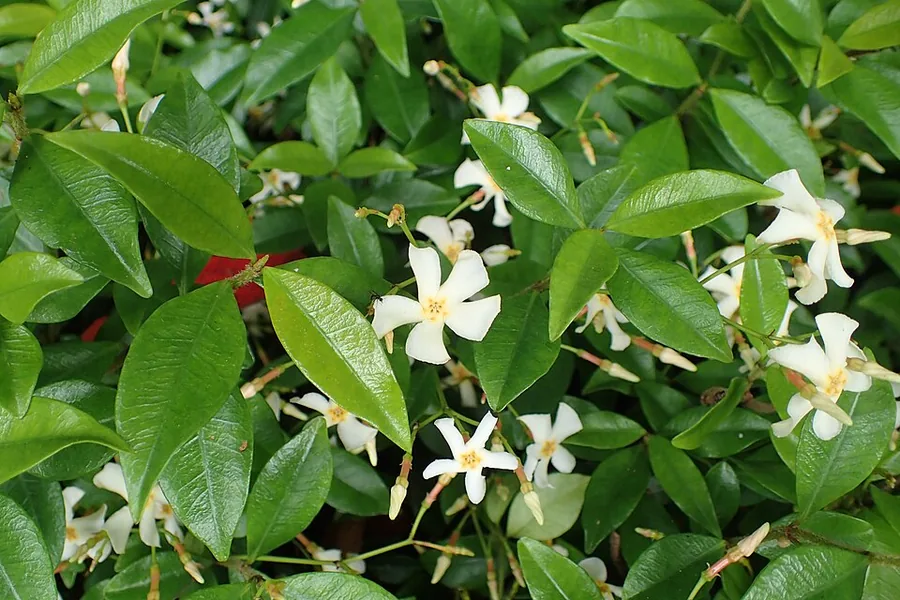
Asiatic jasmine is a low evergreen groundcover prized for the thick mat of small, hard-surfaced leaves it lays across the soil rather than for any bloom. Each leaf is glossy and oval, and the leaves overlap so tightly that the planting reads as one continuous green sheet. It sits in the dogbane family and, the name aside, is no true jasmine. Fresh shoots often open a coppery bronze or red before deepening to a dark green, so the surface of the mat carries a slow flicker of color through the year.
What wins most gardeners over is how little it demands. It takes full sun to deep shade, shrugs off drought once rooted, and grips clay, loam, or sand alike. Hardy from zones 7 to 11, it pulls through cold down to about 10°F (-12°C) and bears heat up to 100°F (38°C), which is why it sheets the ground beneath trees and along curbs where most plants give out.
The catch is sheer vigor. Those slender trailing stems set roots as they run, so the very plant that blankets a bare slope will spiral up a trunk or slide across paving if left alone. Snap a stem and it weeps a milky latex sap, a mark of its dogbane kin. Give it a firm edge to push against and one yearly shearing, and it holds as a flat, even carpet of leaves for decades.
Care
The short version: this groundcover roots into nearly any spot, sun-drenched or deeply shaded, wants steady moisture only during its first season, and afterward needs little beyond an early spring shearing that keeps the leaf mat tight, low, and inside its edges.
Light
Few groundcovers are this flexible about light. Asiatic jasmine grows in full sun all the way to full shade, though the mat stays thickest and the leaves color up most under at least some sun. Heavy shade slows the runners and opens the leaf cover a little, but it still holds.
Water
During the first season, while the roots take hold, the soil should stay evenly moist. Once anchored, the plant handles dry spells on its own and seldom wants supplemental irrigation. Restraint matters here, because an overwatered mat answers with a rush of rank, tangled runners that are anything but tidy.
Soil
It grips almost any well-drained soil, clay, loam, or sand alike, across a wide pH band of 6.0 to 8.0. The one catch is that strongly alkaline ground locks up iron and pales the leaves to yellow, so aim for neutral to slightly acidic where you can.
Temperature
Across zones 7 to 11 the foliage holds through a wide spread of weather, spanning roughly 10°F to 100°F (-12°C to 38°C). Enduring both hard frost and baking heat is what lets the glossy mat persist on ground where tenderer plants fail.
Humidity
Regular outdoor air is all the leathery leaves ask for, with no target percentage to chase. Sticky Southern summers and long stretches of dry weather both pass over the mat without leaving a mark.
Feeding
This plant runs lean. A light spring application of slow-release balanced fertilizer is all it can use, and a settled mat generally needs no feeding whatsoever. Overdo it and the reward is longer, wilder stems that must then be sheared back out.
Pruning
The main job is a once-a-year mow or shear in early spring to renew the planting and keep the leaf mat dense. Trim the running edges now and then through the season to stop them creeping into lawns, beds, and walkways.
Repotting
In open ground the question of repotting rarely arises. A potted specimen shows it needs more room when roots wind around the inside of the pot, poke out through the drainage holes, or water pours straight through without soaking in.
Size & spacing
It stays low, just 6 to 24 inches (15 to 61 cm) tall, but each plant runs wide, from 3 to 12 feet (91 cm to 3.7 m) across. Set plants 1.5 to 3 feet apart for groundcover and give them room away from trunks and structures the stems might climb.
When to plant
Spring planting suits Asiatic jasmine best, after the final frost when the soil is gaining warmth. Set the young plants out then, keep them watered across that opening season, and over the following two years the runners will weave themselves into one unbroken sheet of glossy evergreen leaves.
Northern hemisphere
Southern hemisphere
Typical months for a temperate climate: start earlier in warm zones, later where spring frosts linger.
- Plant: spring after last frost
- Harvest: late spring to early summer (blooms sparsely)
Hardiness
USDA hardiness zones: 7–11
Temperature: down to -18°C
Troubleshooting
Few things go wrong with this plant. When something does look off, it is usually the runners straying where they shouldn't or a soil condition with a straightforward fix. Compare what shows on the stems and leaf surfaces with the entries below and step in early, before a minor issue works its way across the whole carpet.
Slender stems threading into the grass and winding up nearby trunks
The thin, trailing stems travel fast and set fresh roots anywhere they press against damp soil. Too much water, sun, or fertilizer drives the whole mat into a growth spurt, and the runners start spiraling up bark and slipping across paving. Cut a clean edge, peel the climbing stems off shrubs and trees, and shear the planting once a year in early spring to bring the loose runners back into a flat, even sheet of leaves.
Fix:
- Trim and edge the perimeter regularly to keep it in bounds
- Pull or cut stems climbing trees and shrubs
- Mow or shear the whole planting once a year in early spring to renew it
- Reduce supplemental water and fertilizer to slow aggressive growth
Leaf blades gone yellow while the veins stay green
A leaf whose flat surface fades to pale yellow while a fine green net of veins still shows through is the unmistakable face of iron chlorosis, and alkaline soil tying up the iron is nearly always behind it. The smallest, youngest leaves at the tips turn first. A chelated iron supplement greens them back up quickly, and pulling the soil pH down stops the pale leaves from returning.
Fix:
- Apply a chelated iron supplement
- Acidify or amend the soil to lower pH
Open soil showing between the leaf clumps all first year
A fresh planting reads as thin and spotty for its whole first season, with bare ground visible between each small clump of glossy leaves, and that is expected. The plant pours its first year into roots and needs about two growing seasons to knit together into solid cover. Hold the soil evenly moist, set the clumps 1.5 to 3 feet apart so the runners meet sooner, and let the second season close the gaps.
Fix:
- Keep soil evenly moist while establishing
- Space plants closer (about 1.5 to 3 feet apart) for faster coverage
- Be patient; growth accelerates in the second season
Tiny raised bumps along the stems with a sticky film
Now and then scale insects fasten onto the stems and the undersides of the leaves, where they look like rows of small, hard bumps and leave behind a tacky honeydew that blackens into sooty mold. Bad pest outbreaks almost never happen on this plant. Smother the scale with horticultural oil and snip off any stem so thickly crusted it cannot be wiped clean.
Fix:
- Treat with horticultural oil
- Prune out heavily infested stems
Toxicity
Households with pets or children can settle in around Asiatic jasmine: the plant is considered non-toxic, and its close relative star jasmine appears on the ASPCA list of non-toxic plants. The single caution is the sap. Break or shear a stem and a white, milky latex beads out, and that fluid may bother sensitive skin, so gloves make sense for pruning work.
Safe for
People · Cats · Dogs · Horses · Rabbits · Livestock · Birds
Cats None
Safe to grow around cats. The related star jasmine sits on the ASPCA non-toxic list, and a curious nibble on a glossy leaf shouldn't bring on anything worse than a mild, passing stomach upset.
Dogs None
Dogs can share the garden with it without worry. It carries no known toxin for them, so the most a chewed, milky stem might cause is a brief tummy grumble.
Horses Safe
Considered safe around horses. There's no toxin to fear, though as with any flush of tender new foliage it makes sense not to let a horse gorge on it.
Rabbits Safe
Not toxic to rabbits. The leathery little leaves and their milky sap make poor browsing, so most rabbits pass it by.
Livestock Safe
Safe for cattle, goats, and sheep, with no poisoning on record. The bitter latex weeping from broken stems tends to turn grazing animals away on its own.
Birds Safe
Poses no toxic risk to birds. They can tuck into the thick, low mat of leaves without any harm from the foliage.
People Safe
Safe to have around children and adults. The cut stems do bleed a milky latex that can sting sensitive skin, so pull on gloves before a big pruning job.
It is a member of the dogbane family (Apocynaceae) and exudes a milky latex sap when cut that may cause mild skin irritation in sensitive people; wear gloves when pruning. Despite the name it is not a true jasmine.
Varieties
Past the plain green form, a few selections carry color in variegated leaves or brightly tinted new shoots. These are the ones you'll come across most.
'Snow-N-Summer' ('HOSNS')
A variegated form, its young leaves unfurl in pink and white and shift to a green-and-white pattern as they mature.
'Variegatum'
Each green leaf is rimmed and streaked with creamy white, giving the foliage a crisp, two-tone face.
'Bronze Beauty'
Picked for fresh foliage that comes out a deep bronze tipping toward red before it deepens to green.
'Goshiki' / 'Ogon Nishiki'
Fresh shoots arrive splashed with yellow, orange, and red, painting the mat in mixed color.
'Elegant' / dwarf forms
Shorter and tighter in habit, these selections lay down a fine-leaved, low carpet where you want less height.
How to propagate
Asiatic jasmine multiplies with almost no effort, since the trailing stems set their own roots wherever they meet the ground.
LayeringEasy
Growing season · Several weeks to months
Layering is the simplest route to new plants, since the trailing stems already drop roots on their own wherever they rest on damp soil. Pin a runner to the ground during the growing season and it will anchor itself over the next several weeks to months, ready to be cut loose as its own plant.
Stem cuttingsModerate
Summer · Several weeks to a couple of months
Semi-hardwood stem cuttings snipped in summer will also root, though they ask for more attention than pinned-down layers. Allow several weeks to a couple of months for roots to form before you pot them on.
Myths
Asiatic jasmine is a true jasmine.
The name promises jasmine, but this plant is Trachelospermum asiaticum, a dogbane-family species. True jasmines sit in the genus Jasminum, within the olive family, so the two are not close kin at all; the shared name is simply a borrowed label.
Asiatic jasmine is just star jasmine under another name, grown mainly for its flowers.
It is a separate plant from star or Confederate jasmine, hugging the ground lower, packing tighter, and carrying smaller leaves with only a scattering of blooms. It rarely flowers and is grown as a foliage groundcover, valued for its leaves rather than any display.