Shrub · Apocynaceae
Mandevilla
Mandevilla × amabilis
Broad trumpet flowers flare open along twining stems, blooming through summer into fall.
Full sun
Every 3–7 days
45–90°F · 7–32°C
USDA 10–11
Overview
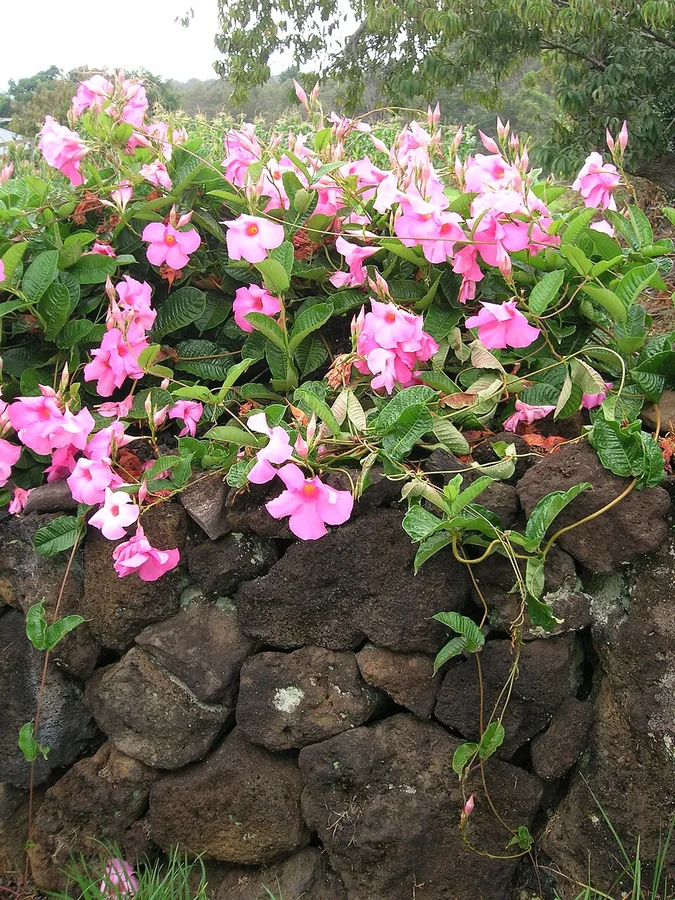
Mandevilla is a fast-growing tropical vine in the dogbane family, and its signature is the flower: a big, flared trumpet that opens along the stems from summer into fall. On the vining types the blooms are often a deep pink, wide-mouthed and facing outward from the twining growth. The plant comes from the warm Americas and holds up outdoors through winter only in zones 10 and 11, so in cooler places it spends summer in a pot and comes inside before frost.
Two forms show off the plant differently. The tall twining Mandevilla sends long stems winding up a trellis or post, climbing well over head height, while the bushier, mounding Dipladenia carries smaller, glossy leaves on a compact, packed frame in pots and baskets. Both share the same trumpet-shaped flowers and the same demands for heat, sun, and steady summer water.
Look closely at a cut stem and the plant shows another feature. It seeps a milky sap, thick and pale, that can sting skin and eyes, which is why gloves belong at hand when pruning. Given warmth and light, the vine keeps opening fresh trumpets for months.
Care
The short version: full sun brings out the fullest trumpets, water stays steady through the summer heat with a drier winter rest, the soil is rich and free-draining, and a bloom feed every couple of weeks keeps the flowers coming.
Light
Mandevilla opens the most trumpets in full sun, ideally 6 or more hours of direct light a day. It survives in part shade or bright indirect light, but the flowers thin out and the leafy growth takes over the dimmer it gets.
Water
Through summer, the soil stays evenly moist but never soggy, watered every 3 to 7 days and more often in heat or in a pot. In winter the vine rests, and the soil is left to dry further between waterings.
Soil
It roots into rich, well-drained ground with humus worked in, or a peat-based mix in containers. It takes a wide pH from 6.0 to 8.0 without complaint, but wet, water-holding soil rots the roots.
Temperature
The vine holds its color and growth between 45°F and 90°F (7°C to 32°C) and slows as the air cools. Frost blackens it, so it comes indoors before nights fall below 50°F (10°C).
Humidity
Mandevilla keeps its foliage best in high humidity, matching its warm tropical home. Indoors over winter, the glossy leaves stay fresher when the plant is grouped with others or set on a pebble tray.
Feeding
It is fed every two weeks through spring and summer while it is putting on growth. A high-phosphorus bloom fertilizer such as 10-20-10 pushes the trumpet flowers, since too much nitrogen swells the leaves and holds back the bloom.
Pruning
Pruning comes in late winter or early spring before new growth, cutting out old crowded stems and shortening the rest, with young plants pinched to thicken them. The severed stems bead with an irritating milky sap, so gloves are worn.
Repotting
It moves up a pot size every 1 to 2 years, or when roots coil the pot, water runs straight through, or growth and bloom stall. A freely draining pot serves the roots better than a large one.
Size & spacing
The plant ranges from a compact 3 feet to a long-stemmed 3 to 10 feet (0.9 to 3 m) depending on the form, spreading 3 to 4 feet (91 to 122 cm) wide. A climbing form needs a trellis or post for its twining stems to wind up.
When to plant
Mandevilla runs on warmth and will not take frost. Seed or overwintered plants stay indoors in late winter, move outside once nights hold above 50°F (10°C), and the trumpet flowers open from summer through fall.
Northern hemisphere
Southern hemisphere
Typical months for a temperate climate: start earlier in warm zones, later where spring frosts linger.
- Sow: late winter to early spring
- Plant: after last frost when nights stay above 50 degrees F
- Harvest: summer through fall
Hardiness
USDA hardiness zones: 10–11
Temperature: down to -1°C
Troubleshooting
Two things mar the look of a mandevilla most often: pests that dull and spot the foliage on plants wintered indoors, and a vine that fills with leaf while the trumpets stay closed. The early signs are visible if you look. Match what you see on the plant below, then act while it helps.
Wilting yellow leaves over soft, blackened roots
Leaves that wilt and yellow over soil that never dries signal root rot from overwatering. Slipped from the pot, healthy roots show firm and pale while rotted ones are dark, soft, and foul-smelling. Watering stops, the plant is repotted into fresh fast-draining mix, the blackened roots are trimmed, and the pot is set to drain freely from then on.
Fix:
- Stop watering and let the soil dry out
- Repot into fresh, fast-draining mix and trim away rotted roots
- Ensure the container has drainage holes and discard standing water
Fine webbing and a stippled, yellowing cast to the leaves
A silvery stippling across the leaves, fine webbing, and tiny moving dots on the undersides point to spider mites, which flourish in the warm, dry air around plants kept indoors for winter. Tapping a leaf over white paper drops the specks into view. A hard rinse of the undersides, then insecticidal soap or horticultural oil, higher humidity, and isolation, clears them off.
Fix:
- Rinse foliage with a strong spray of water, especially leaf undersides
- Treat with insecticidal soap or horticultural oil, repeating per label
- Raise humidity and isolate the plant to limit spread
White cottony masses and sticky film at stems and joints
White cottony tufts, a sticky glaze of honeydew, and dark sooty mold reveal mealybugs, scale, aphids, or whitefly massed on an overwintering vine. The stem junctions and leaf undersides show which insect clusters there. An alcohol-soaked swab lifts the mealybugs and scale, insecticidal soap or horticultural oil handles the rest, and the worst-crusted growth is cut away.
Fix:
- Wipe off mealybugs and scale with a cotton swab dipped in rubbing alcohol
- Spray with insecticidal soap or horticultural oil, repeating as needed
- Remove heavily infested growth and isolate the plant
A leafy green vine with few or no trumpets
A vine thick with green leaf but bare of trumpets is nearly always starved of sun, since full sun is what draws the flowers out. Cool nights and heavy nitrogen also tilt it toward foliage. At least 6 hours of direct sun, warmth, and a high-phosphorus bloom feed such as 10-20-10 bring the trumpets back.
Fix:
- Move the plant to a full-sun location
- Switch to a high-phosphorus bloom fertilizer such as 10-20-10
- Keep it warm, as bloom slows in cool conditions
Toxicity
Mandevilla belongs to the dogbane family, and the same milky sap that beads on a cut stem is the reason nothing should eat it. Chewed foliage gives pets a mild upset stomach, and the pale sap stings skin, eyes, and mouths on contact. No part is edible, so keep it away from grazing animals, pets, and small children, and wear gloves when you cut it.
Toxic to
Cats · Dogs · Horses · Rabbits · Livestock · Birds · People
Cats Mild
A cat that nibbles the leaves usually gets a mild upset stomach, with drooling and sometimes vomiting. The milky sap also leaves the mouth sore and reddened.
Dogs Mild
Chewed foliage brings on drooling and a little vomiting in dogs. Where the cut sap touches, the muzzle can redden and the mouth turn sore.
Horses Mild
The same irritant sap can upset a grazing horse, with drooling and mild stomach trouble the usual result. The bitter foliage is off-putting, so most horses taste it once and stop.
Rabbits Mild
A rabbit that samples the leaves may drool and lose interest in food for a while. Clippings are kept out of the hutch, and safer greens are offered instead.
Livestock Caution
Grazing animals seldom choose this bitter, sappy plant, but a hungry one could end up with an irritated mouth and a queasy gut. It is fenced off where stock roam.
Birds Caution
Little harm to birds is on record, yet the pale irritant latex makes it worth keeping out of reach. Curious pet birds are kept clear of the foliage.
People Caution
No part of the plant is meant to be eaten, and swallowed foliage irritates the mouth and stomach. The milky sap is the greater nuisance, since it stings skin and eyes, so gloves are worn and hands washed after pruning.
Wear gloves when pruning or handling cut stems because the milky latex sap can irritate skin and eyes; wash hands after contact and keep cuttings away from pets and children.
Helpline numbers

United States
ASPCA Animal Poison Control: (888) 426-4435 (fee applies)
Poison Control: (800) 222-1222



Canada
Poison Centres: 1-844-764-7669
Varieties
Mandevilla appears under many named hybrids and series, and they differ most in the color and carriage of their trumpet flowers. These few are worth knowing by name.
Alice du Pont
A classic large vining type whose deep pink trumpet flowers carry it to around 20 feet outdoors.
Sun Parasol series
A popular run of free-flowering hybrids in many colors, from compact mounds to vigorous climbers.
Red Riding Hood
A vigorous vine whose trumpets open in deep rose-red.
Dipladenia (Mandevilla sanderi forms)
The bushier, mounding trade forms, set apart by their smaller glossy leaves, still sold as Dipladenia but now grouped under Mandevilla.
How to propagate
Mandevilla is easiest to increase from cuttings taken off the soft new growth, while seed is a slower path for the patient.
Stem cuttingsModerate
Spring through summer · 4-8 weeks
Cuttings are the reliable way to copy a mandevilla. In the warm season, softwood tips of the new growth have their lower leaves stripped and are set to root in a well-drained mix, where a dip of rooting hormone improves the odds and roots form in 4 to 8 weeks. The cut ends bead with the same irritating milky sap, so gloves are worn.
SeedModerate
Late winter to early spring · Several weeks to germinate
Mandevilla also grows from seed sown in late winter to early spring, though the seed takes several weeks just to germinate. Cuttings are usually chosen instead, since they root faster and keep the named cultivar true to type.
Myths
Dipladenia is a completely different plant from Mandevilla.
Dipladenia is only the old genus name, and these plants all sit within Mandevilla now. The two words survive in the trade to mark a difference you can see in the plant's carriage rather than its genus: the tall twining types are sold as Mandevilla and the bushy, mounding Mandevilla sanderi forms as Dipladenia.