Ornamental · Apocynaceae
Annual Vinca
Catharanthus roseus
Glossy dark green leaves and blooms from white to deep blackberry-purple, annual vinca holds its color from late spring to frost.
Full sun
Every 5–10 days
50–95°F · 10–35°C
USDA 10–11
Overview
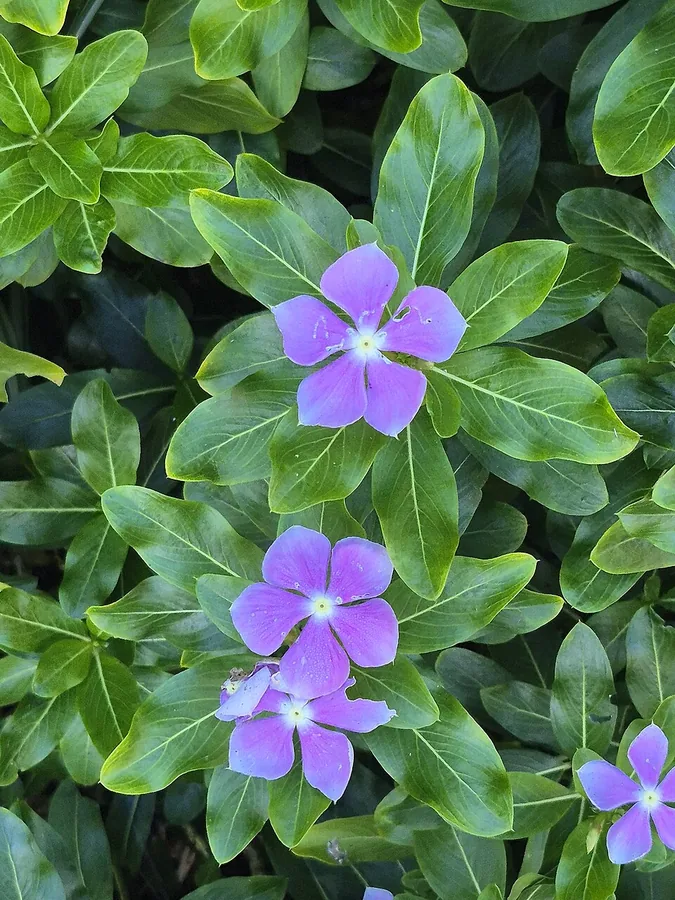
Annual vinca, the plant sold as Madagascar periwinkle, wears glossy dark green leaves that catch the light, and against them sit flat-faced flowers ranging from clean white through pink to a deep blackberry-purple. The plant holds an upright to mounding shape, low and rounded, and it keeps flowering from late spring until frost. For all the shared name, this is Catharanthus roseus, and it looks nothing like the low, sprawling stems of the trailing periwinkle.
Look closely and the deepest color shows in a variety whose blackberry-purple blooms each carry a crisp white eye at the center. The foliage stays a solid, polished green through the heat, and the flowers keep opening across the whole plant rather than fading after a first flush. It reads as compact and full, never leggy or thin.
Through the hottest weeks the leaves stay firm and richly colored while the flowers keep opening, so the plant looks full and even rather than patchy. It never climbs or trails; it builds a low, rounded mound of foliage studded with bloom. Up close, the contrast of bright petals against the dark, shining leaves is the whole appeal.
Care
The short version: full sun and fast-draining soil bring out the densest foliage and heaviest bloom, and the plant wants real summer warmth before it goes in. Water deeply but only after the top of the soil dries, keep the glossy leaves dry, and feed lightly.
Light
In full sun annual vinca grows dense and thickly flowered, with only a little tolerance for partial shade. Strong light packs the foliage tight and deepens the flower color, while shade stretches the plant thin and pales the blooms.
Water
Water deeply but seldom, only when weekly rainfall falls under about an inch, and let the top half of the soil dry between times. Keep water off the leaves, because droplets left on the glossy foliage, along with soggy roots, are where disease first shows.
Soil
Give it well-drained soil, a sandy or organic loam, and it will hold in clay so long as water drains through. The richest, firmest growth comes at a slightly acidic pH of 5.5 to 6.5.
Temperature
The plant looks its best in heat, firm and green from 50°F to 95°F (10°C to 35°C) and fullest at the top of that band. Cold leaves it stunted and dull, and damp chill brings rot, so its color peaks through the hottest weeks of summer.
Humidity
Ordinary outdoor humidity is enough, with no reading to track. Air moving through the leaves counts for more, since still, damp air inside a crowded, leafy planting is where spotting and gray mold take hold.
Feeding
A monthly feed through the growing season with a balanced general-purpose fertilizer, used sparingly, keeps growth firm. Overfeeding puffs the plant into soft, weak tissue and invites root rot instead of more flowers.
Pruning
No pruning is needed. The modern hybrids are self-cleaning, letting spent flowers drop on their own with no pinching or deadheading. Pulling off browning leaves and faded blooms keeps disease from marking the foliage.
Size & spacing
The plant stays a low, rounded mound, 6 to 18 inches (15 to 46 cm) tall and 8 to 18 inches (20 to 46 cm) across. Set with space between plants so air moves through the leaves, which keeps the foliage clean of rot and leaf spot.
When to plant
Annual vinca colors up only once real heat arrives, and it stays sullen and stunted in the cold. Seed starts indoors in March in warmth, and the young plants wait inside until late May or early June, after frost and once the soil climbs past 60°F (16°C). Set into cold, wet ground the plant sits pale and rots; given the heat, it fills out into glossy green growth that flowers from late spring to frost.
Northern hemisphere
Southern hemisphere
Typical months for a temperate climate: start earlier in warm zones, later where spring frosts linger.
- Sow: March in warm temperatures
- Plant: Late May to early June, after frost and when soil temperatures exceed 60°F
- Harvest: Blooms from late spring or early summer (May to June) continuously until frost
Hardiness
USDA hardiness zones: 10–11
Temperature: down to -1°C
Troubleshooting
Most of what goes wrong on annual vinca shows first as a change you can see on the plant itself, and nearly all of it starts with water on the roots or the leaves. Wet soil rots the stems and roots from below, while splashed moisture spreads spots and gray fuzz across the foliage. Match the look of the damage below, then dry the plant and cut away the marked tissue.
Dark stem lesions and a wilting, collapsing plant
Dark brown to black lesions along the stems, with the whole plant wilting and folding down, mark Phytophthora stem blight and root rot, the disease that takes down more annual vinca than any other in wet soil under overhead watering. Pull a failing plant and the outer root tissue slips away from the pale inner core while the leaves yellow and scorch at the edges. Lift and bin the infected plants, dig composted pine bark through the bed for drainage, and treat with potassium salts of phosphorous acid or a copper spray.
Fix:
- Remove and discard infected plants entirely
- Improve drainage by amending with composted pine bark
- Apply potassium salts of phosphorous acid as a soil drench or a copper-based spray
A yellow, collapsing plant over still-moist soil
A plant going yellow and slumping while the soil under it stays damp points to Rhizoctonia stem and root rot, which sets in after deep planting or frequent shallow watering. Ease the roots up and you find them brown-lesioned and stunted, proof the trouble is not thirst. Lift the sick plants with every root, then drench or spray with thiophanate methyl or chlorothalonil.
Fix:
- Remove diseased plants completely including all roots
- Use thiophanate methyl or chlorothalonil as a spray or drench
Small ringed spots banding the lower leaves
Small target-like spots, ringed with light and dark bands, are Alternaria leaf spot, thrown up onto the leaves by overhead watering. They open on the lowest leaves as flecks no bigger than a pinhead, widen to about an eighth of an inch with that banded eye, and climb the plant leaf by leaf. Strip the badly spotted plants, water at the base before dawn, and coat the foliage with weekly chlorothalonil where it keeps spreading.
Fix:
- Remove heavily infected plants
- Apply weekly chlorothalonil sprays for serious infections
- Clear dead plants after frost
Gray fuzz coating dead leaves and flowers
A soft gray fuzz spreading over dead and dying leaves and flowers is Botrytis blight, the gray mold that settles in during cool, damp weather on crowded plants. The furred gray growth claims the spent tissue first before creeping onward. Keep pulling the fading leaves and flowers off, and only coat the plant with a thiophanate methyl spray if the mold runs out of control.
Fix:
- Remove declining leaves and flowers continuously
- Apply thiophanate methyl spray only if severe
Toxicity
Behind its glossy leaves and bright flowers, this plant is genuinely toxic. Every part holds vinca alkaloids such as vincristine and vinblastine, the compounds used in some cancer drugs, and none of it is edible. Swallowed by a pet, animal, or child, it brings on drooling, vomiting, and diarrhea, with tremors, low blood pressure, and seizures possible after a large amount. Keep it away from any mouth that might test a leaf or petal.
Toxic to
Cats · Dogs · Horses · Rabbits · Livestock · Birds · People
Cats Toxic
A cat that bites into any part soon runs with saliva, then brings up vomit and loose stool, and sinks into a dull, listless slump. A larger mouthful drags the blood pressure down and can throw the cat into tremors or seizures, which calls for the vet at once.
Dogs Toxic
A dog that tears at the leaves or flowers drools, vomits, and passes diarrhea before long. Its legs turn unsteady and its mood flattens as the blood pressure falls, and any tremors or seizures are a straight emergency.
Horses Toxic
A horse grazing the plant takes on a churning gut, loose manure, and a heavy, sluggish stance from the alkaloids. A large enough feed sets the muscles trembling and drains real strength, so the plant stays fenced off from pasture and paddock.
Rabbits Toxic
The alkaloids fill every part alike, so a rabbit nibbling the foliage ends up drooling, loose, and hunched low with the energy gone out of it. It is no plant to leave in reach of a hutch or a rabbit let loose to roam.
Livestock Toxic
Cattle, goats, and sheep cropping annual vinca swallow vinca alkaloids that churn the stomach and pull down their strength. A heavier feed leaves them staggering and shaking, so a fence between them and the plant is the answer.
Birds Toxic
The alkaloids sit right through the leaves, stems, and flowers, so birds are caught too. A few torn petals are enough to bring up vomit and leave the bird weak, which keeps the plant clear of aviaries and poultry.
People Caution
Not a leaf or petal of annual vinca is safe to eat. A swallowed piece sets off drooling, nausea, vomiting, and loose stool, with tremors or a drop in blood pressure after a large amount, so it stays out of reach of tasting children and pets.
Keep away from pets; all parts contain alkaloids. Typical exposure causes GI upset, with neurologic signs possible at higher doses.
Helpline numbers

United States
ASPCA Animal Poison Control: (888) 426-4435 (fee applies)
Poison Control: (800) 222-1222



Canada
Poison Centres: 1-844-764-7669
Varieties
Breeding has pushed annual vinca toward tougher plants and larger, more saturated flowers. The series below differ mostly in flower size, color, and the shape of the plant.
Cora Group (Cora XDR)
This series stands up to several strains of Phytophthora, the root and aerial rots that scar and topple annual vinca, which makes it the pick where rot keeps returning.
Pacifica Group
This compact, tightly branched series opens large flowers across a broad spread of colors.
Titan Group
This mounding series bears oversized flowers that stay full-faced and firm through hard summer heat.
Jams 'N Jellies Blackberry
This one shows the darkest color of all, blackberry-purple petals broken by a sharp white eye at the center.
How to propagate
Annual vinca is raised from seed, and warmth is what wakes it. Start it early under cover, and hold it back until the weather is hot enough to keep the young growth firm and green.
SeedModerate
Sow indoors in March in warm conditions; transplant outdoors in late May to early June after frost · Several weeks to germinate and establish before transplanting outdoors
Annual vinca comes from seed, and warmth is the trigger for firm, green seedlings. Sow indoors in March and hold the tray genuinely warm, since cool seed stays put and does nothing. The seedlings need several weeks to break the surface and fill out before they leave, staying under cover until late May or early June, after frost and once the soil warms past 60°F (16°C).
Myths
Annual vinca is the same plant as the trailing groundcover periwinkle.
They only look related because they share a family. Annual vinca is Catharanthus roseus, an upright to mounding warm-season bedding flower, while the trailing perennial groundcovers are Vinca minor and Vinca major in a separate genus with long, creeping stems. Both belong to Apocynaceae, and past that the two plants look and grow nothing alike.
Annual vinca needs frequent watering and deadheading to keep blooming.
It behaves the other way around. Being heat and drought tolerant, it keeps flowering from late spring to frost with no deadheading, the blooms dropping clean on their own. Push more water at it and the reward is not more color but the root and stem rots that mark its foliage and bring it down.