Shrub · Apocynaceae
Star Jasmine
Trachelospermum jasminoides
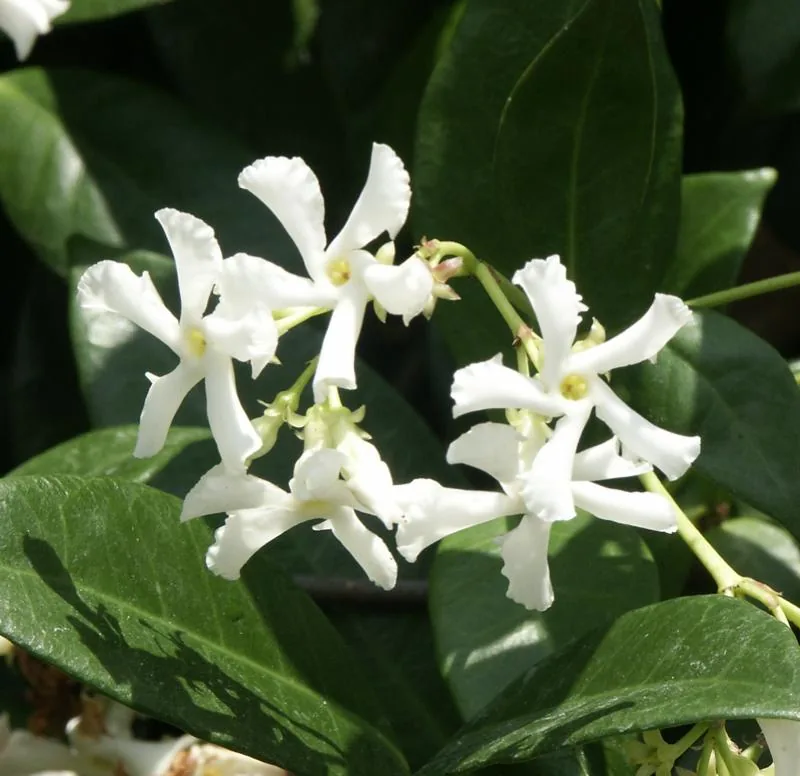
Up close, star jasmine sets white pinwheel flowers against glossy dark evergreen leaves.
Full sun
Every 5–10 days
USDA 8–10
3–20 ft · 0.9–6.1 m
Overview
Star jasmine wears glossy, dark green leaves that hold their color the whole year through, a finish that catches the light. In late spring the white pinwheel flowers unfurl, each one a small spoke of petals set against the deep foliage, and they give off a sweet, carrying scent. Belonging to the dogbane family, it takes the form of a twining vine, a sprawling shrub, or a low groundcover.
The stems twine and coil as they reach, wrapping around a trellis, wire, or fence rather than gripping with pads or roots. Where nothing rises to meet them, they run flat and lace together into a dense, weed-choking mat across the ground. Growth is fast, and the stems stretch anywhere from 3 to 20 feet (91 cm to 6 m) once the plant is settled.
Snap or cut a stem and it bleeds a milky white latex, the sap that marks it as a member of its family. For all its lush, glossy cover, the plant is tough: it fends off most pests, roots into a range of soils, and holds through short cold snaps in milder gardens. Sun, drainage, and a support are all it takes to keep the foliage dense and the flowers coming.
Care
The short version: full sun draws out the thickest cover of white pinwheel flowers, evenly moist but well-drained soil keeps the glossy leaves firm, and a support gives the twining stems something to grip; once established the plant shrugs off dry spells.
Light
In full sun the plant sets its heaviest cover of white pinwheel flowers over the dark leaves. It also takes partial shade and the bright indirect light of an indoor spot, but deep shade thins the bloom and stretches the stems long and leggy, all green and little flower. The brighter the light, the denser the flowering.
Water
While the roots take hold, the soil stays evenly moist, watered about every 5 to 10 days to keep the young leaves firm. Once established the plant turns drought tolerant, and the glossy foliage holds up through dry stretches with only occasional watering.
Soil
The roots run best through fertile, well-drained loam laced with leaf mold, though a range of soils will do. A pH of 6.0 to 7.5 suits them. Standing water is the one thing the roots reject, so the soil has to drain.
Temperature
The plant weathers a wide span, from 10°F to 100°F (-12°C to 38°C), and that cold hardiness keeps the leaves evergreen outdoors in zones 8 to 10. In colder regions the plant lives in a pot and comes inside before frost.
Humidity
Average humidity keeps the foliage in good shape, with no particular level to reach. The leaves take ordinary indoor and outdoor air in stride.
Feeding
A single spring feeding of balanced general-purpose fertilizer thickens the new leaves and stems. When the foliage pales toward yellow in alkaline ground, an iron supplement or acidifier deepens it back to green.
Pruning
Cutting comes after flowering, once the pinwheel blooms have faded, to hold the size and shape and to lay the twining stems along their support. A cut stem weeps milky latex, so the tools want wiping clean afterward.
Repotting
A potted plant moves to fresh soil every 2 to 3 years, or sooner once the roots coil around the base, water shoots straight through, and the leaves and flowers thin out.
Size & spacing
The stems reach 3 to 20 feet (91 cm to 6 m) depending on how they are led, and the plant spreads 3 to 6 feet (91 to 183 cm) across. It wants room and a firm support to wind through.
When to plant
Star jasmine keeps its evergreen leaves through the year in zones 8 to 10. New plants go out in spring, once frost has passed. The white flowers open in their heaviest numbers from late spring into early summer, with a scattering of blooms dotting the dark foliage through the warmer months.
Northern hemisphere
Southern hemisphere
Typical months for a temperate climate: start earlier in warm zones, later where spring frosts linger.
- Plant: spring, after danger of frost has passed
- Harvest: late spring to early summer, with sporadic bloom into summer
Hardiness
USDA hardiness zones: 8–10
Temperature: down to -12°C
Troubleshooting
Trouble shows on star jasmine in the leaves and stems themselves, so a close look usually tells the story. Most signs point to soil chemistry, a sap-sucking insect, or too little light. Match the color and texture you see below and act early.
Sticky, black-filmed leaves with bumps on the stems
The small raised bumps and cottony flecks on the stems are scale insects or mealybugs, and the black film coating the leaves is sooty mold feeding on their sticky honeydew. A wipe of water and mild soap lifts the grime, then horticultural oil or insecticidal soap clears the insects. Any stem thick with them gets cut away.
Fix:
- Wash off honeydew and sooty mold with water and mild soap
- Treat infestations with horticultural oil or insecticidal soap
- Prune out heavily infested stems
Leaves yellowing between green veins
When the leaf blade pales to yellow while the veins stay a sharp green, the plant is showing chlorosis, usually an iron shortage in alkaline ground. A chelated iron supplement or an acidifier deepens the color again, and a leaf mold mulch keeps the soil sweet. Soggy roots paint the same yellow pattern, so check the drainage.
Fix:
- Apply a chelated iron supplement or soil acidifier
- Improve drainage and avoid overwatering
- Mulch with organic matter such as leaf mold
Long, thin stems and few flowers
In too much shade the plant throws long, thin green stems and sets almost no flowers. A brighter position for a container, or a thinner canopy overhead, turns that around. Full sun packs the stems with the heaviest flush of fragrant pinwheel bloom.
Fix:
- Move container plants or relocate to a sunnier spot
- Thin overhead shade where possible
Toxicity
Star jasmine is not toxic. The ASPCA lists it as safe for cats, dogs, and horses, and no toxic compounds are reported for other animals. The one thing to watch is the milky white sap that beads at a cut stem, which can leave sensitive skin a little itchy, so rinse your hands after pruning.
Safe for
People · Cats · Dogs · Horses · Rabbits · Livestock · Birds
Cats None
A cat that mouths the glossy leaves comes to no harm, and the ASPCA lists star jasmine as non-toxic to cats.
Dogs None
The plant reports no toxic compounds for dogs, so a chewed trailing stem does nothing worse than lose a leaf.
Horses None
Rated non-toxic to horses, the foliage poses no grazing risk along a fence line or pasture edge.
Rabbits Safe
No toxins register for rabbits, and the bitter milky sap at a nipped stem tends to end the tasting after one bite.
Livestock Safe
Cattle, goats, and sheep can crop the growth nearby without harm, since the plant holds no known toxic principle.
Birds Safe
The leaves and white flowers pose no danger to backyard or aviary birds.
People Safe
The plant is safe to grow and handle, though the milky sap can leave sensitive skin a little itchy, so rinse your hands after pruning.
Stems exude a milky latex sap when cut, which may cause mild skin irritation in sensitive people; wash hands and clean tools after pruning.
Varieties
A few selections and one close relative reach nurseries, each set apart by the look of its leaves or flowers.
'Madison'
A hardier selection whose stems and leaves take more cold than the species, carrying star jasmine into cooler gardens.
'Variegatum'
Grown for foliage edged in creamy white, each leaf carrying a pale margin that stands out on a shaded wall or fence.
Asiatic jasmine (Trachelospermum asiaticum)
A close relative with smaller, darker leaves and flowers of a tiny yellowish white, knitting fast into a tough groundcover.
How to propagate
Star jasmine copies readily, and the same twining, trailing stems that clothe a fence make two simple methods possible with no special equipment.
Stem cuttingsEasy
Late spring to summer · Several weeks to a few months to root
Cuttings are the common route to new plants. A semi-ripe stem cutting, taken in late spring or summer, sets roots over several weeks to a few months and grows into a copy of the parent, glossy leaves and all.
LayeringEasy
Spring to summer · One season to root before separating
Layering leans on the stems' habit of twining and trailing along the ground. A low stem pinned to the soil in spring or summer roots through a full season before it is cut from the parent to stand as its own plant.
Myths
Star jasmine is a true jasmine.
The name and the sweet scent of the white flowers lead many to take it for a true jasmine, yet it is not one. It belongs to the dogbane family (Apocynaceae) as Trachelospermum jasminoides, set apart from the genus Jasminum that carries the true jasmines.