Shrub · Aquifoliaceae
Japanese Holly
Ilex crenata
Tiny glossy leaves crowd its dark stems, and with acid, sharply drained soil beneath the roots the clipped surface stays crisp.
Full sun
Every 5–10 days
USDA 5–8
3–10 ft · 0.9–3 m
Overview
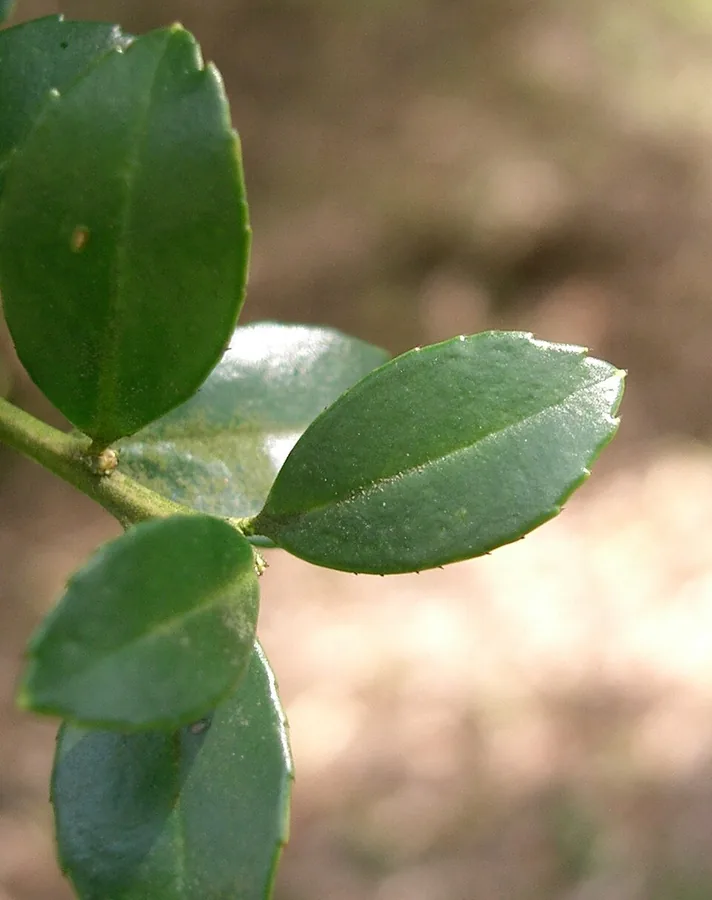
Up close, Japanese holly reads as a mass of small, glossy dark leaves packed tight along dense, woody stems, each blade firm and evergreen and catching the light with a low shine much like boxwood. The foliage sits so thick that a sheared face becomes a smooth green wall, and the plant carries that density year round. Given its own head it rounds slowly into a full shrub of 3 to 10 feet (91 cm to 3 m) tall.
In late spring the shrub opens small white flowers, easy to miss among the dark leaves, and because the plant is dioecious only the female goes on to fruit. Through fall those females set small black drupes that ripen and sit almost hidden against the deep green foliage, round and dark and picked over by birds across the winter. The whole plant grows slowly and lives for many years, hardy through USDA zones 5 to 8 and holding form from -20°F to 95°F (-29°C to 35°C).
The look holds only where the soil stays acidic and well-drained. Let the pH rise and the blades pale to yellow between still-green veins; let cold, wet ground linger at the roots and the whole dark canopy thins and fades. Right soil, room to spread, and the foliage keeps its firm, glossy depth with little more asked of it.
Care
The short version: full sun to part shade in acidic, well-drained soil, kept evenly moist while young, sheared in late winter, and fed once each spring with a fertilizer made for acid-loving evergreens.
Light
Japanese holly holds its firmest, glossiest foliage in full sun, though it takes partial shade and partial sun as well. Fuller light packs the dark leaves in dense and tight so a clipped face stays smooth, while deep shade opens the growth and thins the green.
Water
The soil stays evenly moist, watered roughly every 5 to 10 days as heat and rain shift. Young plants lean on that steady moisture while the roots take hold, and an established shrub, once those roots run deep, rides out a dry spell.
Soil
The roots want light, acidic, well-drained loam and reach through anything from sand to clay so long as water moves on rather than pooling. A pH of 5.0 to 6.5 keeps iron within reach, since alkaline ground locks it away and drains the color from the leaves.
Temperature
The shrub holds its evergreen foliage across a wide swing, from -20°F to 95°F (-29°C to 35°C) and USDA zones 5 to 8. That reach carries it through most temperate winters with the dark leaves intact.
Humidity
Plain outdoor air is enough, so there is no humidity mark to hit. Air moving freely through the dense foliage counts for more, since still air among the packed leaves invites mites and disease.
Feeding
A single early-spring feeding, using a balanced or acidifying fertilizer made for acid-loving evergreens, is all the slow-growing shrub asks. One seasonal dose suits its pace, and an acidifying grade also holds the soil in the acidic range the roots prefer.
Pruning
The dense, small-leaved growth takes a blade cleanly, breaking fresh from cut wood. Prune in late winter to early spring to shape hedges and keep the foliage packed, and since it answers repeated clipping much like boxwood, it holds a tight, formal face.
Repotting
Grown mostly in open ground, it seldom sees a pot at all. Where one is container-grown, repot every 2 to 3 years in spring, watching for roots that circle the rootball or push out the drainage holes as the sign of a crowded pot.
Size & spacing
The shrub reaches 3 to 10 feet (91 cm to 3 m) tall and spreads 5 to 8 feet (152 to 244 cm) wide over years of slow growth. Room for that full spread lets air move through the dense canopy and keeps the foliage firm and clean.
When to plant
This slow, woody evergreen sets no hurried pace. New plants go into cool, workable soil in spring or fall, the small white flowers open among the dark leaves in late spring, and by fall the black fruit ripens and darkens on the female plants.
Northern hemisphere
Southern hemisphere
Typical months for a temperate climate: start earlier in warm zones, later where spring frosts linger.
- Plant: Spring or fall
- Harvest: May to June (small white flowers); black drupes ripen in fall on female plants
Hardiness
USDA hardiness zones: 5–8
Temperature: down to -29°C
Troubleshooting
Almost every trouble on Japanese holly writes itself onto the leaves before anywhere else, whether from the soil below or a single stubborn pest. A bronzed leaf, a yellow one, and a stunted tip each tell a different story. Read the foliage against the entries below and act while the fix still holds.
Bunched, shortened shoots and foliage draining of green
The new tips stop lengthening, the leaves bunch along shortened stems, and the green pales between the veins while the whole shrub thins to a shadow, the mark of black root rot working below in wet, cool ground. Lift a root and the tips show it plainly, darkened from healthy tan to brown and finally to black. Nothing brings it back once it sets in, so the plant comes out and goes in the bin, a raised bed dries the drainage, and a harder-rooted stand-in like Chinese holly fills the gap. Few shrubs take this disease as badly as Japanese holly does.
Fix:
- Remove and discard infected plants (cannot be cured)
- Replace with resistant species such as Chinese holly
- Improve drainage with raised beds
Leaves flecked pale, dulling to bronze under silky webbing
The glossy dark leaves lose their shine first, pale into a fine yellow stippling, then slide toward a tired bronze as the southern red mite drains cell after cell on their undersides, leaving a haze of fine webbing behind. Tap a branch over white paper and the confirmation crawls into view as tiny moving specks. A hard jet of water aimed up under the leaves knocks them loose, horticultural oil smothers the rest, and a second pass a week to 10 days later catches the stragglers. The cupped leaves of Convexa hold mites in their hollows most of all, so those go under the lens first.
Fix:
- Spray undersides thoroughly with horticultural oil
- Use strong water sprays to dislodge mites
- Repeat treatment in 7-10 days
- Encourage natural predators
Flat yellow blades cut through by bright green veins
The leaf blade fades to a flat yellow while every vein stays inked in green, a sharp two-tone pattern that reads as chlorosis, and on this shrub it traces to soil gone too alkaline for the roots to lift iron. A pH test tells the story, its reading sitting above the acidic range these plants hold to. Elemental sulfur worked into the ground eases the pH down, an iron chelate pulls the green back fast, and a blanket of acidic organic mulch keeps the color from slipping away again.
Fix:
- Acidify soil with elemental sulfur per soil test
- Apply iron chelate as a temporary corrective
- Mulch with acidic organic matter
Toxicity
This is a mildly toxic shrub, no cause for alarm with a little care. The firm dark leaves and the small black berries both carry saponins that upset the stomach, and the fruit is the part to watch most. A single nibble seldom does lasting harm, but keep pets and small children from the berries and clear away any that drop.
Toxic to
Cats · Dogs · Horses · Rabbits · Livestock · People
Safe for
Birds
Cats Mild
A cat that mouths a glossy leaf or swallows a small black berry drools, brings the stomach up, and passes loose stools, then curls away quiet and off its food for a while.
Dogs Mild
Dogs meet the plant most, crunching the stiff little leaves or scooping up a dropped berry, and the payoff is vomiting, diarrhea, and a dull, low mood that fades as the gut clears.
Horses Mild
Horses seldom nose into holly, yet a mouthful of the dark foliage or the fruit can still turn the stomach and leave the animal flat and slow-moving.
Rabbits Mild
The saponins packed into leaf and berry sit badly in a rabbit's fine-tuned gut, so clippings and fallen fruit stay well clear of it to head off the diarrhea and the sluggishness.
Livestock Mild
Grazing animals mostly skirt the spiny evergreen, though a hungry one that tears at the foliage meets the same churning gut and heavy dullness.
People Caution
None of this shrub is food. The small dark berries hold the real hazard, since a child who eats a handful can be sick with vomiting and diarrhea, so the fruit belongs beyond the reach of small hands.
Birds Safe
Birds pick the ripe black drupes clean through winter and pass the seeds whole and unharmed, the very way this shrub scatters itself into new ground.
Keep fallen berries away from pets and children; wear gloves when pruning if skin is sensitive.
Helpline numbers

United States
ASPCA Animal Poison Control: (888) 426-4435 (fee applies)
Poison Control: (800) 222-1222



Canada
Poison Centres: 1-844-764-7669
Varieties
Nearly every plant sold is a named cultivar, chosen for the shape and scale of its growth rather than the wild species. These are the ones worth knowing by their look before you buy.
Compacta
A dense, tightly rounded grower whose close foliage takes shearing cleanly, which sends it into low hedges and foundation plantings.
Helleri
A dwarf that swells into a low, pillow-like cushion against the ground, though it falls to black root rot more readily than most.
Convexa
Named for leaves that cup and curl convex along their length, a shape that gathers southern red mite more than the others and asks for a close eye.
Sky Pencil
A slender, tightly upright column of dark foliage that rises straight as a green exclamation point for a vertical accent.
Hetzii
A vigorous, wide-spreading cultivar that throws out fast, sprawling growth yet shares Helleri's weakness for black root rot.
How to propagate
Japanese holly copies faithfully from cuttings, which is how nurseries hold each cultivar true to the parent it came from.
Stem cuttingsEasy
Summer to early fall · 6 to 10 weeks to root
Firm semi-hardwood stems cut from summer into early fall sink roots with little trouble, usually within 6 to 10 weeks. A cutting carries the parent's exact form, so it copies a named cultivar down to its habit and the very shape of its leaves.
Myths
Fruits that small and that dark on the shrub surely hold nothing capable of making anyone sick.
Those small dark drupes look like nothing next to the glossy leaves, yet berry and leaf alike carry saponins that turn the stomach. A pet or child that eats them can end up with vomiting and diarrhea, and the fruit is the part to guard most. The plant is mildly toxic, and the dropped berries are best swept up.