Ornamental · Osmundaceae
Cinnamon Fern
Osmundastrum cinnamomeum
Given wet, acidic shade, the cinnamon fern lifts tall green fronds and slim rust-colored spikes year after year.
Partial shade
Every 2–4 days
USDA 3–9
2–5 ft · 0.6–1.5 m
Overview
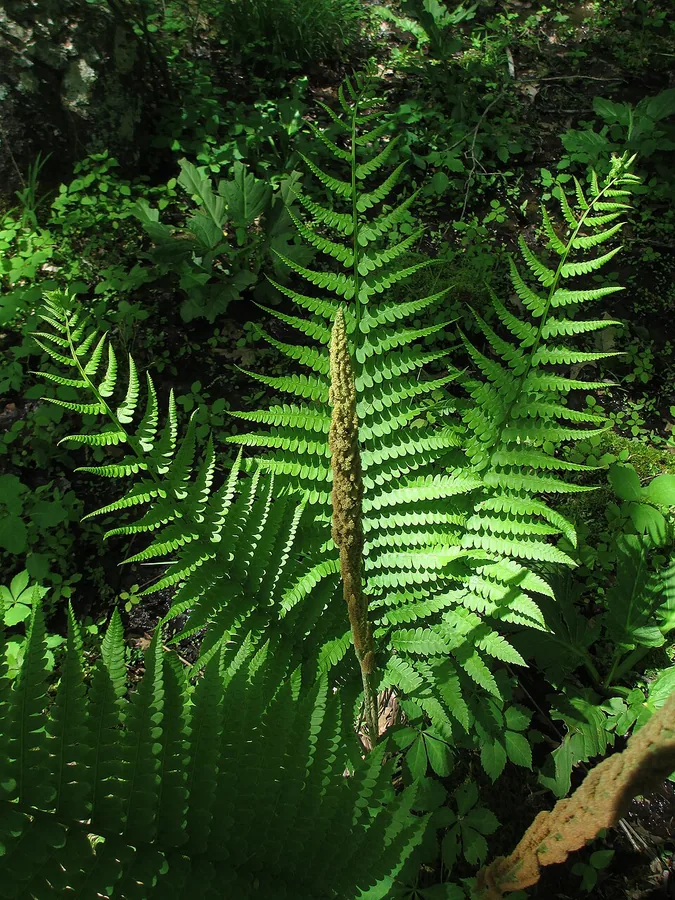
Cinnamon fern is a large, clump-forming native of North American bogs and wet woodlands that grows the same across much of eastern Asia. From the crown each spring rises a ring of upright green fronds, tall and finely cut into many narrow segments, reaching 2 to 5 feet (60 to 150 cm) and arching outward into a hollow vase. Standing apart at the center are the fertile fronds, slender stalks sheathed in rust-colored spores, the cinnamon-brown spikes that give the plant its name.
The fronds emerge in spring as tightly coiled fiddleheads wrapped in pale, woolly hairs, then unfurl into the broad green blades that fill a damp, shaded spot. It takes hold in pond edges, rain gardens, stream banks, and wet hollows, and endures cold to USDA zone 3. The clump thickens at a moderate pace, broadening to 2 to 4 feet (60 to 120 cm) across and rising a little fuller each year.
Its character on the ground is straightforward: it wants shade, acidic earth, and water that never runs out. When the soil dries through summer the green drains from the fronds and they slump into early dormancy well before fall. Kept moist, the blades stay deep green and upright from the first uncurling fiddlehead until the first hard frost.
Care
The short version: part to full shade, rich acidic earth held consistently moist to wet, and steady water all season so the green fronds never dry out and slump into early dormancy.
Light
Cinnamon fern keeps its deepest green in partial to full shade, the dappled light of a woodland floor. It will stand in full sun, but only where the soil stays wet enough to keep the thin frond margins from crisping and browning at the edges.
Water
Water is the one thing the green fronds cannot do without. The soil should stay consistently moist to wet, watered every 2 to 4 days in dry weather, and never dry out. The plant takes standing water and saturated, boggy ground in stride, but a summer drought pulls the color from the blades and tips it into early dormancy.
Soil
It roots best in rich, humusy, acidic earth that holds moisture, around a pH of 4.5 to 6.0. The dark, boggy, low-lying ground that stays wet is exactly its element, and a thick layer of leaf mold keeps the root mass cool and damp.
Temperature
The crown is remarkably cold-hardy, holding from -40°F to 86°F (-40°C to 30°C) across USDA zones 3 through 9. Hard winters leave no mark on it, since the crown sits dormant beneath the soil until the fiddleheads stir in spring.
Humidity
Born of wet woods and bog margins, the fronds prefer damp air, around 50% to 80%. A naturally moist, shaded site keeps that humidity around the blades on its own, so there is rarely anything to manage.
Feeding
The rich, dark earth carries most of the plant's needs, so feeding stays light. A thin spring top-dressing of compost or leaf mold over the crown is enough, and in genuinely good ground even that is unnecessary.
Pruning
The healthy green fronds are left standing through the season. The one cut worth making clears the old, dead, or frost-browned fronds in late winter, before the new coiled fiddleheads push up through the crown.
Repotting
An established crown rarely needs disturbing. When the crowns grow crowded and overlapping and the fronds come up smaller, that shrinking is the sign to lift and divide the dense clump rather than just move it.
Size & spacing
Expect a hollow vase of fronds 2 to 5 feet (60 to 150 cm) tall, the clump broadening to 2 to 4 feet (60 to 120 cm) wide over the years. Each crown wants that much room so the mature ring of fronds can spread without crowding.
When to plant
This fern offers no harvest to time, only a single planting window. New plants go into the ground in spring as the soil warms and the coiled fiddleheads begin to rise, giving the crown a full season to root in before winter.
Northern hemisphere
Southern hemisphere
Typical months for a temperate climate: start earlier in warm zones, later where spring frosts linger.
- Plant: spring
Hardiness
USDA hardiness zones: 3–9
Temperature: down to -40°C
Troubleshooting
Cinnamon fern draws no serious pests or diseases, so almost any trouble shows up first in the fronds and points back to dry soil. The blades pale and crisp before the rest of the plant flags, making them an honest early gauge of thirst. Caught early, a deep watering usually firms the green back up.
Brittle brown rims edging the green fronds
When the soft green edges turn papery and brown, dry roots are nearly always behind it. Cinnamon fern was shaped by bogs and wet woods, so the thin frond margins crisp and curl the instant the soil runs short of water, and the browning bites deepest on the side that faces the most sun. A deep watering brings the soil back to evenly moist, a blanket of leaf mold over the roots keeps it there, and a shadier position spares the fronds from a too-bright spot.
Fix:
- Water deeply to keep soil consistently moist
- Mulch with leaf mold to retain moisture
- Provide more shade if sited in full sun
Green fronds fading to yellow and slumping in summer
When the upright green fronds pale to yellow and sag toward the ground in midsummer, the cause is usually dry soil rather than disease. The fern answers a dry spell by going dormant, drawing the color out of the fronds and letting them fold down ahead of schedule. The crown almost always pushes up fresh fronds the next spring, and steady deep watering with more organic matter worked into the soil keeps the green standing longer.
Fix:
- Resume consistent deep watering
- Improve soil organic matter and moisture retention
Toxicity
For homes with pets and children the verdict is easy. Cinnamon fern is a true fern with no known toxin, so a curious bite of a green frond will not poison a cat, a dog, or anyone else. The one thing to handle with care is the tuft of wiry, cinnamon-colored hairs at the swollen base of each frond, which can scratch or irritate sensitive skin, so wash your hands after handling them.
Safe for
People · Cats · Dogs · Horses · Rabbits · Livestock · Birds
Cats None
Cinnamon fern is a true fern with no known toxin, so a cat that bites through a tender green frond takes no harm. The most that follows from a mouthful of the fibrous foliage is the brief upset any pet gets from overeating greenery.
Dogs None
No toxic compound runs through the fronds, so dogs are safe around them. The stiff, wiry fibers clustered at the swollen frond bases are the one coarse part best kept from a chewer.
Horses None
The green fronds carry nothing that harms a horse, so the plant sits safely along paddocks and the edges of pasture.
Rabbits None
Rabbits can graze the fern with no risk. Neither the curled young fiddleheads nor the open mature fronds hold any toxin.
Livestock None
Cattle, goats, and sheep are not poisoned by it, so the fern stays safe in fields and across the wet ground where stock roam.
Birds None
Neither the fronds nor the rust-colored spores endanger birds, and backyard flocks can scratch and forage among the crowns without trouble.
People None
The plant holds no poison, and the tight green fiddleheads of related ferns are gathered and eaten in spring. The only thing to watch is the wiry hairs at the frond bases, which can scratch sensitive skin, so wash your hands after handling them.
The cinnamon-colored hairs and fibers at the frond bases may cause mild mechanical skin irritation in sensitive individuals.
Varieties
Cinnamon fern reaches gardens mostly as the wild species, though botanists set apart a couple of regional forms worth a closer look.
var. glandulosum
This form shows tiny glandular hairs studding the axes of its fronds, and it grows through the southeastern part of North America.
var. asiaticum
The Asian form stretches the species from the Russian Far East south into Indochina.
How to propagate
No seed grows this fern, because ferns make none. The dependable route is splitting the dense crown of an established clump, with raising it from spores as the slower, more exacting alternative.
DivisionModerate
Early spring before the fronds unfurl · 1-2 years
The reliable way to multiply the plant is to lift an established clump in early spring, while the fiddleheads are still tightly coiled, and split the dense crown into pieces. Each piece takes a year or two to root in and send up full-sized fronds. Fresh spores sown on a moist, sterile mix offer another route, though that one is slow and exacting.
Myths
Cinnamon fern is where culinary cinnamon comes from.
The name traces only the warm, rusty cinnamon hue of the frond-base fibers and the fertile fronds, not the spice. Real cinnamon is the bark of unrelated Cinnamomum trees, so the color is the whole of the connection and the kitchen jar owes this fern nothing.
Cinnamon fern spreads and reproduces by seed.
Ferns set neither seeds nor flowers. This one reproduces by spores packed onto separate upright fertile fronds, the slim rust-colored spikes, beaded with sporangia, that give the plant its name.