Ornamental · Asteraceae
African Daisy
Osteospermum ecklonis
Set it in full sun, sharp drainage, and cool air, and the African daisy spreads a low blanket of bloom.
Full sun
Every 3–7 days
50–75°F · 10–24°C
USDA 10–11
Overview
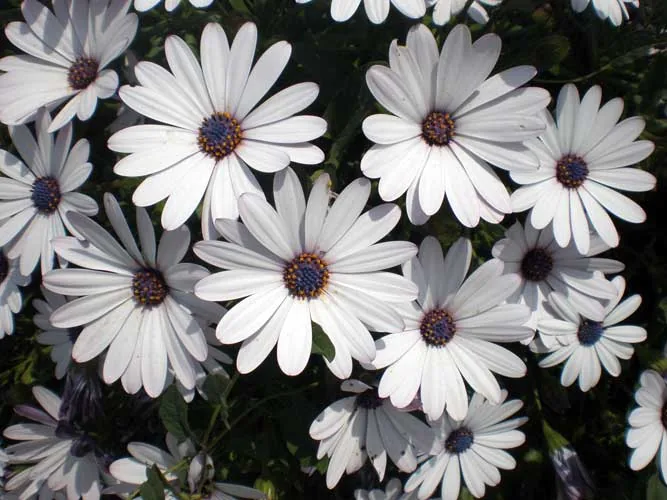
Part of the sunflower family, the African daisy traces back to southern Africa, the land that lent it the names Cape daisy and Cape marguerite. Across much of the country it grows as an outdoor flowering annual, gathering into a low cushion of soft, gray-green foliage that heaps up in some plants and trails over the edge in others. Above those muted leaves, every flower rides a slender stalk and flares into a bright wheel of thin rays that circle a center disk painted in a sharply different shade.
One habit marks it out from a true daisy. The petals draw shut at night and under dim light, then peel open again as the sun lifts, so a planting that looked bare and folded at dawn brightens into full color by mid-morning. The plant is a tender perennial, its woody base lasting the winter only in zones 10 and 11, and in cooler places it is set out fresh each spring and grown for a single season.
Its easy reputation is honest. Set in sun and free-draining soil, with the faded heads clipped away, it keeps spreading color from late spring deep into fall. The one trial it cannot stand is a hot, humid summer, when the bloom can shut down until cooler weather draws it open again.
Care
The short version: full sun and a loose, free-draining bed are the two things that count most. The soil holds an even dampness short of sodden, the feeding stays sparing, and the spent, browning heads come off so fresh buds keep breaking open.
Light
African daisies reach for full sun, at least 6 hours of direct light each day, to open their fullest flush of bloom. They will hold in partial sun, but shade leaves them loose and stretched, the stems thin and the flowers few. A bright, open spot also dries the leaves and keeps mildew from settling.
Water
The soil wants an even dampness, never a sodden one, since pooled water rots the roots into brown mush. Once rooted in, the plant rides out a short dry spell, yet it flowers richest on steady moisture. Let the surface go just dry to the touch between waterings, near every 3 to 7 days as the heat climbs.
Soil
Give it a loose, free-draining bed crumbled through with a little organic matter, since clean drainage is what keeps this daisy sound. It takes acidity in stride across a pH of 5.5 to 7.5. Dense, sodden clay is the single fault to break up before planting.
Temperature
This cool-season plant does its brightest work between 50°F and 75°F (10°C to 24°C). The bloom slows as a hot, humid summer settles over the bed and gathers again when the air cools. Frost blackens and ends the plant in most regions.
Humidity
Plain outdoor air suits it, so there is no level to chase. Air movement counts more than the damp itself, since still, crowded conditions are where the powdery mildew first dusts the leaves.
Feeding
A light hand at feeding serves it best. A balanced slow-release fertilizer or a little compost across the growing season, given seasonally, is ample. Pour it on and the leaves grow lush and dark while the flowers thin, as excess nitrogen tips the plant toward foliage.
Pruning
Clip the spent, browning heads as they fade and the plant keeps pushing fresh ones up the stems. An early pinch of the tips draws a rounder, fuller cushion. Cut back the long, sprawling stems from late summer into autumn to gather the mound back in.
Size & spacing
At maturity it stands 12 to 35 inches (30 to 90 cm) tall and spreads 9 to 24 inches (23 to 61 cm) across the bed. Leave each plant its full width so air slips through the foliage and the leaves dry.
When to plant
The African daisy lives outdoors, wanting warm soil beneath cool air. Start the seed under cover 6 to 8 weeks before the last frost, set the young plants into warmed, frost-free ground, and watch the rays open from late spring into fall, thickest while the days hold cool.
Northern hemisphere
Southern hemisphere
Typical months for a temperate climate: start earlier in warm zones, later where spring frosts linger.
- Sow: 6 to 8 weeks before the last spring frost
- Plant: after the last spring frost when soil has warmed
- Harvest: late spring through fall, blooming most heavily in cool weather
Hardiness
USDA hardiness zones: 10–11
Temperature: down to -1°C
Troubleshooting
Nearly every setback an African daisy meets gathers around two things: roots sitting too wet, or the press of summer heat. The first marks show on the flowers and the lower leaves, where a sharp eye catches them early. Match what you see in the bed to the picture below, then act while the fix still holds.
Limp, yellowing stems sagging at the soil
Most often this is root rot, where waterlogged soil drowns the roots until they slump into brown, soft strands. A disease called verticillium wilt wears the same look, the leaves yellowing and the stems folding over. Let the ground dry between drinks, lift out any plant gone fully limp, and keep fresh daisies away from soil that held the infection.
Fix:
- Improve drainage and let soil dry between waterings
- Remove and discard severely affected plants
- Avoid replanting susceptible species in infected soil
Crumpled young leaves with a glossy sheen
The soft, pinhead-sized bodies clustered on the shoot tips and leaf undersides are aphids, drawing sap and leaving a sticky, shining film over the foliage. A hard jet of water scatters most of the cluster off the stems. Where a few creep back, insecticidal soap clears them, and a scattering of ladybugs grazes down whatever is left.
Fix:
- Spray off with a strong jet of water
- Apply insecticidal soap if populations persist
Bare stems where the blooms once crowded
As a cool-season bloomer, this daisy lets its color thin out through the heavy, sweltering weeks of summer, and many cultivars fall quiet the same way. Lay on too much nitrogen and the leaves swell green while the flower buds go missing. Trim the feeding back, keep clipping the browned heads, and the bright rays crowd the stems again as the air turns cool.
Fix:
- Site in a spot with cooler conditions and good air flow
- Reduce fertilizer and avoid high-nitrogen feeds
- Deadhead regularly to promote rebloom when cool weather returns
A chalky gray-white bloom dusting the leaves
That floury film is powdery mildew, a fungus that takes root where damp, still air pools among plants pressed close, then creeps in pale patches across the green. Pull the plants apart so a breeze can thread through the gaps. Send the water to the roots instead of over the leaves, and strip away the foliage caked the heaviest.
Fix:
- Improve air circulation and spacing
- Avoid overhead watering
- Remove affected foliage
Toxicity
In a bed shared with animals or little ones, the news lands gently. The African daisy carries a non-toxic rating, with approved sources signing off for cats, dogs, and horses. Should a pet or a small child taste a leaf or petal, nothing harmful follows, so it earns a place wherever the family treads.
Safe for
People · Cats · Dogs · Horses · Rabbits · Livestock · Birds
Cats Safe
Non-toxic to cats, so a curious mouthful of the gray-green leaves leaves them entirely unharmed.
Dogs Safe
A dog stretched out among the low mounds, or chewing a leaf in passing, faces no poisoning.
Horses Safe
Cleared for horses by trusted sources, the plant holds no harmful compounds in stem or leaf.
Rabbits Safe
Safe for rabbits, though the soft greens belong as only a small nibble within their daily feed.
Livestock Safe
Cattle, goats, and sheep can crop the growth nearby with no risk of poisoning.
Birds Safe
Pet birds and backyard hens can scratch and forage around the stems without any harm.
People Safe
Non-toxic to people, it sits easily in a garden where toddlers and small children play.
Varieties
The name African daisy stretches across several plants, but the garden Osteospermum narrows to the species and a short cast of named selections. The ones below are worth knowing by sight and name.
Osteospermum ecklonis
The parent species behind most hybrids, it rises from a woody base into a mounding or trailing form, its white rays fanning out around a deep blue-purple eye.
Bright Lights series
A compact hybrid line tested in university trial gardens, marked by saturated, vivid flower color and a long arc of cool-season bloom.
Wildside
A named selection that plant-finder records single out for the offbeat coloring painted across its flowers.
How to propagate
African daisies begin from cuttings or from seed, and the path follows the variety in hand. Most named hybrids hold their coloring true only when grown from cuttings.
Stem cuttingsModerate
During active growth in the growing season · Roots typically form in about 4 to 5 weeks under mist or a humidity tent
A cutting carries the parent's coloring forward unchanged, which is why most named hybrids rise from tips rather than seed. Slip a tip from the plant while it is in growth, coat the raw cut end in rooting hormone, and press it into a damp, crumbly soilless mix. Beneath a fine mist or a clouded humidity tent, pale roots thread out over roughly 4 to 5 weeks.
SeedModerate
Sow indoors 6 to 8 weeks before the last spring frost · Several weeks to transplant size before moving outdoors after frost
A few cultivars rise readily from seed, even as most garden hybrids hold to cuttings. Tuck the seed into trays under cover 6 to 8 weeks before the last spring frost, and let the small seedlings thicken for several weeks to transplant size before they step outdoors once the cold has drained from the air.
Myths
African daisies bloom best in the heat of summer.
The truth leans the other way. Osteospermum throws its brightest rays in cool weather, while many cultivars all but close up through a hot, humid summer. Grow it as a cool-season plant and the color holds far longer across the stems.
Every plant called African daisy is the same one, and it is toxic.
The worry grows from a tangle of names, since several unrelated plants answer to this one. The plant in the bed is Osteospermum of the Asteraceae family, and approved sources name it non-toxic to cats and dogs.