Ornamental · Asteraceae
Bidens
Bidens ferulifolia
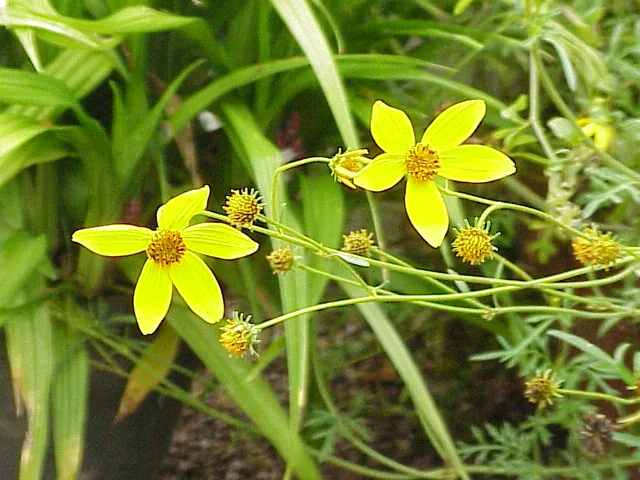
Set it in full sun and average soil, and bidens spills out small gold daisies over fine fernlike foliage from spring right to frost.
Full sun
Every 2–4 days
USDA 8–11
10–15 in · 25–38 cm
Overview
Bidens is a low, trailing member of the daisy clan, prized for months of bloom rather than anything edible. Its stems lean out over basket rims and creep along the front edge of a border, lined with finely cut, almost fernlike leaves and freckled all over with small flowers that most often open a clean gold. Gardeners keep coming back to it because it asks so little and flowers so freely.
Once rooted in, bidens brushes off heat and drought and keeps throwing flowers long after fussier plants give up. Its trailing stems run fast but hug the ground, rarely reaching past knee height, so the plant fans out and tumbles over edges rather than standing upright. The newer named selections stretch the color range past plain gold into creamy white, soft pink, and two-tone petals.
At heart it's a tender plant, grown as a warm-season annual in most gardens and set out fresh each spring once the cold breaks. Hand it sun and ground that drains, and it mostly looks after itself. Cut the trailing stems back once in midsummer and it answers with a thick new flush of small daisies.
Care
The short version: full sun, average well-drained soil, and steady water that never leaves the roots soggy. Feed container plants through the season, pinch the trailing stems back once in midsummer, and the small gold daisies keep opening with no deadheading.
Light
Bidens leans toward full sun, and the more light it drinks the thicker the small daisies come. It tolerates a little afternoon shade, but in deeper shade the trailing stems stretch thin and pale and the flowers grow sparse to match.
Water
Let the soil surface dry between drinks rather than holding it wet, since waterlogged roots are the one thing bidens won't forgive. It carries heat and drought well once settled, though pots and baskets dry out quickly and want watering more often through summer.
Soil
Average, free-draining ground is all it asks, with nothing rich or special added. A pH anywhere from 6.0 to 7.0 sits right with it, so most garden soil serves as long as water moves on through.
Temperature
Bidens grows easily through warm weather and takes a wide band, running from about 36°F to 86°F (2°C to 30°C). A hard frost finishes it, though, which is why most gardeners replant it fresh each spring.
Humidity
Plain outdoor air suits it, so there's nothing to measure or fuss over. What counts more is air moving freely around the fine foliage, since still, packed growth coaxes mildew and gray fuzz onto the leaves.
Feeding
Plants in open ground seldom need feeding, but containers and baskets burn through their nutrients fast. Give those a balanced water-soluble feed every two weeks through the growing season to keep the small flowers coming.
Pruning
Bidens flowers without any deadheading, so the faded daisies can be left where they sit. If the trailing stems sprawl loose or go leggy by midsummer, shear or pinch them back and the plant returns fuller, freshly netted with bloom.
Size & spacing
Plants keep low, reaching about 10 to 15 inches (25 to 38 cm) tall while their stems trail 12 to 24 inches (30 to 61 cm) wide. Give each one room to spread and the planting knits into a flowing mat of small gold daisies.
When to plant
Bidens won't stand a touch of frost, so it holds out for warmth. Start the seed indoors in late winter, move the young plants out once the last frost is past and the ground has warmed, and the small flowers keep coming from late spring all the way to the first frost of fall.
Northern hemisphere
Southern hemisphere
Typical months for a temperate climate: start earlier in warm zones, later where spring frosts linger.
- Sow: 6 to 8 weeks before the last spring frost
- Plant: after the last spring frost when soil has warmed
- Harvest: late spring through fall until frost
Hardiness
USDA hardiness zones: 8–11
Temperature: down to -12°C
Troubleshooting
Bidens runs mostly clean, but a handful of pests and molds creep in under the wrong conditions. Most leave their first marks on the tender new growth or the open flowers. Match what you can see below and act early, while the fix is still simple.
Pinprick speckling and a dull bronze cast with thin webbing
When the air turns hot and dry, spider mites settle on the fine foliage and feed until the leaf surface goes pale and pinpricked, its green fading to a tired bronze. Hold a leaf over white paper and tap, and you'll catch the dots in motion. Hose the foliage clean and reach for insecticidal soap or a labeled miticide if they hold on.
Fix:
- Rinse foliage with water to reduce populations
- Apply insecticidal soap or a labeled miticide if infestation persists
Gray fuzz blanketing the spent blooms in damp spells
A run of cool, soaking weather brings on botrytis, the gray-brown fuzz that creeps over fading flowers and turns the soft tissue underneath to mush. Pinch off the furred blooms and limp leaves and bin them before the mold travels. Open up the planting so the foliage dries quickly after rain.
Fix:
- Remove and discard affected flowers and foliage
- Increase spacing and air circulation to dry foliage
Soft tiny insects packed onto the youngest, stickiest shoots
Those crowded little bodies are aphids, clinging to the soft green tips where the sap pools sweetest. The shiny, tacky film coating the stems beneath them is honeydew. Knock them loose with a sharp blast of water, then wipe up the stragglers with insecticidal soap.
Fix:
- Spray plants with a strong stream of water to dislodge aphids
- Apply insecticidal soap to affected growth as needed
A chalky white dust filming over the fine leaves
That powdery white bloom dusting the foliage is powdery mildew, and it takes hold where the plants sit packed together in still, stale air. Loosen things up by thinning and spacing them, and pull off the leaves wearing the worst of the coating. Bright sun and a steady breeze keep the film from settling back in.
Fix:
- Improve air circulation by thinning and spacing plants
- Remove and discard heavily affected foliage
Toxicity
Reassuring news for a household with pets or grazing animals: bidens holds no known toxin. It stays off the ASPCA list of poisonous plants, so a nibbled leaf is nothing to fret over. It's still raised for its flowers rather than for eating, so there's no call to encourage the habit.
Safe for
People · Cats · Dogs · Horses · Rabbits · Livestock · Birds
Cats Safe
Bidens stays off the ASPCA toxic plant list, so a cat that bats at the fine foliage and nibbles a leaf has nothing to fear. A large mouthful of any greenery can still bring a bit of drool or a queasy stomach, so a gentle nudge away does no harm.
Dogs Safe
Dogs can mill around bidens without concern, since the plant holds no known toxin. A dog that gnaws a trailing stem might end up with a mildly unsettled belly, the way any chewed plant can disagree, but nothing worse comes of it.
Horses Safe
Horses can graze right beside bidens with no danger. The plant is not poisonous, and nothing on record points to it harming them.
Rabbits Safe
A rabbit can taste bidens safely. As with any lush green, a sudden big helping is best avoided, but the plant itself carries nothing harmful.
Livestock Safe
Cattle, goats, and sheep can browse near bidens without trouble, as it carries no toxin that affects grazing animals.
Birds Safe
Bidens is no threat to birds, which often peck at the dried flower heads for the two-pronged seeds inside. Backyard hens can forage around it freely.
People Safe
Bidens is grown for its small daisy flowers, not for the plate, but it is not poisonous to handle or to be near. There's no need to keep children back from it, though it isn't something to eat.
Varieties
The plain species blooms gold, but breeders have nudged bidens into fresh petal colors and tidier, steadier stems. These are the named selections worth knowing.
Blazing Fire
Its two-tone petals glow red-orange deep at the center and pale to gold out at the tips, and it proved an even, reliable grower through University of Georgia trials.
White Delight
This selection sets aside the usual gold for creamy white flowers, a paler face on the same fine-leaved plant, earning its place in the University of Georgia trials.
Pretty in Pink
A pink-flowered form that swaps the familiar gold petals for a softer rose shade, also run through the University of Georgia trials.
Mexican Gold Improved
A sharpened version of the classic golden-yellow species, refined and trialed at the University of Georgia for a fuller show of bloom.
How to propagate
Bidens multiplies with little fuss, whether you're after exact copies of a favorite hybrid or a tray of seedlings to thread through the beds.
Stem cuttingsEasy
Spring through summer during active growth · About 2 to 4 weeks to root
Cuttings are how you duplicate a named hybrid, since the new plant carries every trait of its parent down to the petal color. Clip a soft, growing tip while the plant is pushing hard in spring or summer, and roots form in about 2 to 4 weeks.
SeedEasy
Start indoors 6 to 8 weeks before the last spring frost · Germinates in roughly 1 to 2 weeks at warm temperatures
The species and open-pollinated forms sprout readily from seed, though named hybrids rarely come back true to color. Sow indoors 6 to 8 weeks before the last frost and keep the tray warm, and the green seedlings push up in about 1 to 2 weeks.
Myths
The ornamental bidens carries poison for dogs and cats.
Bidens is absent from the ASPCA toxic plant database, and the ornamental Bidens ferulifolia is handled as non-toxic to pets. A dog or cat that chews a fine leaf faces no real danger, though letting them treat any garden plant as a snack still isn't wise.
The garden bidens scatters everywhere on clinging seeds like the weedy beggarticks do.
Wild bidens picked up the name beggarticks from their two-pronged seeds, which catch on fur and clothing and travel off. The garden ferulifolia hybrids behave differently: grown as warm-season annuals and often bred as low-seeding selections, they stay put instead of overrunning the yard like their weedy relatives.