Ornamental · Asteraceae
Chocolate Cosmos
Cosmos atrosanguineus
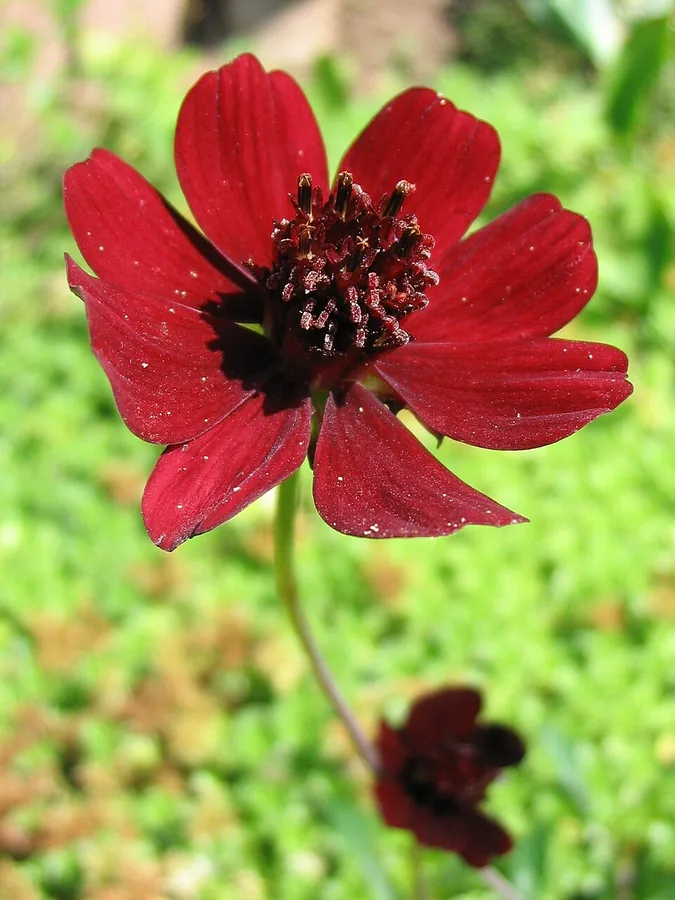
Flowers in deep maroon that genuinely smell of dark chocolate, rising from a tender tuber you handle much like a dahlia.
Full sun
USDA 7–9
2–3 ft · 0.6–0.9 m
Overview
The name fits this plant on two counts: blooms the shade of dark chocolate and, on a warm afternoon, a scent that matches them. A native of Mexico in the daisy family, it pushes up from a small tuber instead of fibrous roots. Nearly every plant sold traces back to one sterile clone that gardeners have handed on by division across many years.
It keeps a compact frame, climbing to 2 to 3 feet (61 to 91 cm), and holds its flowers on slim stems above a fine, ferny mass of leaves. The blooms keep coming from early summer deep into fall, giving you a long stretch of color in a bed or container. Snip a stem for the table and the chocolate fragrance drifts indoors.
Handle it as a tender perennial. It returns each season only where winters stay gentle, so in colder ground most growers lift the tubers and keep them dry, exactly as with a dahlia, and set them back out come spring.
Care
The short version: full sun, plain soil with sharp drainage, and a sparing hand with water. Let the top half of the soil dry out between waterings, feed lightly, and keep the tubers clear of soggy ground.
Light
Set chocolate cosmos in full sun, where direct light reaches it through most of the day. That strong light draws out the richest flower color and stops the slim stems from drawing up tall and toppling.
Water
Water with a light touch and wait until the top half of the soil dries before the next round. The plant copes well with dry to average ground, but wet soil rots the tubers in short order, so lean toward dry and never leave it standing in moisture.
Soil
Set it into average, well-drained soil of middling fertility. Free drainage matters far more than richness here, because the tubers cannot pull through in heavy, sodden ground. Mix in grit or use a raised bed if your soil tends to stay wet.
Humidity
Plain outdoor air suits it, so there is no humidity target to hit. Moving air matters more, since tight, stagnant spacing is what lets powdery mildew creep onto the leaves.
Feeding
A light feed across the growing season covers everything it needs. Overdo it and you push leafy growth at the cost of flowers, so keep it sparing and let the plant aim its energy at the blooms.
Pruning
Deadhead the faded flowers as they go over and the plant keeps setting fresh buds for longer. Trim out any damaged or diseased growth as soon as you notice it to keep things tidy.
Size & spacing
Look for a plant 2 to 3 feet (61 to 91 cm) tall spreading 12 to 24 inches (30 to 61 cm) across. Leave enough gap between plants for air to flow through freely, which holds mildew off.
When to plant
This plant holds out for warmth and has no patience for frost. Where it can't overwinter, sow fertile strains under cover in early spring, move plants outdoors once the chill lifts in late spring, and watch the flowers run from early summer through fall.
Northern hemisphere
Southern hemisphere
Typical months for a temperate climate: start earlier in warm zones, later where spring frosts linger.
- Sow: early spring (seed-grown strains only)
- Plant: late spring after last frost
- Harvest: early summer to fall
Hardiness
USDA hardiness zones: 7–9
Temperature: down to -18°C
Troubleshooting
Trouble with chocolate cosmos tends to begin below the soil line or in stagnant, packed air. Spot the early clues and the remedies stay easy. Find the match below, then step in before it takes hold.
Tubers gone soft underground while the plant droops and folds
What you are seeing is tuber and root rot, driven by ground that holds moisture far too long, not by any sprayable infection. Dig up a failing plant and the tubers lift out brown, mushy, and rank-smelling. Ease back on watering, fork grit through the bed or shift to a raised bed, and toss the rotted tubers before you set the firm ones back in.
Fix:
- Stop overwatering and improve drainage
- Remove and discard severely rotted tubers
- Replant healthy tubers in gritty, well-drained soil or a raised bed
Soft new shoots packed with tiny insects and a sticky film
The little colonies massing on the fresh growth and buds are aphids, frequently with ants standing guard over the sticky honeydew they secrete. A firm blast of water sends most of them flying, and insecticidal soap mops up the holdouts. Backing off the nitrogen pays off as well, since the soft, tender shoots it produces are precisely what pulls them in.
Fix:
- Dislodge aphids with a strong jet of water
- Treat persistent infestations with insecticidal soap
A chalky white dust spreading over leaves and stems
You are looking at powdery mildew, a fungus that takes hold where plants stand packed together in moist, motionless air. The pale patches wipe away from the leaf, which tells you it is not simply harmless residue. Thin the planting so air can pass through, strip off the worst foliage, and direct water to the roots so the leaves stay dry.
Fix:
- Improve spacing and airflow
- Remove badly affected foliage
Toxicity
Pet owners can relax: chocolate cosmos is safe. The ASPCA records cosmos as non-toxic to cats, dogs, and horses, and the chocolate scent holds none of the theobromine that makes real chocolate harmful. At worst a nibble brings a mild, short-lived stomach upset, no different from any non-food plant.
Safe for
People · Cats · Dogs · Horses · Rabbits · Livestock · Birds
Cats None
Fine to keep near cats. Cosmos sits on the ASPCA non-toxic list, so a curious taste is nothing to worry about.
Dogs None
Poses no danger to dogs. One that gnaws a leaf or bloom might get a brief, mild stomach upset, as happens with most non-toxic plants.
Horses None
Fine for horses, with the ASPCA confirming it across the whole cosmos genus. A mouthful or two causes no harm.
Rabbits Safe
Carries no toxin for rabbits. As with any unfamiliar green, offer small portions first so the gut can adjust.
Livestock Safe
Cattle, goats, and sheep can graze on it without being poisoned. The plant holds nothing harmful to them.
Birds Safe
Harmless to garden birds and poultry, which will often pick at cosmos seed heads without any ill effect.
People Safe
No threat to people. It is a decorative garden plant rather than something to eat, so enjoy the dark flowers and the scent and leave it off the plate.
Varieties
Just a handful of named chocolate cosmos forms are in circulation, and they part ways mostly on flower color and how freely they bloom. Here are the ones you stand the best chance of finding.
classic sterile clone
This is the long-cultivated original, bearing deep maroon-brown flowers that smell of chocolate, and it sets no seed, so it travels only through division or cuttings.
'Choca Mocha'
A tidy, generous bloomer that puts out more of the dark reddish-brown, chocolate-scented flowers than the old clone manages.
'Black Magic'
Sought after for flowers in the darkest maroon, so deep they read as nearly black.
How to propagate
Since the classic plant sets no seed, most chocolate cosmos is increased by splitting tubers or striking cuttings instead of sowing.
DivisionModerate
Spring · One growing season
In spring, divide the resting tubers the way you would a dahlia, and each section roots in across a single growing season. With the classic clone setting no seed, division is what holds it true to the parent.
Stem cuttingsModerate
Late spring to summer · Several weeks to root
Pull basal or stem cuttings from late spring through summer, and over several weeks they strike roots and grow into exact copies of the parent. This stays the usual way to bulk up the old clone, which never sets seed of its own.
SeedModerate
Early spring indoors · One season to flowering
Growing from seed only succeeds with the newer fertile strains, never the old sterile clone. Sow it under cover in early spring and the seedlings come into flower inside their first season.
Myths
Because chocolate cosmos has such dark flowers and a chocolate smell, it must poison cats and dogs.
That smell is purely an aroma and holds none of the theobromine that makes actual chocolate harmful to animals. Cosmos appears on the ASPCA list as non-toxic to dogs, cats, and horses, and chocolate cosmos belongs to that very genus. Neither the dark blooms nor the scent give any reason to fret.