Ornamental · Asteraceae
Aster
Symphyotrichum
Set it in full sun and well-drained soil, and the aster studs the garden with color into fall.
Full sun
USDA 3–8
1–5 ft · 0.3–1.5 m
Overview
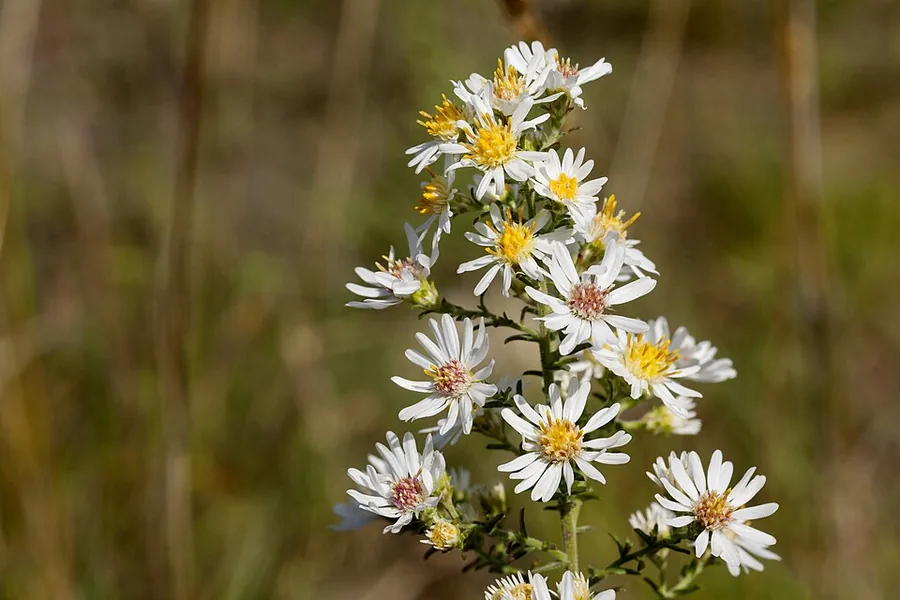
Asters carry rows of small, daisy-like flowerheads on upright stems just as most of the garden fades. They belong to the same family as sunflowers and daisies, and the hardy garden kinds grow as clump-forming perennials, each crown sending up a thicket of leafy stems that returns stronger every year. The clumps range from a low front-of-border mound to a tall, leggy stand reaching for the light.
The flowerheads open in blue-violet, pink, and white, each one a ring of narrow ray petals around a small central disk, set so thickly along the stems that the green leaves nearly disappear behind them. They open from late summer into fall, commonly August through October, and the heads stand as one of the last big nectar sources for pollinators before frost.
The plant carries itself on slim, leafy stems that want full sun and free-draining ground to stay upright. A midsummer pinch thickens those stems so they hold their flowerheads without flopping. Left crowded in damp shade, the leaves take on the white powder of mildew and the stems run long and floppy, so open ground and sun keep the growth firm.
Care
The short version: asters want full sun and well-drained soil of almost any texture, with steady moisture through the growing season. The stems are pinched back in June so they grow thick and sturdy, and crowded clumps are divided every few years to keep the flowerheads coming.
Light
The flowerheads open most thickly in full sun, and the plant will take a little partial shade. In real shade the stems stretch tall and floppy and carry only a thin scatter of heads.
Water
The roots want average, steady moisture through the growing season, since dry soil thins the count of flowerheads. Established plants hold up through a brief drought, but the ground has to drain well, or the stems fall to wilt.
Soil
The clumps take to loam, sandy loam, or clay so long as it drains well and carries some organic matter. They root across a wide pH band from 5.5 to 8.0, which covers most garden ground.
Humidity
Outdoor humidity is whatever the season brings, and the foliage takes it in stride. Air moving through the leaves matters far more than any moisture number, since crowded, still air is where the white powder of mildew first settles.
Feeding
A light spring feed of balanced general-purpose fertilizer carries the stems through the season. Heavy nitrogen pushes soft, floppy growth that leans and sets fewer flowerheads.
Pruning
Pinch the leafy stems back by a few inches from early to late June so they branch low and grow thick enough to stand without staking. Stop after early July to spare the tight flower buds forming at the tips, and cut the spent, browning stems to the ground once the heads finish.
Size & spacing
The stems rise 1 to 5 feet (30 to 150 cm) depending on the species, and the clump spreads 2 to 4 feet (60 to 120 cm) across at the base. Give each one that full width so air slips between the stems and the leaves stay clear of mildew.
When to plant
Asters take their cues from the cool ends of the year. The seed goes in indoors in late winter or outdoors in spring, the young plants set out after the last frost once the soil warms, and the first flowerheads break open late, from August into October.
Northern hemisphere
Southern hemisphere
Typical months for a temperate climate: start earlier in warm zones, later where spring frosts linger.
- Sow: Late winter to early spring; seed germinates in about 15 days indoors
- Plant: After last frost in spring once soil has warmed
- Harvest: Summer into late fall (commonly August to October)
Hardiness
USDA hardiness zones: 3–8
Temperature: down to -40°C
Troubleshooting
Most aster troubles show plainly on the plant itself, in powdered leaves, slumping stems, or a thin scatter of heads, and they trace back to crowding, poor drainage, or too little sun. Read the signs on the leaves and stems and a change of site or spacing usually sets the growth right. Match what you see below before it works through the whole clump.
Yellowing stems slumping along one flank
When the stems yellow and fold while the leaves go limp, usually down a single side, the cause is verticillium or aster wilt, a soil fungus of heavy, waterlogged ground that cannot be cured once inside the plant. The plant droops even with the soil still dark and damp around it. Lift and destroy the worst of them, open up the drainage, and keep susceptible asters out of that ground afterward.
Fix:
- Improve soil drainage
- Remove and destroy severely affected plants
- Avoid replanting susceptible species in the same spot
Bare stems carrying only a thin scatter of heads
A plant with sound green growth but only a few flowerheads is nearly always short of light or water. In shade or dry soil the stems set far fewer heads than a plant standing in full sun with steady moisture at its roots. Move it into the open sun and keep the soil dark and damp, above all through a hot stretch, and the flowerheads fill back in.
Fix:
- Relocate or site plants in full sun
- Maintain consistent soil moisture during the growing season
A white to gray powder dulling the leaf tops
That floury film is powdery mildew, a fungus whose white to gray growth spreads across the upper leaf surfaces, often blanketing the foliage by late summer. It thrives where plants press together and the air stands still. Thin and space the clump to move the air, water at the base to keep the leaves dry, and pull the most heavily coated foliage. A fungicide every 10 to 14 days checks it if the powder keeps creeping outward.
Fix:
- Improve air circulation by thinning and spacing plants
- Avoid overhead watering
- Remove and discard heavily infected foliage
- Apply an appropriate fungicide on a 10 to 14 day schedule if needed
Buckled new shoots glazed with sticky specks
The new shoots twist and pucker under small, soft-bodied aphids crowded along the tips and the leaf undersides, leaving a sticky honeydew shine across the growth. A hard jet of water rinses the clusters loose, and insecticidal soap waits in reserve for the times their numbers swell. A lighter hand with nitrogen helps as well, since the soft, tender shoots it pushes are the very tissue the insects gather on.
Fix:
- Dislodge with a strong spray of water
- Apply insecticidal soap if populations are high
Toxicity
Asters are safe all around, leaf, stem, and flowerhead alike. The ASPCA lists them as non-toxic to cats, dogs, and horses, and they pose no real danger to other animals or to people. The most a nibble brings is the mild stomach upset that almost any plant can cause.
Safe for
People · Cats · Dogs · Horses · Rabbits · Livestock · Birds
Cats None
Garden asters are safe around cats, and the ASPCA lists them as non-toxic. A cat that bites through a leaf may get a mildly upset stomach, which is true of almost any plant.
Dogs None
Dogs can share the garden without worry, since asters carry no poison. The most a curious dog risks from chewing a stem is a little drooling or a brief stomach upset.
Horses None
Asters are non-toxic to horses and pose no danger in or near a pasture. Cropping the foliage leads to nothing beyond the occasional mild digestive grumble.
Rabbits Safe
Rabbits can nibble the leaves and stems freely, with nothing in the plant to fear. As with any fresh greenery, modest portions keep a small gut settled.
Livestock Safe
Cattle, goats, and sheep can graze the foliage without harm. The plant holds no toxin that would trouble a grazing animal.
Birds Safe
Asters are harmless to birds, and the dry seedheads left at the stem tips draw finches and other songbirds. No part of the plant poses a hazard.
People Safe
Asters are not poisonous to people and present no risk to a curious child who handles a leaf or flower. They are not grown to be eaten, so there is no reason to taste them.
Varieties
Hundreds of asters exist, but a few species turn up in gardens again and again. These are the ones worth knowing by name and by the look of their flowerheads.
Symphyotrichum novi-belgii (New York aster)
A front-of-border perennial standing 3 to 4 feet, its stems tipped with blue-violet, pink, or white flowerheads from August to October, hardy to zone 4.
Symphyotrichum dumosum (Bushy aster)
A compact, densely branched American aster smothered in small, button-like flowerheads, low enough to sit at the front of a border.
Symphyotrichum oblongifolium (Aromatic aster)
A drought-tolerant aster whose foliage gives off a scent when brushed and whose flowerheads open very late into fall, hardy through zones 3 to 8.
How to propagate
Asters are easy to multiply, whether you pull apart an established clump or raise new stems from seed. Division keeps a named variety's flower color and form true, while seed is the cheaper route for the straight species.
DivisionEasy
In October as flowering deteriorates, or in early spring · One growing season
Division is the surest way to keep the clumps dense with stems. Lift a crowded clump every few years and pull the crown apart, in October as the flowerheads brown and fade or in early spring before the new shoots push, then set the pieces into well-drained soil. Each one roots down and fills out with fresh growth over a single growing season.
SeedEasy
Sow indoors in late winter or outdoors in spring · Germinates in about 15 days indoors or 20 to 30 days outdoors
Asters rise from seed sown indoors in late winter or outdoors in spring, the first green seedlings breaking the surface in about 15 days under cover or 20 to 30 days in open ground. Named cultivars are better divided, since seed-grown plants often will not match the flower color and form of the parent.
Myths
Asters are poisonous to dogs and cats.
The ASPCA lists garden asters, China aster included, as non-toxic to dogs, cats, and horses. A pet that nibbles a leaf is in no real danger, though chewing any plant can bring on a mild, passing stomach upset.
Asters need rich, constantly moist soil to thrive.
Asters grow well in average, well-drained ground, take a range of soil textures and pH, and established plants ride out a short dry spell. Soggy, poorly drained soil is the real problem, since it invites the wilt that limps the stems and the mildew that powders the leaves.