Ornamental · Osmundaceae
Interrupted Fern
Claytosmunda claytoniana
Give it damp shade and rich, acidic soil, and this native fern unrolls tall, arching green fronds every spring.
Partial shade
Every 3–7 days
USDA 3–8
2–5 ft · 0.6–1.5 m
Overview
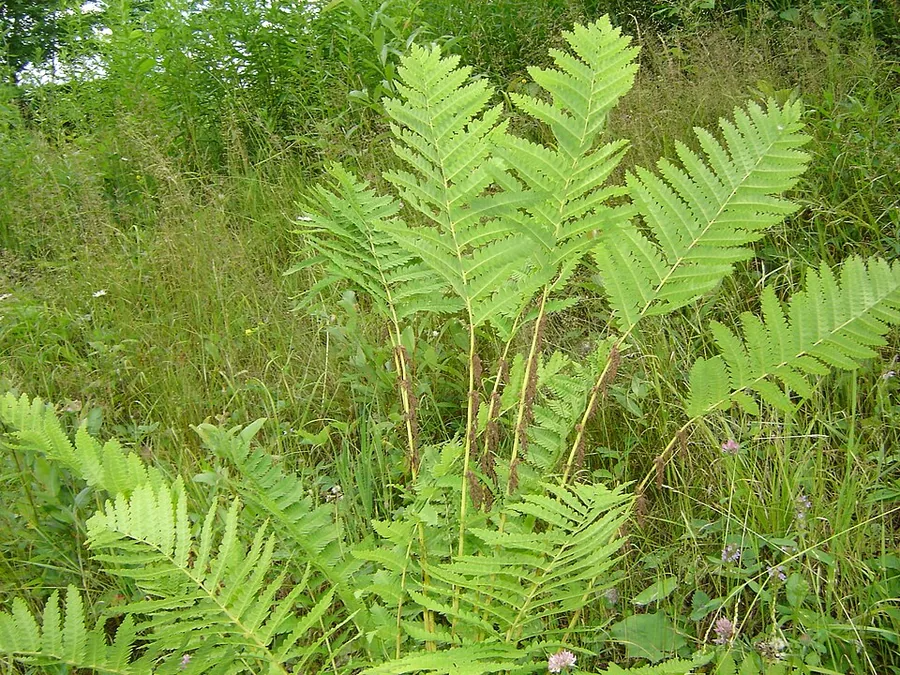
The interrupted fern throws up tall, upright fronds that arch outward into a broad, vase-shaped clump of soft green. The name lives in the frond itself: partway up, several pairs of leaflets shrink into small, brown, spore-bearing beads that break the smooth green run of the blade, so the leaf looks interrupted right at its middle. Those shrunken brown leaflets show up in mid to late spring and shrivel away by summer, and the gap they leave stays visible on the green frond behind them.
Its fronds rise from a stout crown of creeping rhizomes, and the whole plant is tougher than its delicate, feathery texture suggests. It holds its form through winters that drop to -40°F (-40°C), and the deer and rabbits that strip softer foliage leave its fronds untouched. Kept moist, the crown widens year by year into a fuller stand of arching green.
There are no petals or blooms to look for here, only the fine, divided green of the fronds and that brown mid-leaf band. The cinnamon fern and the royal fern raise similar green clumps nearby, but only this fern wears those shrunken brown leaflets cutting across the center of its blades.
Care
The short version: it wants part to full shade, soil kept evenly moist and lightly acidic, and a yearly top-dressing of compost. Once the crown settles in, it asks for little beyond water in dry spells.
Light
Part shade brings out its softest green, though the fern bends to almost anything from full shade to full sun. Sun comes with a condition, water, since the fronds only hold up in bright, open spots where the soil stays constantly wet.
Water
Keep the soil consistently moist and never let it dry out, watering more often through dry weather to keep the fronds full and green. As a wetland fern it stands soggy ground and even short spells of standing water around its roots, conditions that would rot most plants.
Soil
It sinks its roots into moist, humus-rich, acidic ground, happiest at a pH of 4.5 to 6.5. Past that it is unfussy about texture, taking clay, loam, or sand wherever the moisture holds.
Temperature
The crown is remarkably hardy for so soft-looking a plant. It weathers a range from -40°F to 86°F (-40°C to 30°C), riding out brutal northern winters and pushing up fresh green fiddleheads each spring.
Humidity
Like most woodland ferns it wants the air damp against its fronds, ideally around 50% to 80% humidity. In the garden, steady soil moisture and a shaded, sheltered spot keep that green tissue from drying.
Feeding
The fern draws little from the soil. One spring top-dressing of compost or leaf mold laid over the crown is plenty, breaking down slowly the way leaf litter does on a forest floor.
Pruning
There is no routine cutting to do. The dead or tattered fronds get trimmed away in late winter or early spring, before the new coiled fiddleheads push up through the crown.
Repotting
The coarse, spreading crown is no container subject, so division stands in for repotting. The established garden clumps are split every 3 to 5 years, which also renews a crown gone hollow and brown at its center.
Size & spacing
A mature clump stands 2 to 5 feet (61 to 152 cm) tall and its arching fronds fan out 2 to 4 feet (61 to 122 cm) wide. Give each crown room for that full spread so the green blades can arch out without pressing on their neighbors.
When to plant
This fern goes into the ground in spring, once the soil thaws and warms. The coiled fiddleheads unfurl into green fronds as the season opens, the shrunken brown fertile leaflets appear in the middle of each blade by mid to late spring, and they shrivel off by midsummer while the green stays on through fall.
Northern hemisphere
Southern hemisphere
Typical months for a temperate climate: start earlier in warm zones, later where spring frosts linger.
- Plant: spring
- Harvest: Non-flowering; fertile pinnae appear in the middle of the frond in mid-to-late spring and typically wither by midsummer
Hardiness
USDA hardiness zones: 3–8
Temperature: down to -40°C
Troubleshooting
The interrupted fern rarely runs into trouble, and when it does, dry soil or too much sun is nearly always behind the browning fronds or thinning crown. Reading those two parts for the early signs below points straight at the cause.
Green fronds turning brown and brittle at their tips
When the soft green blades stiffen into brittle, brown edges, the cause is nearly always parched soil, with fierce sun crisping them faster. The roots want to stay wet, so a deep soaking plus a blanket of leaf mold or compost keeps that dampness against them. A plant caught in raw midday sun holds its fresh green far better once it sits in shade.
Fix:
- Water deeply to keep the soil consistently moist
- Mulch with leaf mold or compost to retain moisture
- Relocate to a shadier site if planted in full sun
A bare, hollow heart ringed by fresh green fronds
A ring of lush fronds around an empty middle is simply the old rhizome crown aging out, not a disease. Lifting the plant in early spring and splitting it lets the vigorous outer sections carry on while the spent, woody core is discarded. Repeating the split every few years keeps the whole crown dense with new fronds.
Fix:
- Divide the clump in early spring and replant the healthy outer sections
Toxicity
For pet owners the picture is clear: this true fern holds no known toxins in its green fronds, so it is safe where cats, dogs, and other animals roam. The fronds are not food, but a curious bite harms nothing, and the plant is known for standing up to rabbit and deer browsing.
Safe for
People · Cats · Dogs · Horses · Rabbits · Livestock · Birds
Cats None
A cat that bites into the soft green frond comes to no harm from it. A large mouthful of any plant can still leave a sensitive stomach briefly unsettled.
Dogs None
The pliable fronds carry no toxin for a dog, so chewing on one does no damage. A full mouthful might bring only a short, mild bout of digestive upset.
Horses None
This true fern holds nothing in its green tissue that would poison a horse, and grazing animals pass the coarse clump by anyway.
Rabbits None
A rabbit can crop the low fronds without harm. The plant is known to take that browsing in stride and push out fresh growth in reply.
Livestock None
Cattle, goats, and sheep take no injury from the fronds. Stock generally step around the clump, and a stray mouthful does no damage.
Birds None
Nothing in the green blades threatens birds, so poultry and wild visitors pick around the fronds without concern.
People None
The frond feels smooth in the hand and carries no irritant against the skin. It is not a food plant, so a rinse of the hands after working the soil is plain garden habit.
No documented toxicity. Handle normally and wash hands after working with soil.
Varieties
There is no long list of named forms to sort through for this fern. The one worth knowing is the plain wild type itself.
Osmunda claytoniana var. vera
This is the true wild form of the interrupted fern, an infraspecific variety that Wherry named and that Kew's Plants of the World Online still recognizes.
How to propagate
You make more interrupted ferns by splitting the thick rhizome crown of an established clump rather than sowing seed, since the fern carries spores instead.
DivisionModerate
Early spring · 1-2 years
Splitting a settled clump in early spring is the dependable way to make more. The thick rhizome crown is lifted, cut apart, and reset in the ground, and because the fern creeps slowly on horizontal rhizomes, a fresh piece takes 1 to 2 years to knit in and thicken. It will also raise young plants from the fine spores shed by the fertile leaflets, but that is slow, exacting work.
Myths
The interrupted fern bears flowers or seeds.
It never flowers and sets no seed. Like every fern it spreads by spores, and here they cluster on a band of brown fertile leaflets, shrunken and beadlike, dropped into the middle of an otherwise broad, green, sterile frond.
Interrupted fern, cinnamon fern, and royal fern are the same plant.
They are three separate species in the family Osmundaceae. The interrupted fern gives itself away by the band of brown fertile leaflets that breaks the middle of each frond, with full green leaflets spreading above and below the gap.