Ornamental · Fabaceae
Alfalfa
Medicago sativa
Read the seedbed and its pH before a single seed drops, and this deep-rooted legume keeps yielding cut after cut for seasons.
Full sun
Every 7–14 days
60–70 days
USDA 3–9
Overview
Alfalfa is the heavy hauler of the hay field, a deep-rooted perennial legume that growers run the blade across several times each season. It sits squarely in the pea family, and like its kin it draws nitrogen straight out of the air through Rhizobium bacteria packed into knots along its roots. That single taproot bores far down into the subsoil, which is why a settled stand laughs off a dry spell and pushes back up green spring after spring.
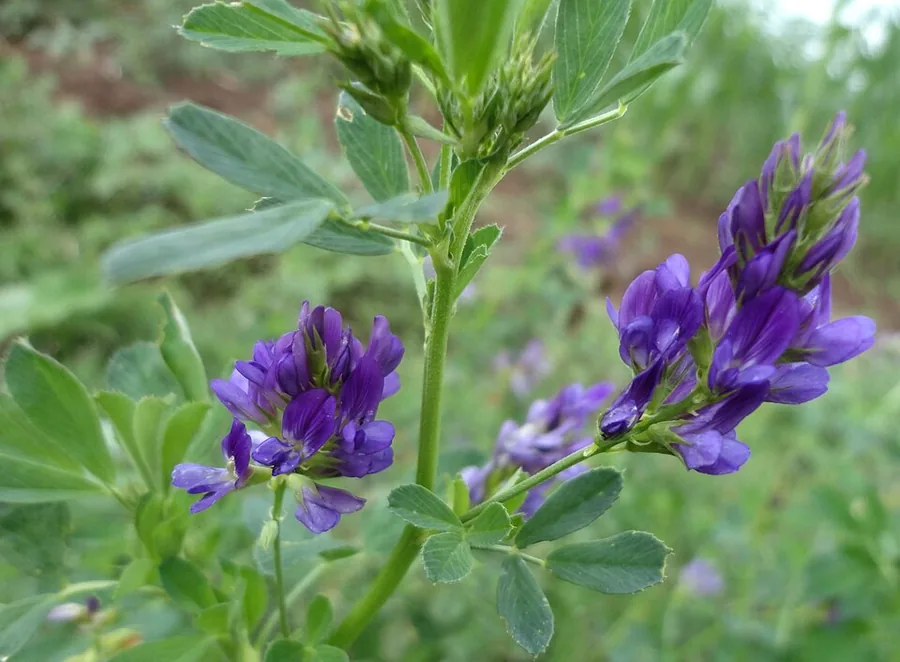
The soil under it is where alfalfa turns choosy. It wants deep, well-drained, near-neutral ground and sours fast on acidic, waterlogged, or thin sites. Square away the pH and the drainage before seed touches dirt and the crop pays you back for years; miss them and the dense stand goes ragged and threadbare in a hurry. By summer the canopy lifts a haze of purple to blue-violet pea flowers, though most fields meet the blade well before the bloom fully takes hold.
It is also a crop that remembers its own footprint. A spent stand turns the soil hostile to its own fresh seedlings, a quirk called autotoxicity, so you cannot simply drill new seed back into a worn-out field. Slot alfalfa into a rotation instead, and whatever follows reaps the leftover nitrogen the old roots tucked away.
Care
The short version: open ground in full sun, with deep, well-drained loam carrying a pH of 6.5 to 7.5. Coat the seed with inoculant, soak the soil hard but rarely once roots have set, and run the blade across the stand on a steady rhythm all season.
Light
This is a full-sun plant through and through, with no patience for shade at all. Wide-open ground bathed in light from dawn to dusk is what powers the thick flush of regrowth that springs up between one cutting and the next.
Water
With the deep taproot reaching far below, a settled stand turns very drought tolerant, so drench the ground deeply and only every 7 to 14 days, letting the top half dry, rather than dribbling a little on often. It draws roughly 10 to 12 inches of moisture over a season, yet drowns under flooding or standing water, so where that water goes counts every bit as much as how much you give.
Soil
Hand it deep, well-drained, fertile loam and hold the pH between 6.5 and 7.5. It sulks on acidic, very alkaline, soggy, or shallow ground, and that pickiness about the seedbed is the one factor that tips a stand toward thriving or failing more than any other.
Temperature
Few crops stretch as wide at both ends, riding out a span from about -20°F to 95°F (-29°C to 35°C) across its hardiness zones. That deep cold tolerance is exactly what carries winter-hardy types through frozen northern ground to green up again each spring.
Humidity
Whatever the open-air humidity does barely registers for a field crop of this kind. What carries real weight is moving air and free drainage, because damp, still, stagnant pockets are precisely what coax out the root rots and the white cottony mold.
Feeding
Being a legume, alfalfa pulls its own nitrogen down through Rhizobium nodules the moment the seed is inoculated, so you never hand it nitrogen. What you do supply is phosphorus, potassium, and lime, guided by a soil test, to keep the pH parked near neutral, both as the stand sets in and after each cutting.
Pruning
The cutting is the entire reason the crop exists. Bring the first harvest off a direct-seeded stand about 60 days after seeding, then keep the blade running on a steady schedule through the warm months for hay or forage.
Repotting
none
Size & spacing
A grown stand rises about 24 to 35 inches (60 to 90 cm) tall, each plant fanning out 12 to 24 inches (30 to 60 cm) wide. Since it goes in broadcast or drilled as a field crop rather than set out plant by plant in a bed, you tend it as one dense sweep of green, not as separate specimens.
When to plant
Seed drops straight into the field here, never into a tray indoors. Drill it into a firm seedbed once the spring soil warms, or wait for the late-summer window, then bring the blade through about 60 days on and again and again while those violet blooms open and fade above the canopy.
Northern hemisphere
Southern hemisphere
Typical months for a temperate climate: start earlier in warm zones, later where spring frosts linger.
- Sow: Not typical; direct sown in field
- Plant: Spring (April-May) or late summer (late July-early September) into a firm, well-drained seedbed at neutral pH
- Harvest: Purple to blue-violet pea flowers in summer (May-October depending on latitude); cut for hay or forage multiple times per season
Hardiness
USDA hardiness zones: 3–9
Temperature: down to -40°C
Troubleshooting
Look down, not up: most of what goes wrong with alfalfa hides in the seedbed and the chemistry of an old stand long before a single yellow leaf shows. Then the pests arrive and the damage climbs into view on the foliage. Match the picture below to your field and step in while the stand still has the vigor to bounce back.
A patchy, threadbare stand that never knits together
Alfalfa is picky about the dirt under it, and a failing stand almost always traces to soil that is too sour or too wet. In acid ground the Rhizobia that feed the plant slip into dormancy, while standing water rots the taproot and shoves crowns up out of the soil over winter. Sweeten the field with lime to near neutral long before seeding, choose a deep, free-draining patch, and coat the seed so the roots knot up with nodules the way they should.
Fix:
- Lime acidic soils to pH 6.5-7.0 at least six months before seeding if pH is below 6.2
- Select deep, well-drained fields and avoid hilltops, eroded ground, and low spots where water pools
- Inoculate seed with the correct Rhizobium and ensure good seed-to-soil contact in a firm seedbed
A reseed into old ground breaks the surface thin and stunted
This is autotoxicity, and it blindsides plenty of growers. A settled alfalfa stand leaks compounds that smother its own seedlings before they can sprout and take, so a fresh drilling straight back into the tired field comes up patchy and far under the 25 plants per square foot you need for a solid sweep. Swing through corn or a grass for a year or more before alfalfa returns, and let that filler crop soak up the leftover nitrogen.
Fix:
- Do not reseed alfalfa directly back into an old alfalfa stand
- Rotate to a non-alfalfa crop such as corn or a grass for at least one year before returning to alfalfa
- Use the residual nitrogen from the old stand for the rotation crop
Plants slumping to a pale yellow-green, crowns gone soft and rotten
A handful of diseases creep in as a slow fade across the stand, and soggy ground brings out their worst. Phytophthora and Aphanomyces root rots turn the roots brown and mushy in waterlogged fields, bacterial wilt leaves the plants short and a washed-out yellow-green, and Sclerotinia smothers the crowns in a white cottony fuzz. Drop in resistant cultivars, open up the drainage, and rotate clear of alfalfa to beat down the inoculum lurking in the soil.
Fix:
- Plant disease-resistant cultivars (bacterial wilt, Phytophthora, Aphanomyces resistant)
- Improve drainage and avoid wet, low fields
- Rotate away from alfalfa to reduce soilborne inoculum
Leaves left ragged and yellowing while the planting thins
Three insects rip through most of this. Alfalfa weevil larvae gnaw the tender new growth down to a lacy skeleton, potato leafhopper scorches the leaf margins a sickly yellow in a burn the books name hopperburn, and aphids crowd in behind them. Drag a sweep net through the canopy to see what is truly out there, treat once counts top the economic threshold, and cut early or sow leafhopper-resistant cultivars to stay a step ahead.
Fix:
- Scout regularly and treat at established economic thresholds
- Use early or timely cutting to disrupt pest cycles
- Plant potato-leafhopper-resistant and pest-resistant cultivars where available
Toxicity
Alfalfa is clean across the whole barnyard and never sits on an ASPCA toxic-plant list. Folks crunch it as sprouts and dried supplement, and it fills the bowls and troughs of cats, dogs, rabbits, horses, and poultry without trouble. The single watch point is grazing cattle and sheep, where a soft green stand can puff up the gut, so the answer is managing how they graze, not steering clear of the plant.
Safe for
People · Cats · Dogs · Horses · Rabbits · Livestock · Birds
Cats None
Alfalfa poses no toxic threat to cats and has never shown up on the ASPCA poison lists. A curious nibble does no more harm than a mouthful of ordinary lawn grass would.
Dogs None
Dogs can wander right through an alfalfa stand with nothing to fear. Dried alfalfa even rides along as an ingredient in some pet foods, so there is nothing here to fence them off from.
Horses Safe
Horses tuck into alfalfa as a rich, leafy hay and digest it well. It ranks among the most nourishing forages you can set in front of them.
Rabbits Safe
Alfalfa is a mainstay in plenty of rabbit diets and a treat they make a beeline for. Young rabbits in particular put on good condition with it in the mix.
Livestock Mild
Cattle and sheep crop alfalfa with no harm in the ordinary way, though one genuine hazard rides along. A soft, pure-green sweep of it can set off frothy bloat that swells out the left flank, and tender new shoots once in a while bring on photosensitization. Cap the legume near a third of the grazing, set hay in front of the herd before turnout, and never run hungry stock onto a thick, heavy stand.
Birds Safe
Birds peck at alfalfa with no harm done, and poultry take to it eagerly as a green feed.
People Safe
People eat alfalfa as well, most often as crunchy sprouts or a dried supplement. The plant holds no toxins that would make it unsafe to swallow.
Not poisonous to cats, dogs, or people. The only real caveats are with grazing ruminant livestock: lush alfalfa can cause frothy bloat in cattle and sheep grazed heavily, fresh alfalfa can rarely cause photosensitization, and alfalfa contains phytoestrogens. Limit legume to about 30 percent or less of pasture, feed hay before turnout, and avoid turning hungry animals onto lush stands.
Varieties
Pick alfalfa apart by two traits above all: how hard it shuts down come autumn, and which diseases it can shake off. Sort these out before any seed gets ordered.
Fall-dormant (winter-hardy northern) types, FD 2-4
A low fall-dormancy rating slows these types down early and pulls them through brutal winters, the exact trait you reach for in cold northern fields.
Non-dormant (southern) types, FD 8-9
A high fall-dormancy rating keeps these plants pushing growth deep into the season for warm southern country, trading away winter toughness to do it.
'Alfagraze'
'Alfagraze' was bred to absorb the punishment of hooves and constant grazing, and it grew into the yardstick that grazing-tolerance trials line every other line up against.
Disease-resistant modern cultivars
Modern breeding has stacked into these lines a defense against bacterial wilt, Phytophthora and Aphanomyces root rots, Fusarium wilt, anthracnose, and the potato leafhopper together.
Companions
Plant near
Grasses (orchardgrass, timothy): Grass-alfalfa mixtures reduce frothy bloat risk in grazing ruminants and improve stand productivity.
Corn or other rotation crops following alfalfa: Rotating to a non-alfalfa crop for a year uses alfalfa's residual nitrogen and avoids autotoxicity when returning to alfalfa.
Keep apart
New alfalfa seeded into an existing alfalfa stand: Autotoxicity from the established alfalfa inhibits germination and growth of the new alfalfa seedlings.
How to propagate
Every alfalfa stand starts from seed sown right onto the ground, and the real craft sits less in the dropping of seed than in nailing the seedbed, the inoculant, and the crop that came before.
SeedModerate
Spring (April-May) or late summer (late July-early September) · About 60 days to first harvest; full stand establishes over the seeding year
Sow this one straight onto the ground, skipping the indoor start, timed either for spring around April to May or for the late-summer stretch running late July into early September. Coat each seed with its matching Rhizobium so the plant can draw nitrogen from the air on its own, set it a quarter to half an inch under, dropping it a shade lower where soil turns sandy, and press it into firm, free-draining, near-neutral tilth. You will lift a first cut roughly 60 days on, while the rest of the canopy thickens over what remains of the seeding year. One unbendable rule holds: never put fresh alfalfa back over a worn alfalfa field, since autotoxicity will ruin whatever comes up.
Myths
Alfalfa is frequently branded poisonous and unsafe to feed to animals or people.
Alfalfa stands as a safe, nourishing forage, set before livestock and rabbits, taken by people as a supplement, and worked into a few pet diets, and it has never once appeared on an ASPCA toxic-plant list. Its only true caveat is frothy bloat striking cattle and sheep driven onto a soft green sweep of it, alongside uncommon photosensitization and a faint dose of phytoestrogens. None of that turns the plant poisonous for pets or for people.
Sources
- USDA Forest Service FEIS
- University of Minnesota Extension
- University of Minnesota Extension
- University of Wisconsin-Madison Extension (Team Forage)
- University of Kentucky
- UC ANR Statewide IPM Program
- UC ANR Statewide IPM Program
- Penn State Extension
- ASPCA
- University of Kentucky
- USDA SARE
- University of Kentucky Master Grazer