Ornamental · Fabaceae
Red Clover
Trifolium pratense
Rosy-pink heads on upright stems, and out of sight red clover fixes its own nitrogen on pink-noduled roots.
Full sun
Every 5–10 days
60–90 days
USDA 4–8
Overview
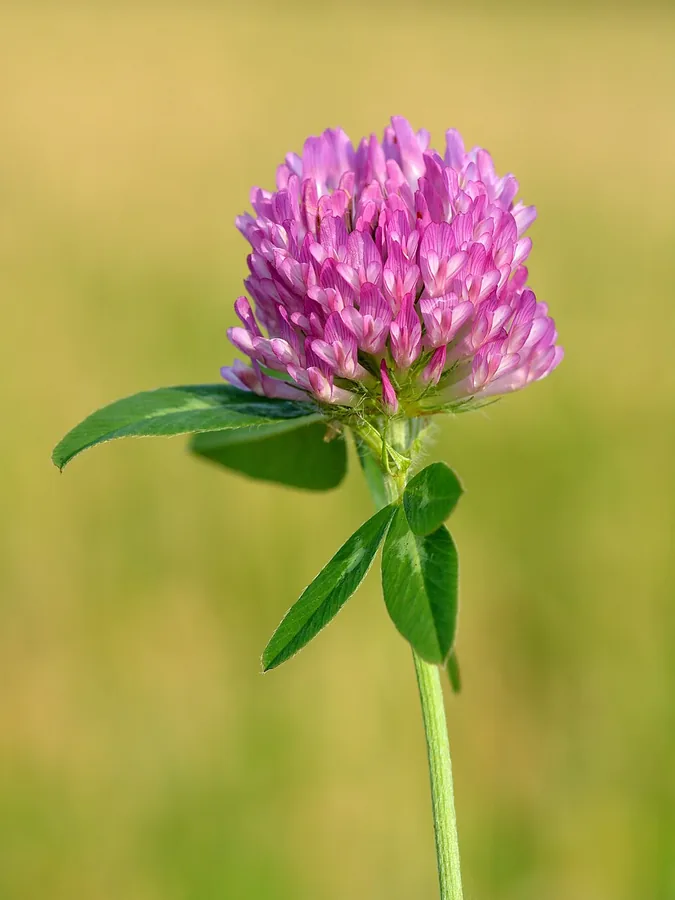
Red clover shows itself as upright, leafy stems that rise in a clump to about 1 to 2 feet (30 to 61 cm), each stem tipped with a rounded, rosy-pink flower head. The heads sit densely packed above the foliage, and through summer bumblebees crawl across them. Underground the plant grips a crown and a deep taproot, and being a nitrogen-fixing legume, its roots carry small pink nodules.
The clump stays compact and upright rather than sprawling, a tight cluster of stems climbing rather than running outward. Red clover is a short-lived perennial, and after two or three years the once-thick stand grows visibly thinner, with bare gaps opening where crowns fail. New seedlings fill those gaps on their own, since the plant reseeds where it stands.
Up close the young plant is soft and green, quicker to cover the ground than alfalfa. Its foliage stays low and dense at first, then throws up the flowering stems that carry the rosy-pink heads. When drought hits, that soft growth is the first to suffer, since red clover holds less against dry spells than its relatives.
Care
The short version: full sun on fertile, well-drained loam, seed dressed with the right Rhizobium and set shallow, steady moisture as the green clump fills in, and a cut or graze 2 to 3 times a season as the rosy heads come and go.
Light
In full sun red clover grows into its thickest, deepest-colored stand, though it still fills in under partial sun or partial shade. More light means denser foliage and a heavier crop of the rosy-pink heads.
Water
The young clump stays soft and green on steady, even moisture, and it wilts and stalls when the soil dries into a hard crust. Red clover covers ground faster than alfalfa but shows drought sooner, so it wants reliable water. Where rain falls short, a soaking every 5 to 10 days keeps the foliage firm and green.
Soil
Its roots run deepest in fertile, well-drained loam or clay loam, the crumbly, moisture-holding ground it prefers. A pH between 6.0 and 7.0 suits it, and it still takes hold in slightly acidic soil that would check many legumes.
Temperature
The plant is built to hold up in hard weather, hardy from about -29°F to 95°F (-34°C to 35°C). That toughness lets the crowns survive frozen, heaving soil during a late-winter frost seeding and green up again.
Humidity
Open-air humidity is all its foliage needs, so no set level applies. What shows on the leaves instead is the effect of stagnant, damp air, since warm, humid spells raise the dark-ringed fungal spots of black patch and other leaf diseases.
Feeding
Because its pink root nodules fix nitrogen, red clover needs little to no added N to green up. Dress the seed with Rhizobium at planting so those nodules form on the roots, then add phosphorus and potassium if a soil test shows a gap.
Pruning
Cut or mow the leafy stems for hay 2 to 3 times a year, and fresh growth pushes back from the crown. Grown as a cover crop, it is cut or tilled at mid-bloom, when the rosy heads are half open and the plant holds the most nitrogen.
Repotting
none
Size & spacing
12–24 in (30–61 cm) tall
When to plant
Red clover starts as bare seed pressed into open ground, never as an indoor seedling. Sow it in spring or late summer, or scatter it in late winter so the freeze-thaw grinds the seed into the soil, and the rounded rosy heads open from late spring through summer.
Northern hemisphere
Southern hemisphere
Typical months for a temperate climate: start earlier in warm zones, later where spring frosts linger.
- Sow: Not typically started indoors; direct sown
- Plant: Spring or late summer; commonly frost-seeded or overseeded into small grains and pastures during freeze-thaw periods
- Harvest: Late spring through summer
Hardiness
USDA hardiness zones: 4–8
Temperature: down to -34°C
Troubleshooting
The plant tells you what is wrong through its look: a stand that thins to bare ground, seedlings that come up sparse and pale, or leaves marked, notched, or scorched by disease and insects in warm, humid weather. Read those visible signs early and you can reseed, cut, or rotate before the patch goes bare. Match the appearance below to its cause.
The stand thins to bare, patchy ground after a couple of years
Thinning is the plant's natural arc, since red clover is a short-lived perennial that often lives like a biennial and gives out in its second or third season, the crowns failing and bare soil showing through. Root rots and foliar disease strip the common medium types even faster. Let it reseed into the gaps, frost-seed fresh plants across the thin ground, or sow a longer-lived cultivar such as Kenland or Freedom that keeps a full stand for 3 to 4 years.
Fix:
- Allow plants to reseed or interseed/frost-seed new clover into thinning stands
- Rotate or replant on a regular cycle
- Choose improved disease-resistant cultivars (e.g. Kenland, Freedom) that can persist 3-4 years
Sparse, pale seedlings and thin, uneven cover
A sparse, pale stand usually means seed that was never inoculated, leaving roots bare of the pink nodules that fix nitrogen, or seed pushed too deep into dry, crusted soil. Pull a young plant and look: smooth roots with no pink knots confirm it. Dress the seed with fresh Rhizobium just before sowing, set it no deeper than 1/4 inch into firm, moist soil, and time frost-seeding to the freeze-thaw so the seed settles into tight soil contact.
Fix:
- Inoculate seed with Rhizobium leguminosarum biovar trifolii (true clover inoculum) just before seeding
- Sow no deeper than 1/4 inch into firm, moist soil
- Frost-seed during freeze-thaw or seed into a prepared, firm seedbed for good seed-to-soil contact
Dark, ringed spots across the leaves and stems
Dark spots ringed with concentric bands mark black patch disease, a fungus that spreads across the foliage in warm, humid weather, sometimes joined by the paler blotches of anthracnose or the dusty film of powdery mildew. That same fungus makes the slaframine behind the harmless drooling in grazing animals. Cut or graze the marked forage early and clear the clippings, keep heavily spotted hay out of the ration, and plant anthracnose- and mildew-resistant cultivars.
Fix:
- Harvest or graze affected forage early and remove clippings
- Avoid feeding heavily infected, slaframine-tainted hay
- Plant anthracnose- and mildew-resistant cultivars
Stunted plants with chewed roots and notched, yellow-scorched leaves
The damage appears at both ends of the plant: clover root curculio larvae chew ragged notches into the roots and nodules, while potato leafhoppers and clover weevils scallop the leaf edges and burn them yellow at the tips, the scorch called hopperburn. Look for notched leaflets, yellowing foliage, and scarred crowns. A thick, well-fed stand carries the feeding better, and cutting early with field rotation breaks the pest cycles.
Fix:
- Scout regularly and harvest early to reduce leafhopper damage
- Maintain vigorous, well-fertilized stands to tolerate feeding
- Rotate fields to break pest cycles
Toxicity
Every part of red clover you can see or touch is safe and non-toxic, from the leafy stems to the rosy-pink heads that dry into herbal tea. Cats, dogs, rabbits, and birds can chew the foliage and flowers without harm. Only grazing horses and livestock carry two small cautions, and both come from forage management rather than any poison in the plant.
Safe for
People · Cats · Dogs · Horses · Rabbits · Livestock · Birds
Cats None
Red clover carries no toxin on the ASPCA list, so a cat that bites a leaf or a rosy floret is unharmed.
Dogs None
A dog can chew the leafy stems and flower heads with no ill effect, since nothing in the plant is toxic to them.
Horses Mild
The green forage itself is safe to graze. The one caution is a fungus, since foliage carrying the dark-ringed black patch mold can bring on harmless drooling, the slobbers, which fades once the feed is changed.
Rabbits Safe
Rabbits can eat the leaves and the rosy heads as a treat, in sensible amounts alongside their usual hay.
Livestock Mild
Cattle, sheep, and goats graze the leafy stands well. Two quirks call for a look: slobbers from mold-spotted forage, and frothy bloat when animals fill up on lush, pre-bloom clover, both headed off by pasture management.
Birds Safe
Chickens and other birds can pick at the leaves and the dry, brown seed heads freely, with no toxic parts among them.
People Safe
People dry the rosy-pink blossoms and steep them into herbal tea. The flowers are edible, and nothing in the plant is harmful.
Safe around pets and people. Two livestock-specific issues exist: when infected by the black patch fungus (Rhizoctonia/Slafractonia leguminicola), red clover produces the alkaloid slaframine that causes harmless but profuse drooling (slobbers) in grazing horses and cattle; and lush clover can cause frothy bloat in ruminants. Neither affects cats or dogs.
Varieties
Red clover comes in a few named types that differ in how tall and vigorous the stand grows and how quickly the cut stems push back up. These are the ones worth telling apart.
Mammoth
A tall, heavy-bodied late bloomer that pours nearly all its growth into one big first cutting, then pushes back up slowly.
Medium (double-cut)
The common type, sending up fresh stems fast enough for two or more cuttings a year and holding a fuller stand than mammoth.
Kenland
An improved medium red carrying anthracnose and virus resistance in its tissue, which keeps its stand full for 3 to 4 years.
Freedom
A disease-resistant type selected to stay thick and persistent longer than the common clovers.
Companions
Red clover pairs best with grasses and grains that balance the pasture or shelter the young stand, and it works as a green manure ahead of a hungry crop like corn.
Plant near
Forage grasses (e.g. orchardgrass, timothy, perennial ryegrass): Grass mixtures dilute the legume in pasture to reduce bloat risk and improve forage balance.
Small grains (wheat, oats, barley): Red clover is commonly frost-seeded or overseeded into small grains, establishing under the nurse crop and fixing nitrogen for the following crop.
Corn: Used as a green manure ahead of corn, supplying fixed nitrogen when terminated.
How to propagate
Red clover begins as small, hard seed and grows from that alone. What matters most is dressing each seed with its inoculant and pressing it into close contact with moist soil so the roots can take hold.
SeedEasy
Spring or late summer; often frost-seeded in late winter during freeze-thaw · Germinates in about 7 days; establishes within a few weeks to a season
Red clover grows from small, hard seed and nothing else, sown in spring or late summer, or scattered in late winter when the freeze-thaw grinds it into the soil. Dress each seed with Rhizobium leguminosarum biovar trifolii first, then press it no deeper than 1/4 inch into firm, moist ground. A green shoot breaks through in about 7 days, and the clump fills out over a few weeks to a season. It drops its own seed to reseed but never sends out creeping stolons, so it stays in place.
Myths
Red clover and white clover are the same plant.
Set side by side they look and grow differently. Red clover stands tall and upright at about 1 to 2 feet (30 to 61 cm), rising in a clump from a crown and taproot, carrying rosy-pink heads that bumblebees work, and lasting only 2 to 3 years. White clover stays flat to the ground, creeps outward on stolons, shows white heads worked by honeybees, and lives longer. The plain visual tell is that red clover never spreads by runners.