Ornamental · Fabaceae
False Indigo
Baptisia australis
Give it full sun and lean, well-drained soil, and false indigo settles in for decades with almost no fuss.
Full sun
Every 7–14 days
730–1095 days
USDA 3–9
Overview
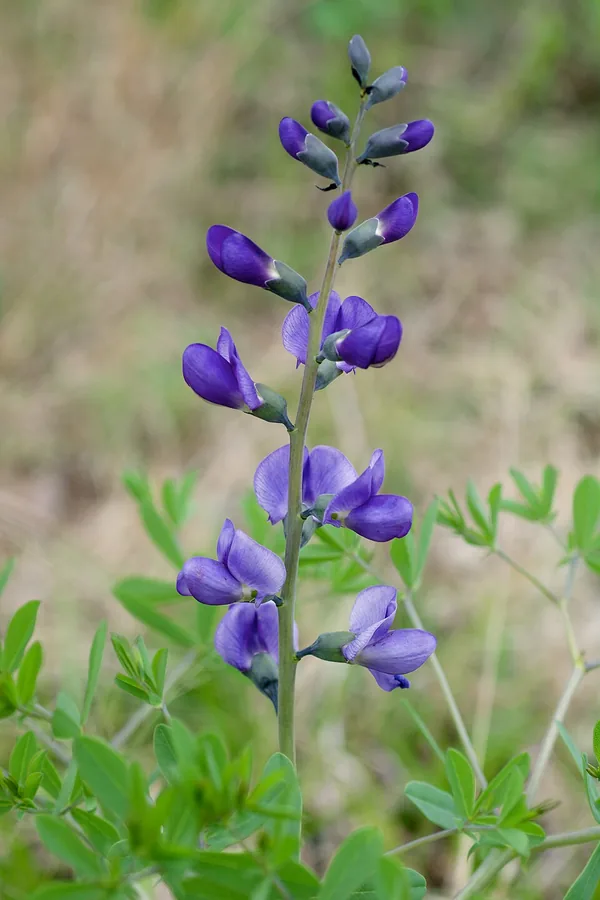
False indigo grows into a shrubby, rounded clump of blue-green foliage, the leaves carrying a soft, dusty cast that sets it apart from the greens around it. It belongs to the pea family, and in late spring it pushes up tall, upright spikes of lupine-like flowers, most often a deep indigo blue, each spike stacked with pea-shaped blooms from base to tip.
After the flowers drop, the spikes give way to inflated black seed pods that swell up fat and hollow, darkening as they ripen until they rattle dryly in the wind and hang on well into winter. Below ground the plant drives down a deep, woody taproot, the thick anchor that lets it stand through drought and poor soil and the reason a settled clump resents being lifted.
Up close the plant reads as solid and substantial, slow to build but full-bodied once grown, taking 2 to 3 years to reach blooming size. The stems rise stiff and upright from the crown, the foliage holds its cool blue-green through the season, and the whole mound carries a quiet, sturdy weight. Give it sun and good drainage at the start and it fills out on its own from there.
Care
The short version: full sun, lean and well-drained soil, and steady water only through the first year. After that the deep taproot carries it through dry spells, so leave it in place and let the clump fill out.
Light
False indigo flowers best in full sun, meaning 6 or more hours a day, where the stems stand stiff and the spikes set thickly. In too much shade the stems stretch thin and lean and the bloom grows sparse, though it will still take partial sun or light shade.
Water
Water it regularly through the first year while the taproot drives down into the soil. After that the plant turns highly drought tolerant and wants a drink only in a long dry spell. It prefers dry to medium soil and resents wet feet, so the dry side is safer.
Soil
Plant it in average, well-drained soil and it thrives. It tolerates poor, clay, and shallow rocky ground, leans a little acidic, and asks chiefly that water drains away from the roots. A pH between 5.0 and 7.0 suits it.
Temperature
This is a cold-hardy plant, comfortable from about -40°F to 95°F (-40°C to 35°C). It needs no winter protection across most of the country and the foliage holds up through summer heat without scorching.
Humidity
Ordinary outdoor humidity is fine, so there is no target to hit. Good airflow matters most here, drying the blue-green leaves and keeping them clean and trouble-free.
Feeding
As a nitrogen-fixing legume, false indigo makes much of its own food and needs little to no fertilizer. A light spring feed is plenty, and too much nitrogen only pushes soft, floppy stems that cannot hold the spikes upright.
Pruning
It asks for very little. Cut back the spent flower spikes after bloom if you like, or shear the foliage by about a third to hold the rounded mound tight, though that strips away the dark ornamental pods. Cut the old stems to the ground in late winter or early spring.
Repotting
False indigo belongs in the open ground for the long haul rather than a pot. The deep woody taproot resents disturbance, so once a plant is established, leave it where it stands and avoid moving or dividing it.
Size & spacing
A mature clump stands 3 to 4 feet (91 to 122 cm) tall and spreads 2 to 4 feet (61 to 122 cm) wide, a dense, shrub-sized dome of stems and leaves. Give each plant room, since it bulks out into a substantial mound over the years.
When to plant
False indigo runs on a slow clock. Sow seed in fall or start it indoors in late winter after a long chill, set plants out in spring once frost has passed, and watch the indigo-blue spikes rise in May and June. The clump puts its energy into roots and leaves first, so flowers seldom show the first year or two.
Northern hemisphere
Southern hemisphere
Typical months for a temperate climate: start earlier in warm zones, later where spring frosts linger.
- Sow: Late winter, after scarifying and cold-stratifying seed 6 to 12 weeks
- Plant: Spring after last frost, or sow fresh seed in fall
- Harvest: Late spring to early summer (May to June)
Hardiness
USDA hardiness zones: 3–9
Temperature: down to -40°C
Troubleshooting
False indigo has few real problems, and the ones it does have trace back to too little sun or soil that is too rich. Look closely at the stems, leaves, and pods and match what you see below before reaching for any fix, since the plant is usually in better shape than it appears.
Blue-green leaves turning yellow near a black walnut
When the normally blue-green foliage pales to a sickly yellow and the whole plant thins out, look for a black walnut overhead. Baptisia reacts to juglone, the toxin those roots leak into the soil, and a plant inside the canopy keeps fading whatever the care. Lifting the crown with as much of the deep root as comes free and resetting it on clear ground is the cure, or fresh plants raised from seed well beyond the tree.
Fix:
- Transplant the crown to a site away from black walnut influence, taking as much of the deep root as possible
- Relocate or start new plants from seed well away from walnut trees
Stems splaying outward with a hollow heart
Flopping shows up as tall stems that lean apart and open a bare gap in the middle of the mound. The stems behind it are soft and slack, grown that way by too little sun or soil that is too rich. Cutting the foliage back by about a third just after flowering forces shorter, firmer growth that stands on its own. Holding back nitrogen keeps the stems stiff, and a grow-through ring set early threads the new shoots upright in a shaded spot.
Fix:
- Shear the foliage back by about one-third right after flowering to encourage a denser, self-supporting mound
- Provide a grow-through support ring early in the season for plants in partial shade
- Stop applying nitrogen fertilizer
Plump black pods with hollow seeds inside
The inflated black pods look full and sound when shaken, yet the seeds inside can be empty husks, the work of weevils. The adults slip eggs into the green pods, and the larvae eat the seed from within while the leaves and stems stay firm and green. Split a few of the dark pods and the small pale larvae or their round exit holes appear. The plant itself loses nothing, so the only reason to pull and bin the spoiled pods is to keep seed worth sowing.
Fix:
- Remove and discard affected pods to reduce the local weevil population
- No control is needed for plant health since damage is cosmetic to seeds only
Toxicity
Every part of false indigo holds quinolizidine alkaloids, so it counts as mildly toxic to pets, livestock, and people. A small bite tends to bring an upset stomach rather than anything serious, but the inflated black seed pods are the part to watch, since they rattle and tempt curious pets and children. Keep them out of reach and wash your hands after pruning.
Toxic to
Cats · Dogs · Horses · Rabbits · Livestock · Birds · People
Cats Mild
A cat that mouths a blue-green leaf or cracks a pod tends to drool, bring a little back up, and pass some loose stool. The upset keeps to the stomach and clears without help.
Dogs Mild
The rattling black pods catch a dog's attention first, and a mouthful usually means a churning stomach with vomiting or diarrhea. The more pod a dog crunches, the rougher it goes, so the pods stay out of reach.
Horses Mild
Horses tend to step around it in the field. Even so, the alkaloids in the leaves and pods can sour the gut and flatten the appetite if a hungry horse grazes much of it.
Rabbits Mild
Rabbits are better kept clear of it. The same alkaloids run through the leaves and the seeds, and anything past a small bite can leave a rabbit with digestive upset.
Livestock Mild
Cattle, goats, and sheep usually leave the clump standing on pasture. They mostly get into trouble only when other forage is scarce and they eat the plant in quantity, which brings stomach upset.
Birds Caution
The seeds and the black pods are not a safe snack, so they are never worth offering. Wild birds tend to overlook the plant, and the one risk is a pet bird picking at a fallen pod.
People Caution
No part of false indigo is meant for eating. Swallowing the seeds or pods can bring on nausea and stomach upset, so wash your hands after pruning and keep the tempting pods away from small children.
Generally safe to handle; wash hands after pruning and keep the rattly black seed pods away from curious pets and small children.
Helpline numbers

United States
ASPCA Animal Poison Control: (888) 426-4435 (fee applies)
Poison Control: (800) 222-1222



Canada
Poison Centres: 1-844-764-7669
Varieties
The wild species carries true indigo-blue spikes, but breeders have widened the color range into deep purples and soft yellows. These are the named selections you are most likely to find.
Purple Smoke
A vigorous hybrid lifting smoky violet-purple flowers along dark charcoal-gray stems, and a touch more shade-tolerant than most.
Twilite Prairieblues
A large, bold selection whose tall spikes carry violet-purple and yellow together in a vivid two-toned bloom.
Carolina Moonlight
A selection that trades the species' indigo for soft butter-yellow spikes glowing against the blue-green leaves.
Companions
False indigo pairs well with other sun-loving prairie plants that share its taste for dry, well-drained ground, and it struggles only near black walnut, whose roots poison the soil around it.
Plant near
Ornamental grasses: Pair well in sunny borders and prairie plantings, providing contrast and support for the upright clumps.
Coneflower (Echinacea): Shares the same full-sun, well-drained, low-water conditions in native and pollinator plantings.
Keep apart
Black walnut (Juglans nigra): Baptisia is sensitive to juglone and performs poorly within the root zone of black walnut.
How to propagate
False indigo is slow to multiply and slower still to bloom, but seed is the dependable route. Cuttings root with care from the green spring shoots, and division is best left alone once the woody taproot has set.
SeedModerate
Sow fresh seed in fall, or cold-stratify stored seed 6 to 12 weeks, then scarify and soak 24 hours before spring sowing · 2 to 3 years to first bloom
Seed is the dependable route, though the seed itself wears a hard, smooth coat that water cannot cross. Scuff that coat with sandpaper or a small nick, then give it a 24 hours soak until it swells, and either sow fresh seed in fall or cold-stratify stored seed 6 to 12 weeks ahead of a spring sowing. Fresh seed breaks ground soonest, in about two weeks, but the wait stretches on, since it takes 2 to 3 years to reach first bloom.
Stem cuttingsModerate
Spring, from softwood growth in late April to early May · Roughly 8 weeks to root
Take softwood cuttings in spring while the late-April to early-May shoots are still green and pliable. Dip the cut ends in rooting hormone and hold them under a cover in damp, close air, and pale roots push out over roughly 8 weeks.
DivisionDemanding
Spring, only if absolutely necessary · Slow and unreliable to recover
Division is a last resort, tried in spring and only when there is no other way. The deep woody taproot runs thick and brittle, so the split is hard and risky and the plant is slow and uncertain to knit back together; replant at once and keep the roots moist. The clump fares far better left whole.
Myths
False indigo is the true source of indigo blue dye.
Settlers once leaned on Baptisia in place of true indigo, which comes from Indigofera, though it gives only a thin, washed-out color. The name states the truth plainly, since this is the false indigo, not the real commercial dye plant.
You can move or divide an established false indigo as easily as most perennials.
A mature plant sinks a deep, woody taproot far into the ground and recoils from any disturbance, which leaves division slow, risky, and often fatal. Set it once and leave it in place, where the clump can stand for decades.