Ornamental · Lamiaceae
Woodland Sage
Salvia nemorosa
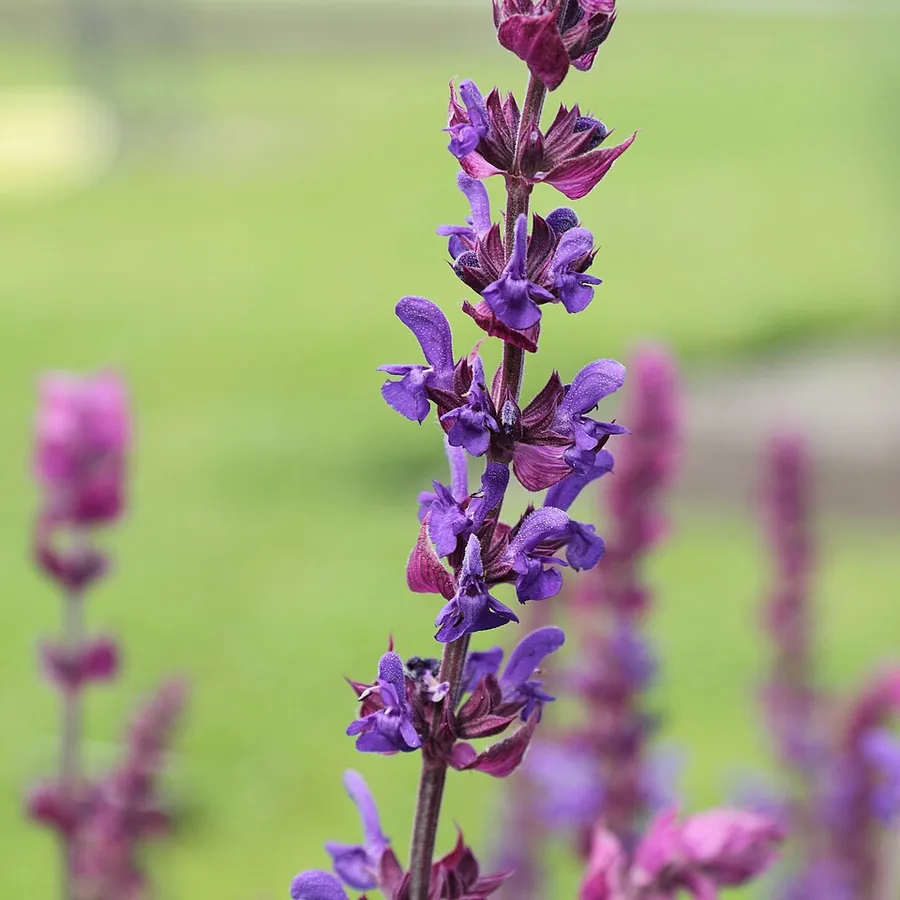
From a low leafy clump, woodland sage lifts dense spikes of violet-blue flowers through summer and into fall.
Full sun
Every 7–14 days
USDA 4–8
2–3 ft · 0.5–0.9 m
Overview
Woodland sage grows as a low, leafy clump that sends up slender flowering stems in early summer, each one crowded with small violet-blue flowers packed tightly along its length. The individual blooms are tubular, and bees and hummingbirds push into them for nectar over many weeks. As the spikes fade and are cut, fresh ones rise to take their place.
Down at the base sits a mound of aromatic foliage that gives off a sharp, pungent scent when brushed or crushed. That same pungency is what turns deer and rabbits away. The clump holds its leaves low and dense, throwing its color upward on the flower spikes rather than in the leaves.
For all its ornamental looks, this is Salvia nemorosa, the plain garden species, and not the psychoactive Salvia divinorum of the headlines. The two look nothing alike beyond a shared genus and name. This one is a harmless border plant, its violet spikes and scented leaves its only real signatures.
Care
The short version: the plant is a low clump of pungent leaves topped by violet-blue flower spikes, and it wants full sun, lean and well-drained soil, sparing water once established, and a shear after the first bloom to push out fresh spikes.
Light
Woodland sage wants full sun, six hours a day or more, and in it the stems stay short and the flower spikes stand upright and dense. Given only a little afternoon shade it copes, but in deeper shade the stems grow long and thin, the spikes carry fewer flowers, and the clump falls open at the middle.
Water
A young plant needs watering until it roots, then very little. Established, it is drought-tolerant and likes the soil to dry between waterings, about every 7 to 14 days. Left standing in wet ground, the roots rot and fungal disease marks the leaves and stems.
Soil
The roots want lean, well-drained soil with a gritty feel. A slightly acidic to neutral pH of 6.0 to 7.0 suits them, and sandy or gravelly ground drains away from the crown where dense, heavy soil would hold water against it.
Temperature
The crown survives cold to about -29°F (-34°C) and the plant carries on through heat to 90°F (32°C). That hardiness is what lets it live outdoors across zones 4 through 8, dying back and returning each year.
Humidity
Ordinary outdoor air suits the leaves, so no humidity reading applies. Moving air over the foliage matters far more, since still, damp air pooled among crowded stems is what lays a powdery film across the leaves.
Feeding
Grown lean, the plant stays compact and its stems stiff. In decent soil with a little compost it needs almost no fertilizer, and a heavy feed pushes soft, floppy stems and disease-prone growth that sprawls.
Pruning
As each spike sets, cut the spent flower stems back down to the low basal leaves, and new spikes rise to bloom again. The old stems are left standing brown over winter to shield the crown, then cut away in early spring once fresh green shoots show at the base.
Repotting
The clump seldom needs lifting, but watch for fewer spikes, a center that dies out and goes bare, or stems packed tight together. When the middle hollows, divide the clump in early spring and replant the strong outer pieces.
Size & spacing
A mature clump stands 1.5 to 3 feet (46 to 91 cm) tall in flower and spreads 6 to 24 inches (15 to 61 cm) across at the base. Leave open ground between clumps so air passes through the stems and no film settles on the leaves.
When to plant
Woodland sage dies back to its low crown each winter and pushes up fresh green growth in spring. Seed goes in indoors in late winter and young plants out in spring after frost, and the violet-blue spikes stand from June to September, with new ones rising into fall wherever the old are cut.
Northern hemisphere
Southern hemisphere
Typical months for a temperate climate: start earlier in warm zones, later where spring frosts linger.
- Sow: About 12 weeks before planting time
- Plant: Spring after last frost
- Harvest: June to September, repeating into fall with deadheading
Hardiness
USDA hardiness zones: 4–8
Temperature: down to -34°C
Troubleshooting
Look closely and salvia's troubles show up on the plant itself: a dusty film on the leaves, a clump splaying open, or stems gone limp. Nearly all of it traces to too much water, too little sun, or crowding. The symptoms below describe what you will see and how to set the conditions right.
Every stem going limp and the plant sinking to the ground
A whole clump wilting and sinking in hot, humid weather points to Southern bacterial wilt or Southern blight, sometimes a slick rot at the stem base or roots in soggy ground, occasionally with white fungal threads at the soil line. There is no bringing it back, so the plant is dug up and destroyed rather than composted. Sharp drainage, full sun, and sparing water keep the rest standing.
Fix:
- Remove and destroy affected plants
- Improve soil drainage
- Avoid overwatering and overhead irrigation
A fine white powder dusting the leaf surfaces
The pale, chalky bloom on the leaves is powdery mildew, which forms where damp air hangs still among crowded stems. Thinning and dividing opens the clump to moving air, watering at the base leaves the surfaces dry, and the worst-dusted leaves are pulled off. In full sun with sharp drainage the leaves stay clean.
Fix:
- Improve air circulation by thinning and dividing clumps
- Avoid overhead watering
- Remove and discard affected foliage
Stems leaning out and the clump splitting open at the center
When the stems soften and lean until the clump splits open, that flopping comes from rich soil, shade, or heavy feeding pushing weak, overlong growth. Cutting the spent stems back to the basal leaves brings a shorter, stiffer set of spikes. Grown lean in full sun, the stems stand straight without support.
Fix:
- Cut back spent stems to basal leaves to promote compact rebloom
- Grow in full sun and lean, well-drained soil
- Avoid over-fertilizing
Toxicity
There is nothing on this plant to fear up close: the leaves and violet spikes of garden salvia are non-toxic to pets and people alike. The ASPCA lists sage as safe for cats, dogs, and horses, and the bitter, aromatic foliage keeps most animals from sampling it. This is the garden species, not the unrelated psychoactive one.
Safe for
People · Cats · Dogs · Horses · Rabbits · Livestock · Birds
Cats None
Nothing on the plant harms cats. The strong, minty smell that rises off the leaves usually keeps a curious cat from touching them.
Dogs None
The plant holds no toxin dangerous to dogs. A dog that bites off a leaf might feel briefly queasy from the amount, nothing more.
Horses None
Sage is listed as non-toxic to horses, so a stand of salvia beside a paddock or grazing area does no harm.
Rabbits Safe
Rabbits take no harm from it and mostly leave it be. The scented, pungent leaves are the reason it is sold as rabbit-resistant.
Livestock Safe
Cattle, goats, and sheep are unharmed by it. The sharp-smelling leaves taste bad, so grazing animals seldom bite the foliage even where it grows within reach.
Birds Safe
Birds face no risk from the plant. The small tubular flowers instead draw hummingbirds and other pollinators in to the nectar.
People Safe
The leaves and flowers are safe to touch and to grow around children. This is the ornamental garden salvia, not the psychoactive Salvia divinorum, a wholly separate species.
Aromatic foliage is generally unpalatable; not a known toxicity hazard. Distinct from the psychoactive Salvia divinorum.
Varieties
The named salvias differ mostly in the color of their spikes and stems and in how tall they stand. Most are selections and hybrids of Salvia nemorosa, and a few recognizable ones show up again and again.
Caradonna
Caradonna is unmistakable for its near-black, dark purple stems that hold bright violet-blue flower spikes up to about 30 inches.
May Night (Mainacht)
May Night, a compact form named Perennial Plant of the Year in 1997, is thick with deep violet-blue flowers.
Ostfriesland (East Friesland)
Ostfriesland stays low and compact at around 18 inches, its spikes a deep, saturated purple.
Companions
Woodland sage pairs best with other sun-loving, drought-tolerant perennials that want the same lean, well-drained soil, filling out a pollinator or cottage border alongside them.
Plant near
Coreopsis: Shares full-sun, well-drained, drought-tolerant conditions in perennial and pollinator borders
Echinacea (coneflower): Similar sun and soil needs; complements salvia in butterfly and cottage gardens
How to propagate
Salvia is easy to multiply, and how the new plants look depends on whether you grow the plain species or a named cultivar.
DivisionEasy
Early spring when new growth begins · One growing season
A clump pulls apart into several rooted pieces. Lift it in early spring as the new shoots break at the base, tease it into sections, and each one roots down and grows to full size across a single growing season.
Stem cuttingsModerate
Late spring to summer · Several weeks to root
Softwood cuttings taken from non-flowering shoots in late spring or summer will root as well. Strip the lower leaves from a healthy shoot, press it into moist mix, and pale new roots form over the following several weeks.
SeedModerate
Sow indoors about 12 weeks before planting time · One growing season to flowering
Seed sown indoors about 12 weeks before planting time grows into flowering plants within their first season. The named cultivars like Caradonna do not come true from seed, their dark stems and rich color not passing reliably to the seedlings, so they are divided or grown from cuttings instead.
Myths
Garden salvia is the same as the hallucinogenic salvia that is a controlled substance.
The violet-spiked plant in the border is Salvia nemorosa, an ordinary perennial with no psychoactive effect. The plant people mean is a separate species, Salvia divinorum from Oaxaca, Mexico, and its compound salvinorin A acts on the brain's kappa-opioid receptors. Beyond a shared genus name, the two have nothing in common.