Ornamental · Lamiaceae
Salvia (Annual)
Salvia splendens
Upright spikes crowded with tubular, fire-red florets rise over compact scarlet sage from summer to frost.
Full sun
Every 3–7 days
50–90°F · 10–32°C
USDA 10–11
Overview
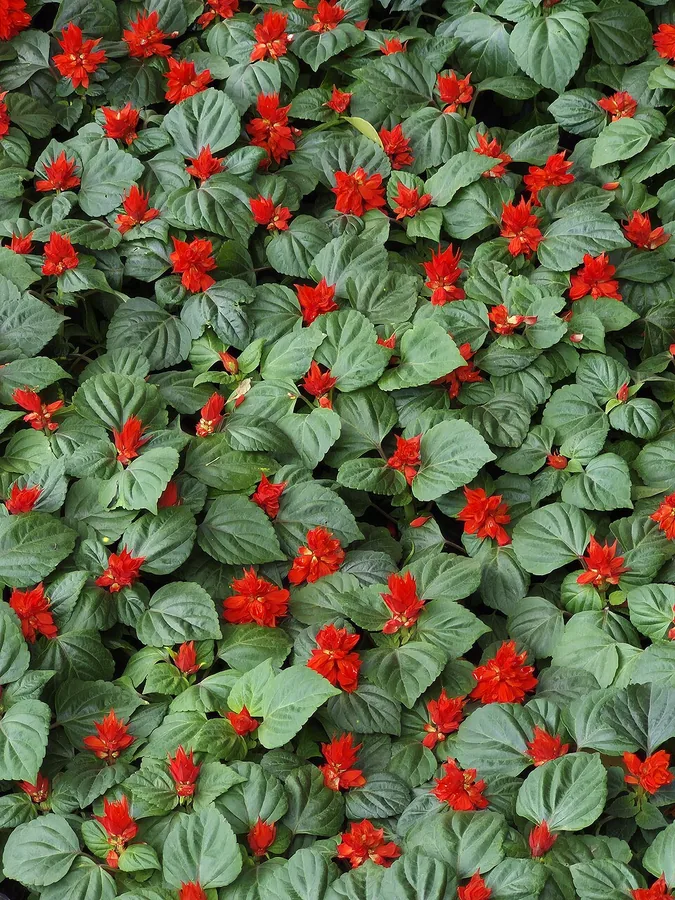
Up close, scarlet sage announces itself with upright flower spikes in a hot, fire-red that sit above the foliage. Each spike is packed with slender, tubular florets ranged along its length, the signature look of this mint-family plant. It grows as a tender perennial, hardy only in zones 10 and 11, and stands in gardens elsewhere as a warm-season annual renewed each spring.
The color holds from early summer until frost, spike after spike opening in the same saturated red. Those narrow tubes are built for the tongues of hummingbirds and bees, which probe them one by one. The whole plant stays low and dense, from 8 to 36 inches (20 to 91 cm) tall depending on the variety, a compact mound topped by its vertical flower stems.
The flowers do not vanish all at once; a spent spike fades at the tip while fresh ones push up below it. Snapping off those faded spikes clears the way for the next flush of red. Given sun, warmth, and steady moisture, the plant keeps renewing that upright, tubular display right through the season.
Care
The short version: full sun to a little afternoon shade, soil held evenly moist and never dry, a slow-release feed at planting, and steady removal of the browning spikes so fresh red keeps rising.
Light
The reddest, most crowded spikes form in full sun, with a little afternoon shade tolerated where summers scorch. Starved of light, the stems draw up thin and leaning and carry far fewer flowers, so the plant looks its fullest in the open.
Water
This salvia wants its soil evenly moist and shows drought quickly, since it is not built to go dry. Water once the top inch begins to dry, and more often for potted plants and in heat. Let it parch and the spikes thin and wilt before the leaves do.
Soil
Roots run best through a well-drained loam rich in organic matter, though average ground serves too. The plant is unbothered by soil acidity across a pH of 6.0 to 8.0.
Temperature
Warmth of 50°F to 90°F (10°C to 32°C) keeps the plant firm and flowering, while frost collapses the soft tissue outright. Set it out only after soil and air have warmed.
Humidity
Plain outdoor air is enough, and no humidity figure applies. Moving air across the leaves counts for more, because a still, crowded canopy is where the dusty film of powdery mildew settles.
Feeding
A slow-release fertilizer for annuals mixed in at planting, plus a light feed later, keeps the spikes coming. Too rich a diet swells the growth soft and floppy instead of firm and upright.
Pruning
Pinching off the faded spikes through summer keeps new red stems rising in their place. A plant gone leggy and open after a flush tightens into a denser mound once sheared back.
Size & spacing
Grown out, the plants stand 8 to 36 inches (20 to 91 cm) tall and fill 8 to 18 inch (20 to 46 cm) across, a low, rounded shape under upright spikes. Spacing to that width lets air slip between the leaves and keeps the mildew film off.
When to plant
Salvia is frost-tender, so its upright spikes belong to the warm months. Seed is started indoors in late winter to early spring, the seedlings go out only once frost has passed and the soil warms, and the red flower stems then climb from early summer until the cold ends them. The show tracks the warmth, not the calendar.
Northern hemisphere
Southern hemisphere
Typical months for a temperate climate: start earlier in warm zones, later where spring frosts linger.
- Sow: 6 to 8 weeks before the last spring frost; do not cover seed as light aids germination
- Plant: After the last frost when soil and air have warmed
- Harvest: Summer to frost (roughly June until first fall frost)
Hardiness
USDA hardiness zones: 10–11
Temperature: down to -1°C
Troubleshooting
Trouble usually shows on the plant itself, in a toppled seedling, a dusty leaf, or a twisted shoot. Read those physical signs early and the fix is usually quick. Match what you see below to the cause and act while it helps.
Thin seedling stems pinch through and topple
The seedlings fall because of damping-off, a soilborne fungus that thrives in cold, wet mix and leaves the stems thin, water-soaked, and pinched right at the surface. Clear the toppled ones, give the mix time to dry between soakings, and move more air over the tray. A fresh sowing in sterile mix and clean pots, kept warm, comes up clean.
Fix:
- Discard affected seedlings
- Improve air circulation and let the surface dry between waterings
- Use sterile mix and clean containers for resowing
Wilting stems and a rotting, thread-webbed base
A plant that droops while its soil stays wet, its base decaying and sometimes laced with white fungal threads, has southern blight or southern bacterial wilt, both at home in hot, waterlogged ground. Nothing revives it, so pull and destroy the plant. Sharper drainage and a different annual in that ground next year keep it from returning.
Fix:
- Remove and destroy affected plants
- Improve drainage
- Avoid replanting susceptible annuals in the same spot
A dusty white film dulling the leaves
That powder is powdery mildew, a fungus that coats the leaves in dusty white patches, often with yellowing beneath, wherever crowding and dead air let it settle. Open the spacing, strip the worst-coated leaves, and keep water off the foliage late in the day. Full sun and moving air clear the film and hold it off.
Fix:
- Increase spacing and airflow
- Remove badly affected foliage
- Avoid overhead watering late in the day
Twisted shoots, a sticky glaze, and specks of insects
New growth curls and turns sticky where aphids, whiteflies, or spider mites work it over, sometimes veiled in fine webbing or clouded with tiny white flies. A hard jet of water strips the colonies, and insecticidal soap finishes the rest. Even watering and a few beneficial insects keep the next generation thin.
Fix:
- Rinse plants with a strong spray of water
- Apply insecticidal soap to affected areas
- Encourage beneficial insects
Toxicity
For all its fiery look, scarlet sage carries nothing harmful: it is non-toxic. The ASPCA lists it safe for cats and dogs, and no part of the plant, leaf, stem, or bloom, poses a threat to other animals, livestock, or people. It can be grown within reach of the whole household.
Safe for
People · Cats · Dogs · Horses · Rabbits · Livestock · Birds
Cats None
Scarlet sage sits on the ASPCA's non-toxic list for cats, so a bitten leaf or chewed spike does no harm. A cat that eats a lot of any plant may bring it back up, but no poison is at work.
Dogs None
For dogs the plant is likewise non-toxic by the ASPCA's listing. A dog that chews through a mouthful of leaves may get a brief stomach upset, as with any greenery, but nothing toxic.
Horses Safe
Nothing in the leaves, stems, or flowers is poisonous to horses, and the plant is no grazing hazard in a border or pasture.
Rabbits Safe
Rabbits can strip the soft leaves and flowers without harm. Bring any new green in slowly so the gut adjusts.
Livestock Safe
Cattle, goats, and sheep take no toxic harm from grazing the foliage of this salvia.
Birds Safe
No part of the plant harms birds, and pollinators crowd the open florets. Backyard fowl can pick at it without trouble.
People Safe
Scarlet sage is not poisonous to people; the plant is grown for its red spikes, not for eating. A child who handles the leaves or tastes a flower is in no danger.
Varieties
The named salvias differ most in the color and height of their spikes. A few turn up again and again, and these are the ones worth picturing.
Bonfire
Bonfire raises even, scarlet spikes on a straight, upright plant of about 26 inches.
Salsa Series
The Salsa Series is a low, compact plant of 12 to 14 inches carrying scarlet or mixed-color spikes that keep their look through Southeast heat.
Vista Group
The Vista Group is a small, dwarf plant whose early spikes come in a broad range of colors.
Salvia farinacea (mealycup sage)
Salvia farinacea, mealycup sage, lifts slim spikes of blue, violet, or white over 1 to 2 foot clumps and is often grown as an annual.
How to propagate
More of these red spikes come easily, either raised fresh from seed or struck from cuttings taken off a favorite plant.
SeedModerate
Start indoors 6 to 8 weeks before the last frost; surface sow because light aids germination · Several weeks to germinate and grow on before transplanting after frost
Seed starts the plants off, sown indoors 6 to 8 weeks before the last frost and left bare on the surface, since the seed needs light to break dormancy. Held warm and bright, it takes several weeks to sprout and thicken into seedlings ready to set out after frost.
Stem cuttingsModerate
Take softwood cuttings in late summer to overwinter plants indoors · A few weeks to root
Cuttings carry a plant's exact spike color through winter. Softwood cuttings taken in late summer root within a few weeks into small plants that hold in a bright, cool spot until spring.
Myths
The fire-red scarlet sage is the same plant as the psychoactive Salvia divinorum.
They look nothing alike and share only the genus. The ornamental annuals, Salvia splendens with its red spikes and Salvia farinacea with blue ones, are grown for their flowers alone and carry none of the effects tied to Salvia divinorum.
Salvia takes drought in stride and can be left dry once established.
Annual scarlet sage is not drought tolerant, and it wears its thirst plainly. Its spikes stand fullest in warm, well-drained soil kept evenly moist; let the root zone dry and the red bloom thins and fades fast.