Ornamental · Lamiaceae
Lamb's Ear
Stachys byzantina
Thick, soft silver leaves furred like felt, spreading low across the ground on creeping stems.
Full sun
USDA 4–8
6–18 in · 15–46 cm
Overview
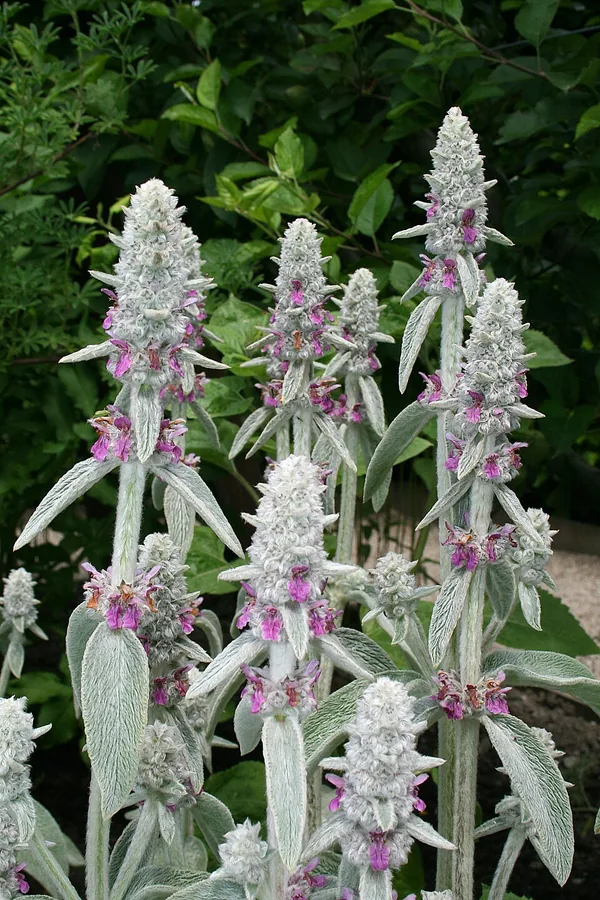
Lamb's ear is a plant you know first by its leaves. Each one is thick and slightly cupped, drawn out into the long oval that gives the plant its name, and wrapped in a dense coat of fine silver-white hairs that catch the light and blur the outline of the leaf. Run a finger across it and the surface gives like felt, cool and plush, with the pale hairs laid in a soft nap over a green blade beneath.
The leaves crowd into low rosettes that ride on creeping stems, and those stems run flat along the ground and root where they touch, packing rosette against rosette into a low silvery mat. Seen from above the whole planting reads as a rippling sheet of grey-silver, the fur on every leaf softening one clump into the next.
When it flowers, tall stalks push up above the felted leaves and carry small purplish-pink blooms in spikes from May to July, the stems themselves woolly to the tip. Many gardeners cut these stalks away to keep the eye on the silver foliage, though the little flowers draw bees when left to open.
Care
The short version: full sun, dry and very well-drained soil, and a light hand with water. Feed it rarely, water at the base rather than over the furred leaves, and divide the silver mat every few years to keep it fresh.
Light
In full sun the leaves grow thickest and their silver hairs pack densest, so the whole clump reads brightest. It takes partial shade too, a help in hot-summer regions where afternoon cover eases the heat, but in dim light the rosettes stretch thin and floppy and the silver dulls.
Water
Once its stems have rooted in, the plant is drought tolerant and wants the soil to dry between drinks. Send water to the base and keep it out of the fur, because moisture caught in the woolly leaf turns fast to leaf rot and disease through a humid summer.
Soil
It roots into average, dry to medium soil that drains fast, even loose sandy or rocky ground. It grows across a pH of 6.0 to 8.0 without complaint, but the felted leaves depend on sharp drainage to stay firm and silver rather than soft and brown.
Humidity
There is no humidity target, yet muggy summers are this plant's main enemy, because damp, still air settles into the nap of the leaves. That trapped moisture is what turns the silver felt to rot, so an open clump that lets air comb through the fur stays healthiest.
Feeding
Feed it rarely, if at all. Rich ground pushes soft, floppy leaves that splay open, lose their tight silver nap, and rot, so skip the heavy fertilizer and give it no more than a thin spring topdressing of compost.
Pruning
Grown for the silver foliage, its woolly flower stalks come off before or as they rise. Each spring, shear away the matted, dead, or browned leaves so fresh, bright rosettes can push up clean through the mat.
Size & spacing
The furred rosettes stay low, 6 to 18 inches (15 to 46 cm) tall, while each clump creeps 12 to 18 inches (30 to 46 cm) wide on its rooting stems. Set them about that far apart and the silver mats close the gaps into one continuous carpet.
When to plant
Lamb's ear is a hardy perennial that returns on its own, so the timing is about getting the silver rosettes established rather than chasing a harvest. Start seed indoors in late winter or set divisions out in spring once the frost has passed. The woolly purplish-pink spikes push up from May to July, though many gardeners shear them off to keep the low felted leaves in view.
Northern hemisphere
Southern hemisphere
Typical months for a temperate climate: start earlier in warm zones, later where spring frosts linger.
- Sow: Late winter, about 8 to 10 weeks before the last frost, if growing from seed.
- Plant: Spring after the last frost; space plants 12 to 18 inches apart for groundcover.
- Harvest: Purplish-pink flower spikes from May to July, though many gardeners remove them.
Hardiness
USDA hardiness zones: 4–8
Temperature: down to -34°C
Troubleshooting
Almost every problem with lamb's ear starts in the fur, where moisture lodges in the dense hairs and cannot dry. Learn to read the silver felt for the first dark, slumping patches of rot on the leaves and crown, and you can act before a damp spell melts the whole clump. Match what you see below, then move quickly.
Silver rosettes slumping flat over a mushy crown
Crown and root rot flattens the whole rosette, and it grows from soil left sodden around the base. The giveaway is a plant whose silver leaves droop and slump even while the ground reads plainly wet, because the softened roots can no longer pull water up the stem. Dig out the mushy crowns and discard them, tuck firm divisions into fast-draining soil, and pull back on the watering.
Fix:
- Dig and discard severely affected crowns
- Replant healthy divisions in well-drained soil
- Reduce watering
Silver leaves darkening to brown mush at the clump's core
The silver felt goes slack and brown here, the mark of leaf rot. It takes hold when moisture lingers in the woolly nap through humid weather or heavy rain, because those dense hairs press a film of water flat against the leaf, right where fungus wants it. Pull the blackened, slumping leaves, thin the clump so air threads through the mat, and send water to the base alone.
Fix:
- Remove and discard affected leaves
- Improve air circulation by thinning and dividing
- Water only at the base of the plant
A woody, hollow center rimmed with fresh silver rosettes
This bare heart is just an aging clump, not a disease. As the silver mat rolls outward year after year, the oldest center thins to woody, leafless stubs while a ring of plump new rosettes crowds the rim. Lift the whole mat, replant the firm outer pieces, and toss the woody middle.
Fix:
- Lift and divide the clump
- Replant vigorous outer sections
- Discard the old center
Toxicity
For homes with pets and children, lamb's ear is non-toxic across the board. Nothing in the soft, silver-furred plant threatens cats, dogs, horses, rabbits, livestock, birds, or people, and those plush leaves are the whole draw rather than any hazard. At worst, a pet that gulps a big mouthful of the woolly foliage might feel a brief, mild stomach upset.
Safe for
People · Cats · Dogs · Horses · Rabbits · Livestock · Birds
Cats None
Safe for cats. A cat that mouths the velvety, silver-haired leaves comes to no harm, and the woolly nap on the tongue rarely tempts a second bite.
Dogs None
Not poisonous to dogs. Beyond a brief, mild stomach upset from bolting a big mouthful of any greenery, the soft leaves pose no danger.
Horses Safe
Not toxic to horses. The thick, hairy leaves feel like felt on the muzzle and hold little grazing appeal, so they are left standing in the pasture.
Rabbits Safe
Safe for rabbits. A nibble at the fuzzy foliage does no harm, and the dense hair on each leaf turns most of them away.
Livestock Safe
Cattle, goats, and sheep graze nearby without harm. The plant carries no toxin, and the felted, silver leaves make unappealing forage.
Birds Safe
No threat to birds. Some strip the soft silver fibers from the leaves and weave them into the lining of their nests.
People Safe
Harmless to people, children included. The plush, cushiony leaves have a long folk history as a soothing cover for small scrapes, a tradition rather than medicine.
Varieties
A few named selections shift the look of the silver leaves and flowers, from oversized blades to strictly foliage mats. These are the ones worth knowing.
Big Ears (Helene von Stein)
Its broad silver leaves stretch up to a foot long, it holds up to heat and humidity better than the species, and it rarely throws a flower spike, which makes it the pick for warm, muggy gardens.
Silver Carpet
A low, non-flowering selection grown for one thing alone, a dense mat of tightly packed silver leaves.
Primrose Heron
Its woolly leaves unfurl a bright chartreuse-yellow in spring, then deepen to silvery green as the season warms.
Cotton Boll (Sheila Macqueen)
Its flower stems trade the usual spikes for odd, puffy cottony balls clustered along the stalk.
How to propagate
Lamb's ear is one of the easiest perennials to multiply, whether you split an established silver mat or start a fresh batch of seedlings.
DivisionEasy
Spring or fall · A few weeks for rooted divisions to take hold
Division is the simplest route, and spring or fall is the moment for it. The low stems root as they creep across the soil, so the shallow outer rosettes lift away with pale roots already dangling beneath them. Replant those firm, silver pieces and they knit in within a few weeks.
SeedEasy
Start indoors in late winter or sow outdoors in spring · One season to form a usable groundcover mat
Seed works as well, started indoors in late winter or sown straight outside in spring, and a single season packs the small seedlings into a usable groundcover mat of overlapping silver leaves. The plain species comes true this way, but many named cultivars do not, so take divisions for an exact copy.
Myths
Lamb's ear is poisonous to cats and dogs.
It sits nowhere on the ASPCA toxic plant lists and is treated as non-toxic to both cats and dogs. A curious pet can sniff or nibble the soft leaves in safety, and only a big helping of any plant tends to bring a passing stomach upset.
Lamb's ear needs frequent watering to keep its soft leaves looking good.
Once settled, the plant is drought tolerant and resents a heavy hand with the hose. Water caught in the woolly nap of the leaves is exactly what breeds rot and leaf disease, so a dry stretch keeps the silver felt cleaner than a wet one.