Ornamental · Lamiaceae
Russian Sage
Perovskia atriplicifolia
Set in full sun and dry, sharp-draining soil, Russian sage lifts silvery stems into a shimmering haze of small blue flowers from midsummer to fall.
Full sun
Every 10–21 days
USDA 4–9
2–4 ft · 0.6–1.2 m
Overview
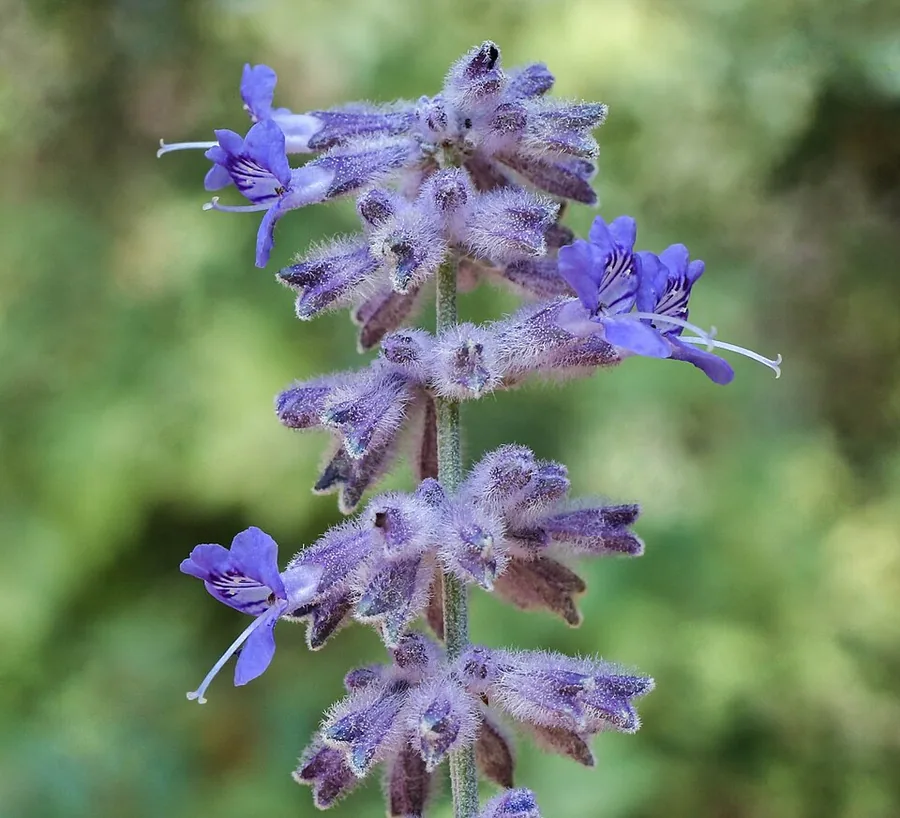
Up close, Russian sage is a study in silver and blue. Slim, pale silvery stems rise in a loose, branching clump, and along their upper reaches sit airy sprays of tiny blue flowers, each one small on its own but massed into a soft, smoky cloud. Brush the foliage and it gives off a sharp, sage-like scent. The plant is no relation to culinary sage, though, and carries its central Asian origin in its wiry frame and finely cut leaves.
The color is the thing that stops you. The flowers open in a cool blue that drifts toward violet, held so loosely on their branching spikes that the whole plant reads as a see-through veil rather than a solid block of bloom. Behind them the silvery stems stay pale and upright, and the small leaves keep a fine, almost feathery texture. Together they give the plant its signature hazy, blue-lavender shimmer.
Every part of it leans toward the slender and airy. The stems are narrow and firm, the leaves are cut into fine segments that catch the light, and the flowers scatter along the tips in small, well-spaced whorls. Grown well, on lean, sunny ground and cut hard each spring, it holds those pale stems bolt upright and carries a fine mist of blue across their length for months.
Care
The short version: those silvery stems and blue flowers depend on full sun and sharp drainage first. Keep the soil lean and dry once the plant is established, skip the fertilizer, and cut every stem back almost to the ground in late winter so fresh, upright growth can rise.
Light
Full sun is what keeps those pale stems standing straight and studded with small blue flowers. In part shade the stems lengthen, soften, and lean apart, and the flowering scatters and thins. The more sun the plant catches, the tighter and more upright its silvery frame stays.
Water
Once its roots run deep, Russian sage is one of the most drought-tolerant perennials around, and the dry-country look shows in its wiry stems and fine foliage. Water it through the first season to establish those roots, then let the soil dry between waterings. Wet ground softens and rots it far faster than dry ground ever will.
Soil
Sharp drainage is what keeps the plant firm and silver rather than soft and failing. It grows on poor, dry, clay, and alkaline ground across a wide pH of 6.0 to 8.0, the lean conditions that suit its slender build. Wet, heavy soil is the one thing that rots the roots out from under it.
Temperature
The plant is hardy well beyond its delicate look, taking winter cold down to -29°F (-34°C) and summer heat up to 100°F (38°C) on those thin silvery stems. That range is what carries it through zones 4 to 9.
Humidity
Dry air suits its fine, aromatic foliage, in keeping with the hot, open country it comes from. Damp, still air troubles it more than dry air, so open space and moving air keep the small leaves clean and the stems firm.
Feeding
Lean ground is what gives the plant its taut, upright form, so little or no fertilizer is the rule, a light spring feed at most. Overfeed it and the stems grow tall, soft, and floppy, losing the fine, wiry character that makes it worth looking at.
Pruning
Each spring the whole plant is cut back almost to the ground in late winter or early spring, once new growth shows at the base. From that hard cut rise fresh, straight silvery stems, and those new shoots are the ones that carry the blue flowers and hold themselves upright through the season.
Repotting
It rarely needs repotting and prefers to stay put, its woody base thickening in place over the years. In a container, roots circling the pot or water sliding straight through without soaking in are the visible signs it has outgrown its space.
Size & spacing
A mature clump of silvery stems reaches 2 to 4 feet (60 to 120 cm) tall and fans out about as wide, 2 to 4 feet (60 to 120 cm). Spaced that far apart, the airy stems have room to arch and stand without tangling, and the light passes through the whole see-through mass.
When to plant
Russian sage is hardy through zones 4 to 9 and is slow to green up in spring, the bare silvery stems standing a while before new leaves break. Set young plants out after the last frost and cut the old stems back as the fresh shoots appear, and the small blue flowers open from July and hold their haze through October.
Northern hemisphere
Southern hemisphere
Typical months for a temperate climate: start earlier in warm zones, later where spring frosts linger.
- Sow: late winter to early spring; seed germinates in 1-4 months at 60-65 degrees F
- Plant: spring after last frost
- Harvest: July to October
Hardiness
USDA hardiness zones: 4–9
Temperature: down to -34°C
Troubleshooting
Russian sage rarely runs into trouble, and the two problems that show up are easy to see in the plant itself: stems that lean and flowers that fade over soft roots. Both trace back to too much water or soil that is too rich, and both are read in how the plant looks.
Wilting stems above soft, browning roots
When the silvery stems droop and dull even in wet soil, the trouble is root rot below, the roots gone brown and soft in soggy, poorly drained ground. That standing wet lets pythium and phytophthora take hold at the base. Lift the plant to a raised, sharply drained spot, cut the water right back, and clear away any crown too far rotted to firm up again.
Fix:
- Improve drainage or move to a raised, sharply drained site
- Reduce irrigation and let soil dry between waterings
- Remove and discard severely rotted plants
Silvery stems lean out and gap at the center
The familiar flop shows in stems that lengthen, soften, and splay outward, leaving a bare gap where the clump opens up. It comes from too much shade or rich, damp soil that draws out weak, leggy growth, and uncut plants fall open the same way once the flowers fade. Full sun on lean, dry ground, less water and feed, and a hard spring cut bring the upright silvery frame back.
Fix:
- Cut stems back almost to the ground in late winter to early spring
- Move or site in full sun with lean, well-drained soil
- Reduce watering and fertilizer
Toxicity
For all its pungent, aromatic foliage, Russian sage is harmless to touch and taste. The ASPCA lists it as non-toxic, so a curious cat, dog, or child that brushes the silvery stems or bites a leaf gets nothing worse than a strong, resinous flavor. The one thing to remember is that this is an ornamental, not a kitchen herb.
Safe for
People · Cats · Dogs · Horses · Rabbits · Livestock · Birds
Cats None
Safe for cats. The ASPCA lists it as non-toxic, so a curious bite of the fine, aromatic leaves does no harm.
Dogs None
No toxicity to dogs is on record. The sharp, resinous scent of a chewed stem usually puts a dog off, but it comes away unharmed.
Horses Safe
Horses can graze nearby without risk. Nothing in the plant is poisonous, and the bitter, aromatic foliage tends to keep them cropping other plants instead.
Rabbits Safe
Rabbits mostly pass over the pungent silver stems, which is a bonus rather than a hazard. The strong-scented leaves are entirely safe, if rarely tempting.
Livestock Safe
Cattle, goats, and sheep take no harm from it. The plant holds no known toxins, and the sharp aroma of its foliage usually turns grazers away.
Birds Safe
Birds are safe around it. The small blue flowers draw pollinators through summer, and no part of the plant is harmful to a visitor.
People Safe
Safe to handle, with only the strong scent left on your fingers after brushing the leaves. It is not a culinary sage despite the name, so it should not be eaten.
Aromatic foliage; despite the common name it is not a true culinary sage and should not be eaten.
Varieties
The named selections differ mostly in height and in how finely the foliage is cut, from compact and neat to tall and feathery. These are the ones seen most often.
Little Spire
Little Spire is compact and tight at about 18 to 24 inches (2 feet), its silvery stems held more upright so the small clump stays neat instead of splaying.
Blue Spire
Blue Spire rises near 3 feet, carrying deeply cut leaves and large, loose panicles packed with small violet-blue flowers.
Longin
Longin is tall and narrow at about 4 feet in both height and width, its stems notably stiff and bolt upright.
Filigran
Filigran reaches 2 to 3 feet and is the most delicate to look at, its foliage cut into fine, lacy segments along an upright frame.
How to propagate
Russian sage can be raised from cuttings or seed, and the choice comes down to whether an exact copy of a named plant is wanted. Cuttings hold a cultivar's look true, while seed brings variation.
Stem cuttingsModerate
Summer · Several weeks to a few months
Cuttings are the way to copy a named cultivar exactly, since seedlings will not come true. Softwood cuttings of 3 to 4 inches, snipped in summer, root over several weeks to a few months into new plants that match the parent stem for stem.
SeedModerate
Any time of year, just covering the seed · Germinates in 1-4 months at 60-65 degrees F
Seed can be scattered at almost any time under the thinnest cover, though it is slow, since germination takes 1 to 4 months at 60°F to 65°F (16°C to 18°C). A cold spell first can lift the strike rate, and because the species varies, seed-raised plants differ in height and in how finely their leaves are cut.
DivisionDemanding
Spring · Slow
Division is the hardest and least useful method. The woody base resents being split, is slow to knit back together in spring, and seldom needs dividing, so cuttings or seed are the surer ways to more silvery stems.
Myths
The strong, sage-like scent of Russian sage means you can cook with it like garden sage.
The smell fools the nose, but this is Perovskia, now reclassified as Salvia yangii, and it is grown for its silvery, flowering stems alone. Crushed leaves release a sharp sage-like aroma with no flavor fit for food. It is neither Russian nor a true sage, but a native of central Asia.