Ornamental · Asteraceae
Purple Coneflower
Echinacea purpurea
In full sun and lean, well-drained soil, rosy-purple petals and a bristly cone open from early summer into fall.
Full sun
Every 7–14 days
USDA 3–8
2–4 ft · 0.6–1.2 m
Overview
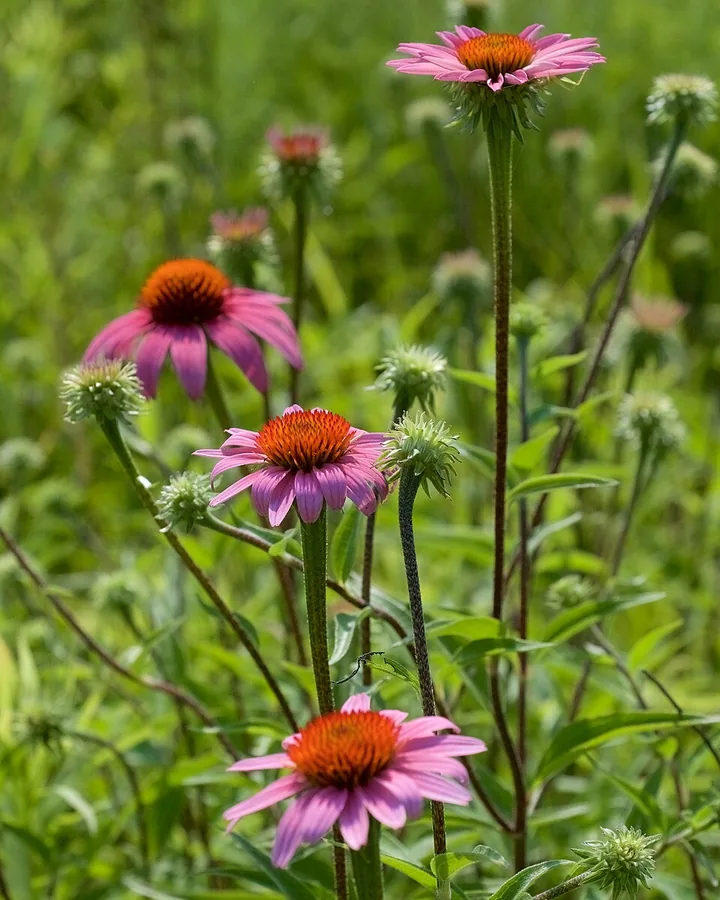
Purple coneflower is a tough, sun-loving perennial in the daisy family, native to the prairies and open woods of eastern North America. Each stiff, upright stem ends in a ring of rosy-purple ray petals that splay outward from a raised, bristly central cone, and the clump sends up more of them each year. Hardy through USDA zones 3 to 8, it endures cold winters and hot, dry summers alike.
Watch one bloom and you see why it is so valued. The flowers open from early summer well into fall, their domed cones crowded with tiny florets that bees and butterflies work over all season, and the spent cones, drying to a dark bristly knob, feed finches through winter when left standing. The plant also has a long history as the herb echinacea, taken as a supplement for generations.
For all its presence, it asks very little. Coneflower needs full sun and soil that drains, then mostly fends for itself, the coarse, sandpapery leaves and deep roots carrying it through drought and poor ground that would sink fussier perennials. Give it room to breathe and it returns, fuller, for years.
Care
The short version: full sun and lean, well-drained soil bring out its best, and once established it needs water only every week or two. It takes clay, sand, and drought, asks little feeding, and each year sends up a fuller crown of stems and cones.
Light
Coneflower wants full sun, at least six hours of direct light a day, to color its petals fully and hold its stems straight and stiff. It will take partial shade, but in too much shade the stems stretch thin, the blooms thin out, and the whole plant leans.
Water
Once it has rooted in, coneflower is drought tolerant and needs water only every 7 to 14 days, preferring dry to medium moisture. Water at the base rather than over the rough leaves, since beaded moisture on the foliage opens the way to leaf disease.
Soil
It grows in average, well-drained loam and takes to clay, sand, and gritty, rocky ground without complaint. A wide pH of 6.0 to 8.0 suits it, and the one thing those thick roots will not endure is soil that stays soggy.
Humidity
Ordinary outdoor air is all it needs, so there is no humidity mark to hit. Air moving through the leaves matters more, since crowded, damp foliage is where a powdery film of mildew settles in.
Feeding
Coneflower has low feeding needs and does fine in lean soil. A light slow-release feed such as 12-6-6 in early spring is plenty, and heavier feeding only swells the stems soft and floppy at the cost of the flowers.
Pruning
Snip the spent, browning cones to neaten the plant and stretch the bloom, though fresh petals keep coming without it. Leave a few of the dark seed heads standing into winter to feed the birds and let it self-sow, and cut the stiff stems back in late fall or leave them as shelter for native bees.
Size & spacing
In bloom the stems rise to 2 to 4 feet (60 to 120 cm) tall. Set each plant 12 to 24 inches (30 to 60 cm) apart so air slips between the leaves and a mildew film cannot settle.
When to plant
Coneflower keeps to the rhythm of a northern season. Seed goes in indoors in late winter, the young plants move outdoors after the last spring frost, and the first rosy petals unfurl in early summer and keep opening into fall.
Northern hemisphere
Southern hemisphere
Typical months for a temperate climate: start earlier in warm zones, later where spring frosts linger.
- Sow: Sow indoors at 65 to 70°F about 8 to 10 weeks before last frost; germinates in 10 to 20 days.
- Plant: Transplant outdoors after the last spring frost.
- Harvest: Blooms early summer through mid-fall, peaking June through August.
Hardiness
USDA hardiness zones: 3–8
Temperature: down to -40°C
Troubleshooting
Coneflower's troubles read on the petals and the leaves first, and a healthy stand shows little of it. Learn the early marks on the foliage and flowers below and you can act before they spread through the bed.
Rosy petals gone green above a tuft-sprouting cone
Petals that come in green instead of rosy, with small leafy tufts pushing out of the cone, are the mark of aster yellows, a phytoplasma that leafhoppers carry from plant to plant. It runs through the whole plant and never clears, so once the petals green and the witches-broom tufts appear the plant is past saving. Dig it up, bag it for the trash rather than the compost, and keep leafhoppers and weedy hosts in check nearby.
Fix:
- Promptly dig up and remove infected plants
- Bag and discard them in the trash, not compost
- Control leafhoppers and weedy hosts nearby
Foliage chewed to lace in midsummer
Leaves reduced to a lacy skeleton of veins in midsummer point to Japanese beetles, their metallic green-and-bronze bodies clustered over the foliage and blooms. Pick them off into a pail of soapy water first thing in the morning while they are sluggish, and treat lighter outbreaks with insecticidal soap. Scouting early in summer lets you thin them out before they build.
Fix:
- Hand-pick beetles into soapy water in early morning
- Treat with insecticidal soap for light infestations
Contorted flower heads bunched into a rosette
Flower heads that open twisted, with the cone bunched into a rosette, are the work of eriophyid mites feeding out of sight inside the developing buds. The mites are far too small to see, so the warped, tufted blooms are the only clue. Cut off and discard the affected heads in fall to clear the mites before they overwinter.
Fix:
- Cut back and remove affected flower heads in fall
White powdery film coating the leaves
A dusty white-to-gray bloom coating the upper leaf surfaces in humid weather is powdery mildew, and it spreads fastest over leaves packed close together. Open up the spacing so air moves between them, and keep the foliage dry by watering at the base. The film looks rough on the leaves but rarely does lasting harm.
Fix:
- Improve spacing and air circulation
- Avoid overhead watering
Toxicity
Good news for a pet-friendly garden: purple coneflower is non-toxic across the board. It does not appear on the ASPCA toxic plant list, it is safe around cats, dogs, horses, and livestock, and people have taken it as the herb echinacea for generations. Plant it freely where animals roam.
Safe for
People · Cats · Dogs · Horses · Rabbits · Livestock · Birds
Cats None
Should a cat mouth one of the coarse, bristly leaves, nothing ill follows, since the ASPCA leaves purple coneflower off its toxic roster.
Dogs None
A dog may snuffle at the stiff stems or chew a leaf with no threat of poisoning.
Horses Safe
A horse cropping the leaves or the spiky flower heads meets no poison in either.
Rabbits Safe
Rabbits take no harm from the foliage or the stems, though a hungry one may crop the whole plant to a bare stub.
Livestock Safe
Cattle, sheep, and goats can crop the coarse leaves and stems with no ill effect, for coneflower bears no known toxin.
Birds Safe
Birds are welcome here, and finches in particular flock to the dried, bristly seed heads through fall and winter.
People Safe
Echinacea has served people as a herbal remedy for generations, and the coneflower itself rates as non-toxic.
Varieties
Named coneflowers vary in petal color and cone tone, from the old rosy-purple forms to bright modern mixes. The few below are the ones you will meet most.
Magnus
Magnus stands out for its large flowers, the rosy-purple petals held flat and horizontal so they ray straight out rather than drooping the way many coneflowers do.
White Swan
White Swan trades the usual purple for clean white petals encircling a warm coppery-orange cone.
Cheyenne Spirit
Cheyenne Spirit grows from seed as a single mix, one packet yielding blooms of orange, red, purple, cream, and yellow.
How to propagate
Coneflower is easy to multiply, whether you pry apart an established clump of roots and shoots or sow its bristly seed and let the plant scatter its own.
DivisionModerate
Divide clumps in spring or fall, roughly every 3 to 4 years when they become overcrowded. · One growing season to re-establish.
Lift a crowded clump in spring or fall, every 3 to 4 years or so, and split the tangled crown into pieces that each keep roots and shoots. Replant the divisions right away and they knit back in over a single growing season.
SeedEasy
Sow indoors 8 to 10 weeks before last frost or allow self-seeding in the garden. · Germinates in 10 to 20 days; typically blooms the second year from seed.
Start the small, wedge-shaped seed indoors 8 to 10 weeks before the last frost, or let the plant drop its own from the dried cones into the bed. Sprouts appear in 10 to 20 days, but the plants usually wait until their second year to flower. Leave the seed heads standing and coneflower reseeds itself with no help from you.
Myths
Coneflowers will not rebloom unless you deadhead them.
The plants push out fresh petals on their own whether or not you snip the old, browning flowers. Deadheading mainly cleans up the look, while leaving some seed heads feeds the birds and lets the plant sow itself for next year.
Nibbling coneflower can poison a pet.
Purple coneflower never appears on the ASPCA toxic plant list and is treated as non-toxic across the board. It even carries a long track record as an herbal supplement for people.