Tree · Cactaceae
Saguaro
Carnegiea gigantea
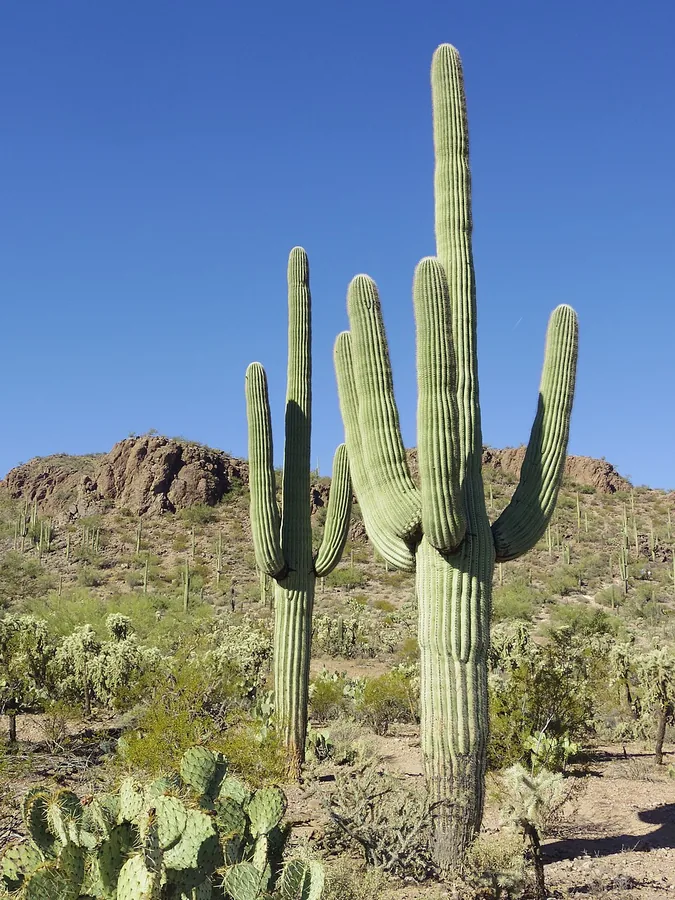
The saguaro rises as a fluted green column bristling with rigid spines, its arms curving upward into the desert giant everyone knows.
Full sun
Every 14–30 days
USDA 9–11
33–59 ft · 10–18 m
Overview
Up close, the saguaro is a massive fluted column, its surface folded into tall vertical ribs that run the height of the stem. From that single green trunk, thick arms curve outward and then bend upward, and a full-grown plant lifts them well above head height. Every rib is lined with clusters of long, rigid spines that stand out stiff from the pleats.
The ribs are more than texture. They work like the folds of an accordion, letting the whole column swell visibly fatter after rain and draw thin again through drought as the stem spends its stored water. This is a plant that changes shape with the seasons yet grows almost imperceptibly, often needing 50 to 75 years before a single arm breaks from the trunk, and some columns stay armless for life.
In late spring the saguaro opens white flowers in the dark, blooms that shut again by day. As each fades, a red fruit takes its place, a bright note of color against the green column. The rest of the year the plant reads as a plain mass of ribs and spines, unhurried and unchanging.
Care
The short version: the saguaro wants full sun, gritty fast-draining soil, and sparing water. The soil dries out completely between waterings, the plant stays nearly dry through winter, and hard frost is kept off its ribbed green stem.
Light
The saguaro wants full sun on its ribs all day. It is built for the bare, open desert and takes every hour of direct light, which keeps the green column firm and full. Young plants accept a little afternoon shade while the tissue hardens, then stand in the open sun.
Water
Water the plant deeply, then leave it dry, only once the soil has dried through completely in warm growth, which lands at roughly every 14 to 30 days. Through winter the ribbed stem stays nearly dry. An established saguaro draws instead on rainfall and the water swelling within its pleated column.
Soil
Root the saguaro in gritty, sharply draining mineral soil, coarse with rock and sand. A pH from 6.0 to 8.0 suits it. Wet soil around the roots is the one thing the plant cannot bear, and it shows first as softening at the base.
Temperature
The green column shrugs off searing heat, up to about 113°F (45°C). Cold is what marks it. A brief dip to around 23°F (-5°C) passes without lasting harm, but a hard or long freeze blackens and constricts the tissue and can open it to rot.
Humidity
The saguaro belongs in dry air, around 10% to 30%. Damp, humid conditions settle on the ribbed surface and raise the risk of rot, so the plant has no place in a steamy spot.
Feeding
The plant asks for very little feeding. A dilute, low-nitrogen cactus fertilizer through spring and summer is plenty. Too much nitrogen pushes soft, swollen growth that the rigid column cannot hold.
Pruning
Leave the ribbed column whole. It needs no routine pruning, and only a clearly damaged or diseased arm is cut away. On a mature plant a professional does the work, since the heavy arms and stiff spines make it dangerous.
Repotting
Only young potted plants are repotted, about every 2 to 4 years while the column is still small. Once the saguaro is rooted in open ground, it holds its place for life.
Size & spacing
A mature saguaro rises as a 33 to 59 feet (10 to 18 m) column, its arms reaching 2 to 11.5 feet (60 cm to 3.5 m) across. It needs wide, open ground and a permanent place, since that green ribbed form stands for generations.
When to plant
The saguaro runs on heat and cannot survive a hard freeze. Seed starts through the warm months of late spring and summer, and young plants move outdoors only after the last frost. The white night flowers appear in late spring, and the red fruit ripens through early summer.
Northern hemisphere
Southern hemisphere
Typical months for a temperate climate: start earlier in warm zones, later where spring frosts linger.
- Sow: Late spring into summer when soil is warm (21-27°C)
- Plant: Spring after all danger of frost has passed
- Harvest: Late spring to early summer (May-June); white night-opening flowers, followed by red edible fruit
Hardiness
USDA hardiness zones: 9–11
Temperature: down to -7°C
Troubleshooting
Most trouble on a saguaro reads on its surface. Too much water and hard cold are the usual causes, and both mark the green ribbed stem and the base first, where discoloration and softening show plainly. Match the look below and act before the damage runs deeper into the column.
Dark, sunken, oozing lesions on the trunk or arms
This is bacterial necrosis, where Erwinia cacticida enters through a wound or frost crack and rots the tissue from within, leaving soft dark patches that seep on the green surface. The bad flesh is cut back to solid green tissue with a sterilized blade, and the wound is left to dry and callus in open air. A large column needs an arborist before any cut.
Fix:
- Cut out infected tissue back to firm healthy green flesh using sterilized tools
- Allow the wound to dry and callus in open dry air
- Consult an arborist or extension specialist before treating large plants
A soft, discolored base and a column that leans
This is root and basal rot, caused by overwatering or soil that will not drain. The base loses its firmness and turns soft and discolored, and the tall column begins to lean or topple under its own weight. Watering stops, the soil dries out completely, and a gritty mineral mix replaces the sodden ground.
Fix:
- Stop watering and allow the soil to dry completely
- Improve drainage or replant in gritty fast-draining mineral mix
- Cut away rotted tissue where accessible and let it callus
Yellowed, blackened, pinched bands near the tips after cold
This is frost damage, showing as yellowed, scarred, or blackened pinched bands on the growing tips and the most exposed surfaces after a hard freeze. Cutting waits until warm weather reveals how deep the harm runs. Only the plainly dead or rotting tissue is then removed from the column.
Fix:
- Do not cut immediately; wait until warm weather to assess the extent of damage
- Remove only clearly dead or rotting tissue once freeze risk has passed
Toxicity
Nothing in the saguaro's flesh is poisonous, and its red fruit is edible, so a taste does no harm. The danger sits on the outside. The long, rigid spines stand stiff along every rib and drive deep into skin, and a mature column is heavy enough to weigh several tons. Handle it only with thick gloves and proper tools, and keep children and pets clear of the spines.
Safe for
People · Cats · Dogs · Horses · Rabbits · Livestock · Birds
Cats None
The green inner flesh holds no poison, so a cat that bites it is not sickened. The stiff spines are the true hazard, each one able to drive deep into a paw or the face and often needing a vet to draw it back out.
Dogs None
A dog that gnaws the ribbed stem meets no chemical harm. The risk is a spine punched into the nose or lodged in the mouth, so the long, rigid needles are best kept out of a dog's reach.
Horses None
A horse takes no poison from the saguaro. A single brush against the stiff spines still tears painful puncture wounds in the hide, which is reason enough to keep the plant clear of a paddock.
Rabbits None
The tissue carries no toxin for a rabbit. The rigid spines, long relative to a small animal, can pierce and injure it badly, so low arms within reach are a real hazard.
Livestock None
Cattle, goats, and sheep are not poisoned by the plant. The spines are the whole danger, hard and sharp enough to wound mouths and legs when animals press against the ribbed column.
Birds None
Birds come to no harm, and many desert species hollow out nests inside the fleshy stem. The spines, so fierce to larger animals, scarcely trouble them.
People None
The flesh is not poisonous, and the ripe red fruit has been gathered and eaten for generations. The one real danger is the field of sharp spines, so the plant is handled only with thick gloves and proper tools.
The danger is physical, not chemical: large rigid spines can puncture skin and cause painful wounds, and mature plants are extremely heavy.
Varieties
There are two shapes to know by sight. The ordinary saguaro holds its familiar ribbed column, while a rare form twists that growth into something stranger at the top.
Typical columnar form
The usual saguaro is a tall single column, ribbed from base to crown, that sends out the familiar upswept arms and swells to full tree size over decades.
Crested (cristate) Saguaro
The rare crested saguaro carries a mutation at its apex, where the growing point spreads into a wide, flattened fan instead of the normal rounded column.
How to propagate
The saguaro grows from a small seed into a slow green seedling. Sprouting comes quickly, but the tiny ribbed plant that follows creeps upward over years.
SeedModerate
Warm season, late spring through summer · Germinates in 1-3 weeks but takes several years to reach a transplantable size
The saguaro grows from seed sown fresh on a gritty mix and kept warm and lightly moist through the warm season from late spring into summer. A tiny green seedling breaks the surface within 1 to 3 weeks, then thickens and rises so slowly that it needs several years of growth before it is large enough to transplant.
Myths
Owning or growing a saguaro is against the law.
A saguaro can be grown, sold, and planted without breaking any law. Arizona rules cover only the harvest, removal, or destruction of native plants in the wild. A cultivated or nursery-grown column is entirely legal to keep.
The number of arms on a saguaro gives its exact age.
The arms are too erratic to read as a calendar. A saguaro may stand armless for 50 to 75 years before the first one pushes from the ribbed trunk, and some never branch at all. The count of arms reveals almost nothing about the plant's age.