Houseplant · Cactaceae
Barrel Cactus
Ferocactus wislizeni
A ribbed, rounded body armored in hooked, fish-hook spines, this desert barrel holds its sculptural form for decades on full sun and gritty soil.
Full sun
Every 14–28 days
USDA 9–11
2–10 ft · 0.6–3 m
Overview
The barrel cactus is a thick, squat cylinder ribbed from top to base, a green barrel whose pleated columns run vertically down the body and hold that rounded form for a lifetime. It is built for the deserts of Arizona and Sonora, storing water in its swollen body through blazing sun and long rainless stretches. Indoors it keeps the same look on the same terms: a bright window, gritty soil, and very little water.
Up close, two features stand out. The fishhook spines are the signature, stiff central spikes that curve at the tip into a sharp, downturned hook and give the plant its other name, bristling out along the raised ribs. The body itself swells slowly, since this is a slow grower that takes years to add girth, and that unhurried thickening is part of why it lasts so long.
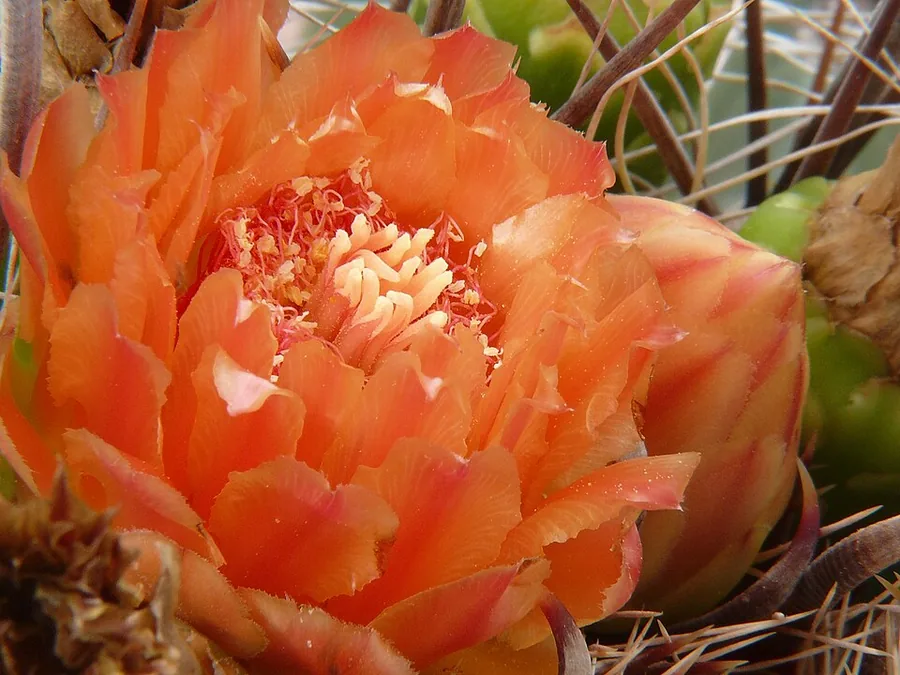
In summer the crown can open into bloom in shades of red, orange, and yellow, color set against the hard green skin and the dense armor of hooks. The rest of the year the plant reads as pure form and texture, a firm, ribbed globe studded with curved spines, asking only for strong light and dry roots. Wet soil is what undoes that firm body, since over-watering rots it from the roots up.
Care
The short version: full, direct sun on the ribbed green body, gritty, sharply drained soil, water only when the mix is bone dry and barely any in winter, and thick gloves whenever those hooked spines are within reach.
Light
Give the ribbed body full, direct sun, the more the better. It hangs on in partial sun or bright indirect light, but starved of light the new growth at the crown stretches pale and thin and loses the tight, round swell of the rest of the plant.
Water
Let the soil dry out completely between drinks, then water deeply but sparingly through the growing season, roughly every 14 to 28 days. Keep it nearly dry all winter. The firm flesh rots easily, so it never sits in wet soil.
Soil
Set it in a gritty, sharply drained sandy or cactus mix that water runs straight through. A pH from 6.0 to 7.5 suits it. Sharp drainage matters far more here than rich soil.
Temperature
The body takes a wide range, from about 41°F to 95°F (5°C to 35°C). Desert heat suits the thick green flesh, but a hard freeze splits it, so bring it in or shelter it before temperatures fall near the low end.
Humidity
Low humidity suits the dry, firm skin, just as in the desert air it comes from. There is no number to chase and no need to mist, since damp, still air settling on the body only invites rot.
Feeding
Feed lightly through spring and summer while the body is actively swelling, about once a month with a dilute, low-nitrogen cactus fertilizer. Skip feeding in winter. Too much nitrogen pushes soft, pale growth that breaks the firm form.
Pruning
It needs no routine pruning, and the ribbed shape stays as it is. The only cuts are to remove damaged, rotted, or dead tissue, and even then with sterile tools and thick gloves to clear away just the bad flesh.
Repotting
Repot only every 3 to 4 years, or once rootbound, with roots pushing through the drainage holes or the heavy body tipping in its pot. Always work with thick gloves or a band of rolled material, since the hooked tips grab at the slightest contact.
Size & spacing
Its slow swell keeps it compact indoors for years, though in the ground over a long life the body can rise to 2 to 10 feet (60 cm to 3 m) tall. Allow a spread of 12 to 24 inches (30 to 60 cm) around the ribs, and keep it well clear of walkways so no one brushes the spines.
Troubleshooting
Nearly every problem on a barrel cactus shows up first on the body itself, and it traces back to water and light. A patch of soft, discolored skin is the sign that matters most, since rot eats through the firm green flesh fast and cannot be reversed. Match what you see on the plant below and act before it spreads.
Soft, mushy brown or black patches on the body or base
Brown to black areas that sink in soft and slick are rot, and the trigger is almost always water lingering in soil too slow to drain. Once fungus or bacteria reach that pulpy, sour-smelling tissue, the flesh there is finished, so stop watering and cut it back to firm green flesh with a sterile blade. Let the open wounds dry to a dull callus, then set the plant into a gritty, fast-draining mix.
Fix:
- Stop watering immediately
- Cut away all rotted tissue back to clean, firm green flesh with a sterile blade
- Allow cuts to callus in dry air
- Repot into dry, gritty, fast-draining mix and resume watering only once established
Pale, stretched new growth losing the round shape
When the crown turns out a pale, narrow column that tilts toward the glass, that is etiolation, the plant reaching for light it lacks. The fresh tissue thins and pales rather than swelling into the tight, squat globe the rest of the body keeps. Full sun corrects the form, brought on across a week or two so the soft, light-starved skin does not scorch.
Fix:
- Move to a full-sun location, acclimating gradually to avoid scorching
A wrinkled, shriveled body
When the ribs draw in and the surface puckers into loose folds, the usual reason is drought, water spent down over too long a dry spell. Rot can carve the same wrinkled, deflated look by killing the roots so the body cannot refill. A look at the roots decides it: firm roots take a deep watering and plump the folds back out over days, while soft, mushy roots point to rot.
Fix:
- Water thoroughly once and observe for firming over days
- If roots are rotted, treat as rot: cut to clean tissue and re-root in dry gritty mix
Corky brown scarring low on the body
Dry brown patches with a rough, corky texture low on the body are usually just age, the green skin there hardening over time. The same firm, woody crust can also mark old sunscald, where strong light hit unhardened skin too fast. As long as the patches stay firm and give off no smell, they are harmless, and a slower step into bright light keeps fresh skin from scalding next time.
Fix:
- No action needed for natural corking; for sunscald, shade and acclimate gradually
Toxicity
The body holds nothing toxic: this cactus is not poisonous to people, pets, or livestock, and the ASPCA does not list it as toxic. The real hazard sits on the surface and is physical, not chemical. The stiff central spines hook at the tip and can drive deep into skin and paws, so keep the plant out of reach and handle it only with thick gloves.
Safe for
People · Cats · Dogs · Horses · Rabbits · Livestock · Birds
Cats None
Nothing in this cactus poisons a cat. The danger lies in the hooked spines, whose curved tips can sink into a curious nose or paw.
Dogs None
A dog is not poisoned by chewing it. Those barbed, fish-hook tips puncture skin and snag in the soft mouth, so the plant belongs out of reach.
Horses Safe
Horses face no chemical risk. The only wound to expect is a puncture from the rigid spines where a horse brushes the body.
Rabbits Safe
Rabbits are not poisoned by it. The sharp, hooked spines are the hazard, and a small body presses into them easily.
Livestock Safe
Cattle, goats, and sheep graze near it without toxic effect. The stiff, hooked spines still tear and puncture on contact.
Birds Safe
Birds are not harmed by eating it. The needle-sharp spines are the only real hazard around the plant.
People Safe
People are not poisoned by handling it or being near it. The hooked spines are the issue, so thick gloves are worn and children kept clear.
Stout, rigid spines with sharp, fish-hook-shaped tips readily cause painful puncture wounds and can embed in skin or paws; keep out of reach of pets and children and handle only with thick leather gloves or rolled material.
Varieties
A few named forms of Ferocactus wislizeni are recognized, set apart by where they grow and by small shifts in stem and stature. These are the forms the references document.
Ferocactus wislizeni subsp. tiburonensis
An island form from Isla Tiburon in Sonora, set apart in POWO as its own infraspecific taxon.
Ferocactus wislizeni subsp. herrerae
It stands taller on noticeably more slender stems and is sometimes treated as the separate species Ferocactus herrerae.
Ferocactus wislizeni var. ajoensis
A form tied to the Ajo region of Arizona and recorded in POWO.
How to propagate
Growing more barrel cacti is slow, close work, since seed is realistically the only route and the seedlings swell at a crawl.
SeedModerate
Spring, with sustained warmth (about 21-27°C / 70-80°F) · Several years to reach a few centimeters; very slow
Seed is realistically the only way to start this cactus, since it rarely pushes out the small offsets or pups that crowd around many other species. Sow in spring and hold a steady warmth around 70°F to 80°F (21°C to 27°C) for the tiny seedlings to break the surface. They stay small for a long while, taking several years just to swell to a few centimeters across.
Myths
A barrel cactus is a reliable emergency water source in the desert.
The pale pulp inside a fishhook barrel is sharply acidic, not clean water, and drinking it can bring on nausea, vomiting, and diarrhea that leave a person worse off than before. Most barrel cacti carry legal protection on top of that. Keep this filed as survival folklore, not a real plan.