Houseplant · Cactaceae
Christmas Cactus
Schlumbergera × buckleyi
Give it bright, indirect light and cool fall nights, and the jointed green stems of this old houseplant tip into flower for the holidays.
Bright indirect
55–81°F · 13–27°C
USDA 10–12
6–12 in · 15–30 cm
Overview
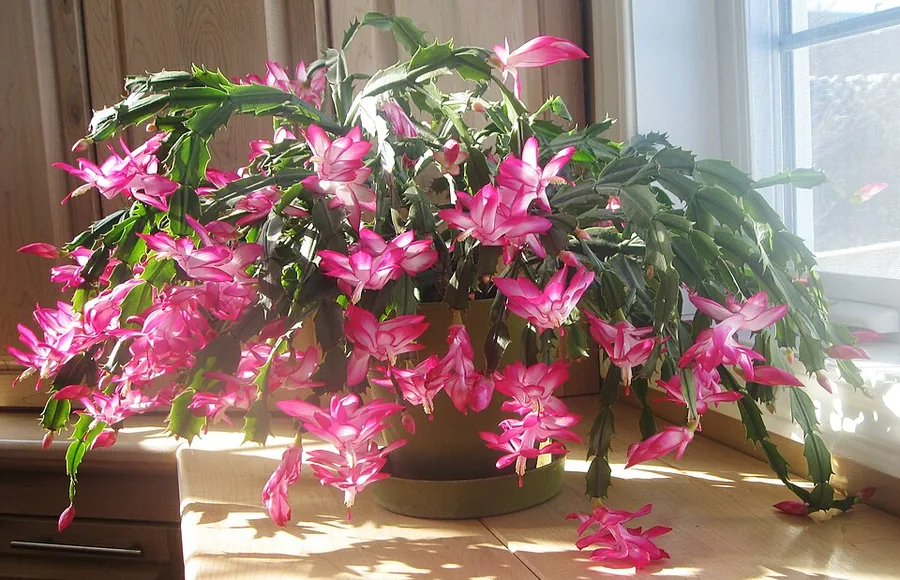
The Christmas cactus is built from flat, fleshy green segments rather than the round, spined stems of a desert cactus. Each segment is a small, jointed pad that links to the next at a notch, so a stem reads as a hanging chain of leaf-like links. In the wild it grows in the trees of the Brazilian rainforest, anchored to branches with its roots in pockets of leaf litter, and that origin is why the smooth, succulent segments stay plumper and softer than the hard tissue of spiny cacti. Indoors it stays small and lives for decades.
Its flowers are the showpiece. From the tip of an end segment a bud swells and opens into an arching, tubular bloom, its layered petals flaring back from a long throat in pink, red, white, or coral. The flowers hang and nod from the ends of the pads rather than standing upright, set against the deep green of the flat segments behind them, and they open around the holidays.
The whole plant takes a soft, cascading form as the chains of jointed segments lengthen, arch outward, and trail down under their own weight. Keep it in bright, indirect light, water when the top of the mix dries, and leave it be. A plant held slightly pot-bound and undisturbed pushes the most buds from its segment tips.
Care
The short version: bright, indirect light, water once the top of the mix dries, and a stretch of cool nights with long, unbroken darkness in fall to swell the buds at the segment tips.
Light
Give it bright, indirect light through most of the year. It holds its even green in medium light or light shade, but harsh direct summer sun scorches the flat segments and stains them red at the surface. An east or shaded west window suits it well.
Water
Water when the top half of the mix dries out, then water thoroughly. As a forest cactus its fleshy segments want more moisture than a desert cactus, yet the roots must never sit in soggy soil. Once buds swell at the tips, keep the mix evenly moist, since a dry spell then drops them.
Soil
Plant it in a well-drained, organic-rich potting mix, a cactus or succulent blend loosened with extra grit. A pH between 5.5 and 7.0 suits it. Drainage matters most, because standing water at the roots is what rots and kills these plants.
Temperature
Ordinary room warmth between 55°F and 81°F (13°C to 27°C) keeps the segments firm and green through the year. The exception comes in fall, when cool nights around 55°F to 60°F (13°C to 16°C) are part of what triggers the buds.
Humidity
Average household humidity is plenty, so there is no number to chase. As a rainforest plant its segments hold up better with a little more moisture in the air, and grouping it with other plants or setting it on a pebble tray covers that.
Feeding
Feed monthly through spring and summer while new segments form, using a balanced houseplant fertilizer at half strength. Stop by late summer to push it toward fall flowering, and switch to a low-nitrogen, high-phosphorus feed as bloom season nears.
Pruning
After it flowers in spring, pinch or twist off a few end segments at the joint to push out side branches and a fuller, bushier chain of pads. The pieces removed are not waste, since each rooted segment becomes a new plant.
Repotting
Repot only every 3 to 4 years. It blooms best left slightly pot-bound, so a too-roomy pot grows more leafy segments and fewer flowers. Roots creeping from the drainage holes, or soil that dries almost at once, tell you the time has come.
Size & spacing
A mature plant stays compact at 6 to 12 inches (15 to 30 cm) tall but spreads 12 to 24 inches (30 to 61 cm) wide as the jointed stems arch and trail. The long chains of flat segments give it the soft, cascading form that suits a hanging basket or a high shelf.
Troubleshooting
Most Christmas cactus trouble comes down to water, light, or the conditions it needs to bloom, and it writes the problem right onto the plant. Yellowing buds, soft and mushy segments, or color flushing across the flat pads each point to a cause. Match what you see on the segments below and adjust before a small slip costs the season.
Segments gone soft and mushy over wet soil
When the flat segments lose their firmness and turn limp and mushy while the soil stays wet, the trouble is root rot from overwatering or a dense mix that traps water. Lift the plant and look at the roots, which read brown and soft to the touch rather than the firm, pale white of healthy ones. Dry the plant out, cut the mushy roots away, repot it into fresh, fast-draining mix, and pour off any saucer so the base never sits in standing water.
Fix:
- Allow the plant to dry out
- Repot into a fresh, fast-draining mix and trim away rotted roots
- Empty saucers so the pot never stands in water
Buds yellow at the segment tips and fall
Bud drop shows as the small buds at the segment tips paling to yellow and letting go before they ever swell open. It follows a sudden change once the buds have set, whether a cold draft, a warm vent, or a missed watering. Hold the plant in one steady spot with evenly moist soil so the forming buds stay firmly attached, and leave it unturned, since even a quarter turn loosens them while they are this delicate.
Fix:
- Keep the plant in a stable spot away from heat vents and cold drafts
- Keep the growing medium evenly moist once buds appear
- Avoid moving or rotating the plant while in bud
Full green segments but no buds at the tips
A plant that won't bloom carries plump, healthy green segments yet stays bare at the tips where buds should swell, usually after a fall kept too warm and too bright. Buds form at the segment ends only after cool nights around 55°F to 65°F (13°C to 18°C) joined with 12 or more hours of unbroken darkness each night for about 6 weeks. A single lamp glowing during that dark stretch is enough to keep the tips from setting flowers.
Fix:
- Provide cool nights of about 55 to 65°F
- Give 12 or more hours of continuous darkness each night for roughly 6 weeks starting in fall
- Avoid interrupting the dark period with artificial light
Green segments flushing yellow and red
Segments that lose their even green and flush yellow or red at the surface are sunburned from too much direct light, a change seen most through summer. The fix is to set the plant back in bright, indirect light and shade it through the hottest months. The flat pads usually deepen back to green once the harsh sun stops striking their surface.
Fix:
- Move the plant to bright, indirect light
- Provide light shade during hot summer months
Toxicity
For pet owners the verdict is reassuring: the Christmas cactus is safe. The ASPCA lists it as non-toxic to cats and dogs, and the fleshy green segments hold no poison that threatens other animals or people. A pet that chews a number of the fibrous pads may get a brief, mild stomach upset, and that is the whole of it.
Safe for
People · Cats · Dogs · Horses · Rabbits · Livestock · Birds
Cats None
Cats are safe around the plant, which holds no toxin in its fleshy green segments. A cat that chews through a number of the fibrous pads may have a brief bout of vomiting or loose stool, and nothing more.
Dogs None
Dogs meet no poison in the stems. A dog that bites off and swallows a big mouthful of the firm green segments may show only short-lived stomach upset that clears on its own.
Horses None
Nothing in the plant is toxic to horses, and its low, compact mass of trailing segments keeps it well out of a horse's reach in any case.
Rabbits None
Rabbits can nibble the flat green segments without harm. A very large helping of the fibrous tissue might loosen the gut for a day, as any green would, but it carries no danger.
Livestock None
The fibrous green stems hold no toxin that troubles goats, sheep, or cattle, and as a small indoor plant it rarely comes near farm animals at all.
Birds None
Pet birds face no poisoning risk from the segments or the tubular flowers, so a peck at either is harmless.
People None
People, young children included, are safe near the plant. The fleshy segments are not grown to eat, so there is no reason to taste them, and a curious bite does no harm.
Varieties
Three holiday cacti pass under the same name, and the edge of each flat segment, together with the flowering time, sets them apart. These are the ones you will run into.
Thanksgiving cactus (Schlumbergera truncata)
Its flat segments are edged with pointed, claw-like teeth that catch the eye, and it opens its flowers near Thanksgiving, which is why most plants sold as Christmas cactus are really this one.
True Christmas cactus (Schlumbergera × buckleyi)
Its segment margins are rounded and softly scalloped rather than toothed, the stems hang in a drooping habit, and the flowers open closer to Christmas than its earlier cousin.
Easter cactus (Rhipsalidopsis / Hatiora gaertneri)
A separate genus, its rounded segments are rimmed with small bristles along the edges and its flowers open in spring.
How to propagate
Few houseplants copy as easily. A short chain of segments twisted off at a joint will root almost on its own, which is how these plants get passed from hand to hand.
Stem cuttingsEasy
Late spring to early summer after flowering (about May to June) · Roots form in about 2 to 8 weeks
Take cuttings in late spring to early summer after the flowers fade, around May to June. Twist off a short chain of 2 to 5 joined segments at a joint, let the exposed cut end dry to a callus for a day, then press that end into a moist, well-draining mix. Fine new roots push from the buried joint in about 2 to 8 weeks, and a humidity cover over the cutting speeds the rooting along.
Myths
The three holiday cacti are the same plant, so the shape of the segments and the bloom time do not matter.
They are different plants, and the edge of each segment gives them away along with their flowering time. Thanksgiving cactus carries pointed, claw-like teeth on its segments and blooms in late November, true Christmas cactus has rounded, scalloped margins and opens nearer Christmas, and Easter cactus is a separate genus with bristle-edged segments that waits for spring. Most plants sold as Christmas cactus are actually Thanksgiving cactus.