Houseplant · Cactaceae
Golden Barrel Cactus
Echinocactus grusonii
A ribbed green globe crowned in stiff golden-yellow spines, this cactus wants bright sun and little water.
Full sun
50–86°F · 10–30°C
USDA 9–11
12–35 in · 30–90 cm
Overview
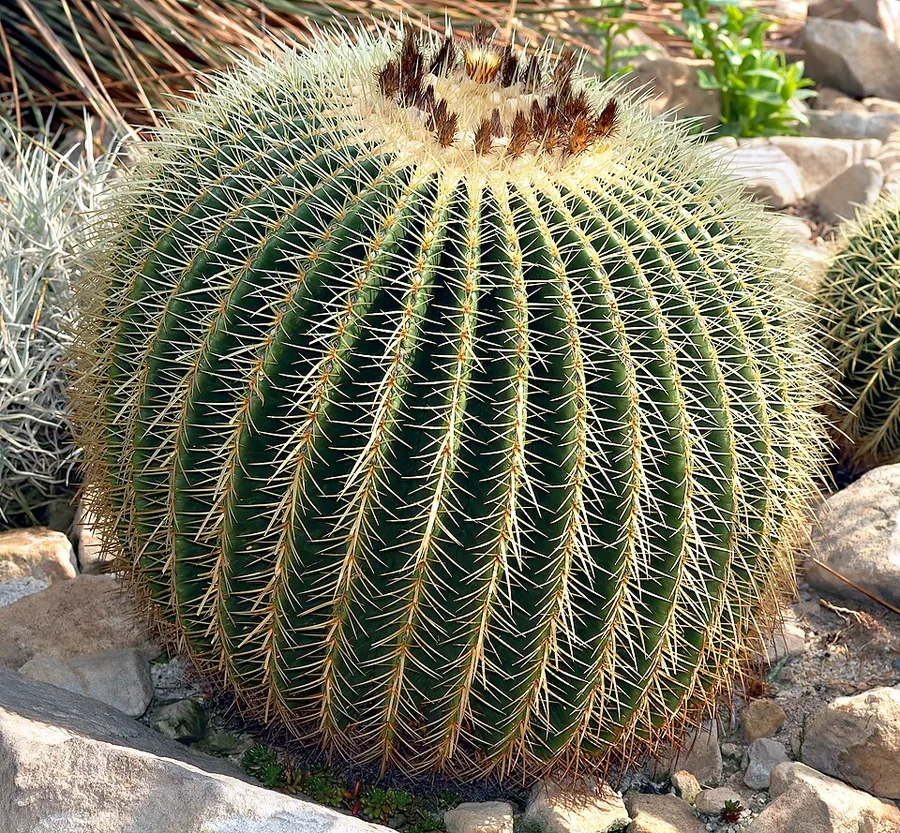
The golden barrel cactus is a squat green globe, its surface pleated into deep vertical ribs that run from the top clear down to the base like the folds of a melon. Along every ridge sit tight clusters of stiff, straight golden-yellow spines, hard and sharp to the touch, that sheath the whole body in a bristling coat.
The body itself is firm and full, packed with water beneath a taut green skin, and it holds that near-spherical shape as it slowly swells with age. Growth is slow, so it creeps toward its full 12 to 35 inches (30 to 90 cm) across only over many years. Older plants broaden into a heavy, rounded barrel roughly as wide as they are tall, every rib deepening and the spines lengthening as the surface expands.
On rare, well-grown mature plants a ring of small yellow flowers opens at the top in summer, though that bloom seldom shows indoors. Even without it, the plant is all texture: the ribbed green flesh and the sharp golden armor, a desert form that stays as striking in a pot as it is in the wild.
Care
The short version: the brightest sun you can give it, a gritty mix that drains fast, and water only when the soil is bone dry. Keep it nearly dry all winter, and handle the spiny body with thick gloves to stay clear of the golden spines.
Light
The golden barrel wants the brightest light you can give it, ideally full sun at a south-facing window, which keeps the green flesh firm and the spines a deep golden-yellow. It holds on in bright indirect light, but starved of sun the round body stretches into a pale, slack column and loses its tidy shape.
Water
Water only when the soil turns bone dry, then soak it through and let every drop drain away from the firm, water-filled body. Through winter dormancy keep it nearly dry. Standing moisture is the one thing that undoes this cactus, softening the green base into fast and often fatal rot at the roots and base.
Soil
Plant it in a gritty, sharply drained cactus mix that never packs down wet against the base. A pH anywhere from 6.0 to 7.5 suits it, so the coarse, free-draining texture of the mix matters far more than its exact acidity.
Temperature
The plump green body is comfortable across a wide band, from 50°F to 86°F (10°C to 30°C). Ordinary room warmth keeps it firm and full, though it takes a cooler, drier rest in winter.
Humidity
Low humidity is exactly what this desert plant wants, so there is no number to chase and no misting to do near its spiny surface. Dry household air suits the taut green skin perfectly.
Feeding
Feed lightly through spring and summer while the body is actively swelling, about once a month. Use a dilute, low-nitrogen cactus fertilizer, and stop feeding once growth slows for winter.
Pruning
There is nothing to prune on the round, self-contained body of a golden barrel. A blade comes out only to cut away damaged, rotted, or diseased tissue back to firm green flesh, and it should be clean and sharp.
Repotting
Repot only every 3 to 4 years, or once the swelling body outgrows its pot. Watch for roots pushing through the drainage holes, the barrel lifting in its pot, or soil that dries out unusually fast, and grip the spiny plant with thick gloves to move it safely.
Size & spacing
This is a slow, compact grower that rounds out to 12 to 35 inches (30 to 90 cm) tall and about as wide, a heavy ribbed globe at full size. It takes years to swell that far, and a single barrel makes a striking specimen on its own.
Troubleshooting
A healthy golden barrel keeps its firm green flesh and crisp ribbing, and the few problems it shows nearly always come down to water or light. The base and the newest crown growth are where the first changes appear, a softening here or a paling there. Spotted early, the plant usually pulls through.
Mushy brown flesh climbing the ribbed sides
When the firm green base turns soft, dark, and sunken, that is root and base rot, and too much water or a mix that stays wet lies behind it. Once the tissue goes to mush, the rescue means lifting the plant, slicing away every rotted patch with a clean blade down to firm pale flesh, drying the cuts to a callus, and settling it into dry gritty mix. No water touches it again until fresh roots take hold.
Fix:
- Withhold water immediately
- Unpot and cut away all rotted tissue with a clean blade
- Allow cut surfaces to callus, then replant in dry gritty mix
- Resume watering only once roots re-establish
The ribbed globe drawn out pale and thin
When the tight globe softens into a paler, taller column, that is etiolation, the cactus straining toward light it lacks. The fresh growth comes in a washed-out green, stretched and slack against the crisp, close ribbing beneath it, and that thin new tissue never rounds back out. The plant needs the brightest spot you have, eased into direct sun across a week or two so the pale skin does not scorch.
Fix:
- Move to the brightest available position
- Introduce direct sun gradually to avoid scorch
Toxicity
Reassuring news for pet owners: the green flesh of the golden barrel cactus holds no toxins and is safe around cats, dogs, and other animals. The danger is physical, not chemical. That coat of stiff, needle-tipped golden spines can drive a painful puncture, so keep the plant out of reach and handle it with thick gloves or a folded band of newspaper.
Safe for
People · Cats · Dogs · Horses · Rabbits · Livestock · Birds
Cats None
Nothing in the green flesh will poison a cat. Those stiff golden spines are the real danger, since each one ends in a hard point that can drive a painful puncture into a curious paw or nose, so keep it well out of reach.
Dogs None
A dog takes no poison from chewing this plant. The hazard is the rigid, needle-tipped spines, which can stab a mouth or a pawing foot, so set the pot where a dog cannot blunder into it.
Horses None
No toxin lurks in this cactus for a horse. The only threat is the sharp spines, whose hard tips can wound the soft skin of a muzzle.
Rabbits None
The flesh carries nothing that would harm a rabbit, but the stiff golden spines are far too sharp and closely set for a small animal to nose in among safely.
Livestock None
Goats, sheep, and cattle face no poisoning from this plant. A mouthful of those hard spines would tear soft tissue, though, so it is no plant to graze near.
Birds None
No toxin here troubles a bird. The one danger is a landing among the stiff, upright spines.
People None
Safe to keep in any home, since nothing in the plant is poisonous. The dense armor of sharp spines is the only thing to respect when you handle it, so reach for thick gloves or a folded band of newspaper.
The plant is densely armored with stiff, sharp golden spines that can cause painful puncture wounds. Handle with thick gloves or a folded band of newspaper and site it away from walkways, children, and pets.
Varieties
Most golden barrels wear the usual golden-yellow spines over a deep green body, but a couple of named forms shift that surface texture and color in ways collectors prize.
Echinocactus grusonii var. albispinus
Its spines come in white to pale rather than the usual golden-yellow, so the whole ribbed body reads cool and frosty instead of warm.
Echinocactus grusonii 'Intertextus'
A more compact form whose flattened spines cross and interlace tightly across the ribs, laying a woven texture over the surface.
How to propagate
Growing a golden barrel from scratch means watching a tiny green bead swell over years, since the plant grows slowly and rarely offers a shortcut.
SeedModerate
Spring, in warm, bright conditions · 1 to 2 years to reach a recognizable seedling
Seed is how most golden barrels begin, as tiny green beads that swell into round little bodies. Sow in spring somewhere warm and bright and germination comes reliably enough. The catch is patience, since it takes 1 to 2 years to grow into a recognizable little barrel with its first spines.
Offsets & pupsModerate
Spring to summer when offsets are firm · Several months to root after callusing
This plant rarely buds a small pup at its base, so this route is the exception. When a firm offset does swell in spring or summer, sever it cleanly, let the raw cut dry to a callus, and set it in dry gritty mix. Expect several months before it puts down roots.
Myths
A cactus this common on shelves must be just as common across the Mexican desert.
The full shelves of golden globes tell you nothing about how it fares in the wild. In its native Mexican range it is endangered and rare, its wild populations badly thinned by habitat loss and over-collection.
That fat, ribbed sphere stows enough water to never need a drop more.
That plump, ribbed body really does bank water inside its flesh, yet it still wants an occasional deep soak through the growing season. Overwatering is the real killer, since standing moisture rots the roots and the firm green base.