Houseplant · Cactaceae
Fairy Castle Cactus
Acanthocereus tetragonus
A slow, sculptural cactus of ribbed green stems and sharp spines that wants bright light and very little water.
Full sun
Every 14–21 days
50–86°F · 10–30°C
USDA 9–11
Overview
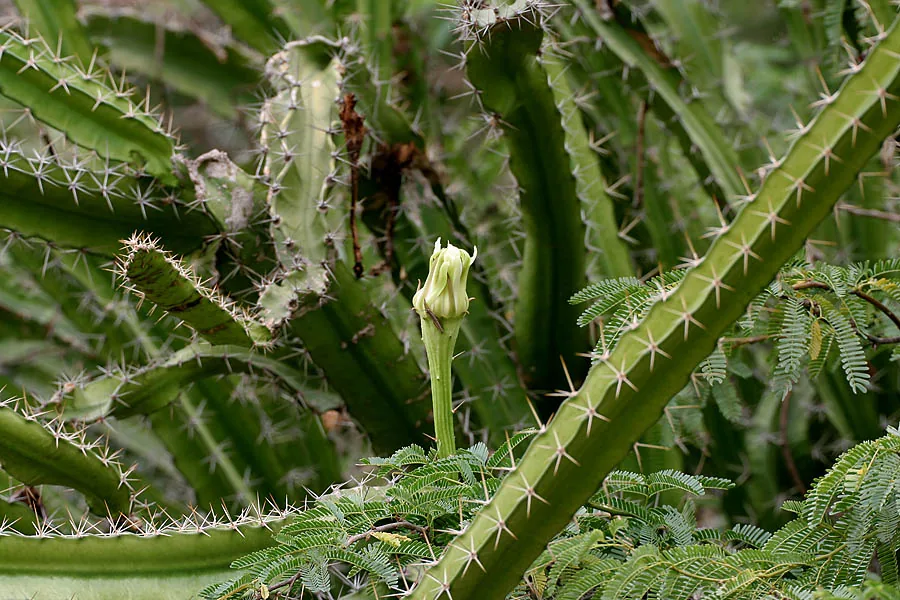
The fairy castle cactus is a mass of upright, turret-like stems that pile up over the years into the rough outline of a small green castle. It is the monstrose form of Acanthocereus tetragonus, a mutation whose stems branch and bulge in irregular, uneven columns rather than rising in clean lines. Each stem is ribbed and angled, three- and four-sided, with sharp spines studded along the edges.
Inside those ribbed stems the plant stores its water, which is why they look plump and firm rather than thin, this being a desert species at heart. The green can stay compact for years before stretching past a foot in height. Set close along the ribs sit clusters of sharp spines reaching up to about 2.5 cm long, stiff and needle-fine, the one part of the plant that bites back.
Many plants in shops wear a bright flower fixed to the very top, and that small colored button is not real. The monstrose form rarely flowers indoors. The true flower of the wild species is a large white bloom that opens only at night, and the wild plant later sets a red, edible fruit, neither of which looks anything like the dyed paper crown sold on the shelf.
Care
The short version: the ribbed green stems want the brightest light around, water only when the soil is bone dry, a gritty fast-draining mix, and skin kept off the spines.
Light
The stems want the brightest spot around, ideally a south- or west-facing window with several hours of direct sun, which keeps them stout and deep green. They tolerate bright indirect light. In too little light the new stems come in pale and thin and stretch out long as they lean toward the window.
Water
The plant drinks deeply, then the soil is left completely dry before the next watering, which lands at roughly every 2 to 3 weeks in spring and summer while the stems are firm and full. In winter it takes only enough water to keep the stems from shriveling and creasing. The pot never sits in water, since soggy roots rot this plant.
Soil
The roots want a fast-draining cactus or succulent mix, such as equal parts potting soil and coarse sand or grit. The plant tolerates a pH of 6.0 to 7.5. What counts is that water slips straight through the grit rather than pooling around the base of the stems.
Temperature
Ordinary room warmth keeps the stems comfortable, anywhere from 50°F to 86°F (10°C to 30°C). The plant has no frost tolerance, and cold blackens the green tissue, so it stays indoors or comes inside well before the first cold nights.
Humidity
Dry air matches this desert plant, around 20% to 40%. Misting is unnecessary and wets the ribbed surface for no gain. Steady humidity around the stems invites the rot the plant is prone to.
Feeding
The plant feeds lightly during the growing season, from late spring into early fall, about once a month. A diluted low-nitrogen cactus fertilizer such as a 5-10-5 suits it. Heavier feeding swells soft, weak green growth that pests settle into.
Pruning
Pruning is rarely needed and is just the removal of bad tissue. Damaged, rotted, or unwanted segments are cut out with a clean, sharp blade. Thick gloves keep the hands off the spines that line every rib.
Repotting
The plant is repotted every 2 to 3 years, ideally in spring as new green pushes out. Roots emerging from the drainage holes, a top-heavy column of stems, or soil that dries out unusually fast all signal it is time.
Size & spacing
Indoors the stems grow slowly and stay compact for years, then over time the plant reaches from 6 inches to nearly 6 to 71 inches (15 to 180 cm) tall and spreads about 6 to 12 inches (15 to 30 cm) across as side stems branch out. It needs room, and a spot where no one brushes against the spines.
Troubleshooting
Almost every problem you will see on these stems comes down to water or light. Tissue that turns soft, dark, and discolored has taken on too much water, while pale, thin, stretched growth is the green reaching for more light. Match the look of the stems to the entries below.
Mushy, brown-black blotches marking the lower stems
Stem tissue that turns soft, squishy, and brown or black is root and stem rot, almost always from water held around the roots. Watering stops, the plant comes out of the pot, and every soft, discolored piece is cut back to firm green with a clean blade. The healthy cuttings callus for a few days, go into dry, fast-draining mix, and get only light water until the roots take again.
Fix:
- Stop watering immediately
- Remove the plant and cut away all rotted tissue with a clean blade
- Let healthy cuttings callus for several days, then repot in dry, fast-draining mix
- Resume watering only sparingly once re-established
Cottony white wisps or hard brown knobs along the stems
Soft white cottony tufts tucked into the stem crevices are mealybugs, and the hard brown bumps stuck fast to the surface are scale. Each one is dabbed with a cotton swab dipped in 70% isopropyl alcohol, and the treatment repeats weekly until the stems are clean. The plant stays apart from the others during treatment, and feeding eases off, since soft, overfed green is what these pests cling to.
Fix:
- Dab insects with a cotton swab dipped in 70% isopropyl alcohol
- Repeat treatment weekly until no pests remain
- Isolate the plant from others while treating
Bleached, thinned stems curving toward the glass
Stems that come in pale, narrow, and drawn out, bending toward the glass, show etiolation, the plant reaching for light it lacks. A bright south- or west-facing window with several hours of direct sun corrects it, and turning the pot keeps the new green even on all sides. The stretched stems stay thin and will not thicken back, but fresh growth comes in tight and firm and deep green.
Fix:
- Move to a brighter spot with several hours of direct sun
- Rotate the pot regularly so growth stays even
Toxicity
There is no poison in any part of this plant, and the wild species sets a red fruit that is even edible, so a bite harms no pet, child, or grazing animal. The hazard lives on the surface of the stems. Running along the ribs are clusters of sharp spines, stiff and fine enough to puncture skin and paws, so keep the plant out of reach and handle it with thick gloves.
Safe for
People · Cats · Dogs · Horses · Rabbits · Livestock · Birds
Cats Safe
Nothing in the green stems will poison a cat that takes a bite. The real risk is the spines, fine and stiff enough to jab a curious nose or stick in a paw, so the pot belongs where a climber cannot reach it.
Dogs Safe
A dog is not poisoned by chewing the stems, but a mouthful of those sharp spines can prick the lips and tongue. The plant belongs well out of reach of an inquisitive snout.
Horses Safe
No toxin in the plant threatens a horse. A grazing muzzle can still catch the stiff spines along the ribs, which is reason enough to keep this one out of the barn and paddock.
Rabbits Safe
Rabbits face no chemical danger from the plant. The sharp spines are the only concern, so it stays away from where a rabbit roams or might nibble the stems.
Livestock Safe
Cattle, goats, and sheep cannot be poisoned by it. The stiff spines are what to watch, since a curious animal could end up with one lodged in its mouth.
Birds Safe
Pet birds are not harmed by the green itself, and the wild species even sets edible fruit. A perching bird stays clear of the spines, which can scratch delicate feet and skin.
People Safe
Nothing in the plant is poisonous to handle or, in the case of the ripe red wild fruit, to eat. The spines are the only caution, fine points that puncture skin easily, so thick gloves go on whenever the plant is moved or pruned.
Handle with thick gloves or a folded strip of newspaper wrapped around the stem, and remove any embedded spines from skin promptly. The danger is mechanical, not chemical.
Varieties
What is sold under this name is one mutation shown in a couple of physical forms. The two below differ mostly in how their stems are shaped and colored.
'Fairy Castle' (monstrose)
A slow-growing mutation whose many irregular, lumpy, turret-like stems crowd together into the castle shape, and the form found on almost every shelf, though it very rarely flowers indoors.
'Ming Thing'
A compact blue-green cultivar of short, thick columns packed tightly side by side rather than reaching upward.
How to propagate
New plants come readily from the stems themselves, far less so from seed. Cuttings and offsets are taken in the warm growing months, and the raw, cut surface is left to dry into a firm callus before it ever meets soil.
Offsets & pupsEasy
Spring to summer during active growth · 4 to 8 weeks
The easiest method snaps off one of the small offsets or side branches in spring or summer while the stems are growing. The cut end dries into a callus over a few days, then sits in dry cactus mix and gets no water until it roots, which takes 4 to 8 weeks.
Stem cuttingsEasy
Spring to summer · 4 to 8 weeks
A stem segment is cut in spring or summer, with thick gloves against the spines, and the raw wound dries and hardens into a callus for 1 to 2 weeks before potting so it does not rot. Set into dry mix, a cutting usually roots within 4 to 8 weeks.
SeedDemanding
Warm season · Several months to over a year
Seed is rarely worth the trouble, since the monstrose form does not come true from seed and reverts to the plain, smooth-ribbed species. Sown in the warm season, the seed germinates and grows slowly, taking several months to over a year to make a usable plant.
Myths
The vivid flower capping a fairy castle cactus opened from the plant itself.
The little colored button on the crown is a dried strawflower or a dyed paper flower glued onto the tip for sale. The monstrose 'Fairy Castle' almost never flowers indoors, and the species' real flowers are large and white and open at night, nothing like the small dyed shape on the stem. The fake bloom should be peeled off, since it holds moisture against the stem and can start rot.
Fairy castle cactus carries a poison that harms pets and people.
No part of the plant carries a toxin, and this species is not on the ASPCA toxic plant lists. The wild form even sets a red, edible fruit. The only real danger is the spines, the stiff, fine points along the ribs that prick skin and paws, not anything inside the green.