Houseplant · Cactaceae
Cholla Cactus
Cylindropuntia fulgida
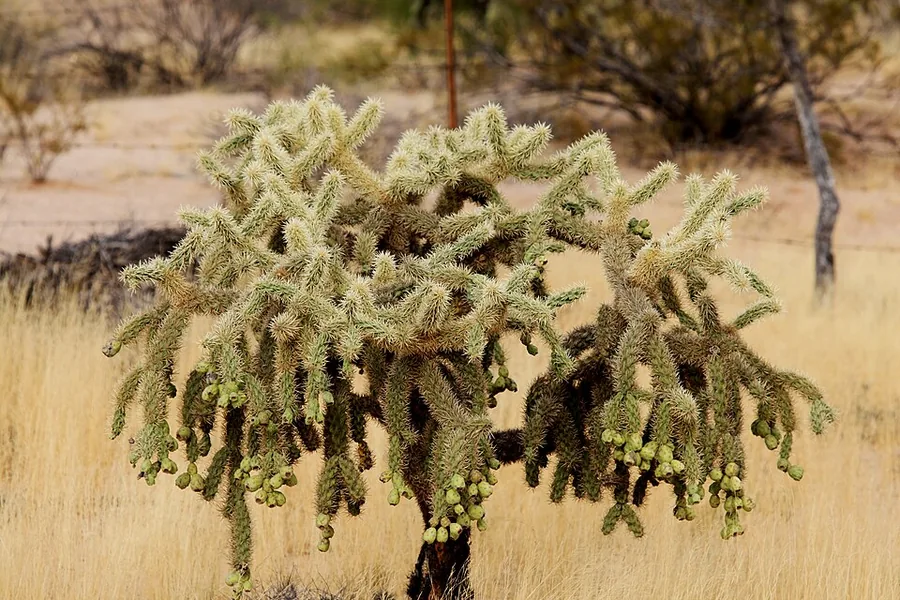
Cylindrical joints stacked into a small spiny tree, every one armed with barbed, grabbing spines.
Full sun
USDA 8–11
3–13 ft · 1–4 m
Overview
Cholla is a desert cactus shaped for heat and drought, its body made of cylindrical segmented joints that pile one on the next into a small spiny tree. It grows wild across the arid Southwest and takes a hard swing in temperature, from 23°F to 104°F (-5°C to 40°C). Left alone it inches upward over years toward 3 to 13 feet (1 to 4 m) tall.
The trait that marks this cactus is how loosely each joint clings to the next. A faint brush peels a barbed segment free, and it rides off on skin, fur, or a pant leg, the move behind the name jumping cholla. Those same detachable joints carry the plant outward, dropping to the ground and rooting where they fall. In late spring to early summer the segments open pink to magenta flowers along their tips.
Up close the surface is anything but soft. Sheaths of barbed spines bristle from every joint, ready to catch at a touch, while the smoother var. mamillata wears far fewer of them and the teddy bear cholla cousin is furred in dense golden spines. The real attention goes to respecting those spines and placing the plant where no one walks too close.
Care
The short version: full sun, a gritty fast-draining mix, and water only once the soil has gone bone dry. Those cylindrical joints handle a wide temperature swing and want little fuss beyond sharp drainage and a wide berth from the barbs.
Light
Cholla craves full sun and as much of it as the open desert pours on, which keeps its joints firm and tightly packed. A little partial sun it will take, but anything dimmer leaves the segments weak and far quicker to rot.
Water
Water sparingly, and only once the soil has dried straight through. Each plump joint stores its own moisture for drought, so wet roots rot it fast, worst of all in cool or dim air, and the dry side is always the safer side.
Soil
Set it in a gritty, sharply drained sandy or cactus mix that lets water run clean through. A pH anywhere from 6.0 to 8.0 suits it, the same span as most desert ground.
Temperature
Cholla shrugs off a wide range, from roughly 23°F to 104°F (-5°C to 40°C). That hardiness is why its spiny joints hold up outdoors in USDA zones 8 through 11 where softer cacti would fail.
Humidity
Low humidity is exactly what these joints want, so dry desert air sits well with them. Damp, still air invites rot, and there is no number to chase, only the steady aim of keeping things dry.
Feeding
Feed lightly through spring and summer growth with a dilute low-nitrogen cactus fertilizer, just once a season. Too rich a dose pushes soft, swollen growth the joints neither need nor hold up well.
Pruning
Cholla asks for almost no cutting, only the clearing of dead or damaged joints. Always reach in with long tongs or thick gloves, since the barbed segments come loose at the lightest touch and lodge in skin.
Repotting
Move it up only every 2 to 4 years, or when the plant outgrows its pot or leans top-heavy. Roots poking through the drainage holes or soil that dries unusually fast are the cues it is time.
Size & spacing
A grown cholla stacks its joints to 3 to 13 feet (1 to 4 m) tall and 3 to 7 feet (100 to 200 cm) across. Leave wide clearance so no one brushes those barbed segments in passing.
Troubleshooting
Cholla rarely falters, and when it does the joints tell the story. Soft dark segments and creased, caved-in ones point opposite ways, so read what the cylinders are showing before you reach for water. Keep tongs in hand the whole time you work on it.
Firm green joints going slack and dark down at the base
What you are looking at is root and stem rot, set off by water pooling in soil that drains too slowly. The base gives off a sour smell and the once-plump joints go limp under a finger. Cut off the water, slice the failing joints away with tongs deep into firm green tissue, let those cuts dry to a callus, and reset the plant in a dry gritty mix.
Fix:
- Stop watering immediately
- Cut away rotted joints with tongs well into healthy tissue
- Allow cuts to callus and repot into dry gritty mix
Plump cylinders gone thin, puckered, and creased
Creased, caved-in joints signal prolonged drought, or roots that have died back so the plant can no longer pull water up into its segments. The mix has usually sat bone dry for a long stretch. Return to a deep but infrequent soak through the growing season, and feel the roots to be sure they are still firm and doing their job.
Fix:
- Resume a deep but infrequent watering schedule
- Check roots are intact and functional
Toxicity
Nothing in this cactus poisons a person or an animal, so set the idea of a toxin aside. The hazard lives entirely in the spines. The barbed, detachable joints hook and bury themselves in skin, mouths, and fur at the lightest touch, they hurt, and they fight being pulled out, so keep people and pets well clear and handle the plant only with tongs.
Safe for
People · Cats · Dogs · Horses · Rabbits · Livestock · Birds
Cats None
Chewing on this cactus carries no poison for a cat. The trouble is the barbed joints: they snag in paws and faces, and a curious cat that bats at the spines can wind up with a segment caught in its mouth or on its tongue.
Dogs None
A dog gets no toxin from nosing or biting this plant, but the loose spined segments lock on hard and bury their barbs in the muzzle, lips, and paw pads, leaving real pain and a job for careful tweezing.
Horses None
There is nothing poisonous here for a horse. Grazing lips and gums can still press the barbs in deep, so set the plant beyond any spot a horse can stretch to reach.
Rabbits None
A rabbit faces no poisoning, yet those spines threaten small soft mouths and feet, and a heap of shed joints on the ground can pin a hopping rabbit in place.
Livestock None
Cattle, goats, and sheep take no toxin from cholla, though the chain-fruit segments cling to legs and faces, and spines lodged around the mouth can keep an animal from eating.
Birds None
No part of this cactus poisons a bird. Some desert birds even tuck their nests in among the spiny joints for cover, so the only thing to watch is the plain physical sharpness of the barbs.
People None
Nothing in the plant is poisonous to people. The barbed joints are the whole story: they let go at the lightest brush and bury themselves painfully in skin, then resist coming out, so reach for the plant only with long tongs.
The real danger is physical: detachable, barbed spine joints (the 'jumping cholla') cling to and embed in skin at the slightest brush, are very painful, and are difficult and hazardous to remove. Keep well away from people and pet traffic and handle only with tongs.
Varieties
Cholla shares its genus with many kin, and a couple of close relatives, told apart by their spines, turn up often enough to know by name.
Cylindropuntia fulgida var. mamillata
Its joints run smoother and far less spiny than the bristling, heavily armed form most people call to mind.
Cylindropuntia bigelovii (teddy bear cholla)
A near relative wrapped in dense golden spines, with joints that fall away at a touch even more readily than those of the chain-fruit cholla.
How to propagate
Cholla all but plants itself, since each loose joint roots wherever it drops. You can do that on purpose with a single segment, or start from seed if you can wait.
Stem cuttingsEasy
Spring to summer during active growth · 4 to 8 weeks to root
Rooting a single fallen joint is by far the simplest route to a new plant, and it takes best in spring or summer while growth is on. Leave the broken end to dry into a firm callus, then stand the segment upright in gritty mix, where it sends out roots in 4 to 8 weeks. Shift it only with tongs, since the barbs catch skin at the lightest contact.
SeedModerate
Spring in warm conditions · Several months to a year for seedlings to establish
Seed is the slower, less dependable path. Sow in spring and hold the seeds in steady warmth to bring them up, then settle in for a long wait, because the seedlings need several months to a year to firm up into sturdy young plants.
Myths
Cholla jumps and throws its spines at you.
It neither jumps nor flings anything. The barbed joints perch so loosely that the faintest brush, or even a static spark, frees one onto whatever grazed it. The cactus stays put while a segment hitches a ride before you feel the contact, and that is precisely how the jumping name stuck.