Houseplant · Cactaceae
Easter Cactus
Rhipsalidopsis gaertneri
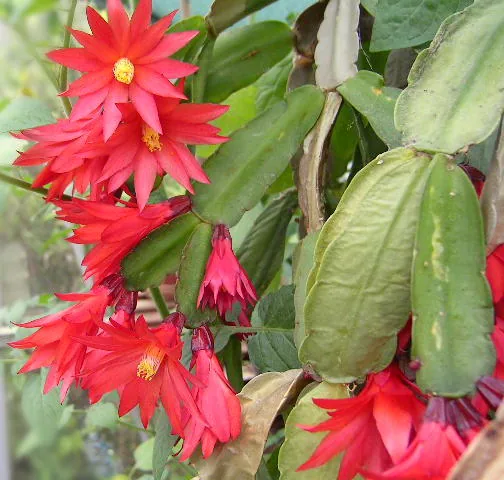
Give it a cool winter rest and a settled spot, and the Easter cactus tips its flat green segments with scarlet, star-shaped spring blooms.
Bright indirect
Every 7–14 days
50–77°F · 10–25°C
USDA 10–12
Overview
The Easter cactus opens its flowers in spring, around the holiday it is named for, and they emerge as scarlet stars at the very tips of its flat, jointed segments. It sits in the cactus family, yet it lives as a forest epiphyte, its roots clinging to tree branches in the Brazilian rainforest rather than anchoring in dry desert sand. Up close the plant looks nothing like a spiny desert cactus, since the segments are soft, fleshy, and flattened, built for shade, steady moisture, and humidity.
It is easy to mistake for the Thanksgiving and Christmas cacti until you study the segments. Each pad along its edges carries rounded, scalloped teeth rather than the sharp claw-like points of its cousins, and its color arrives in spring instead of midwinter. It is also the slower grower of the group, so the segments lengthen and the plant fills out only gradually, which makes a fully flowered specimen feel hard-won.
What it relies on is a cool, short-day rest through late autumn and winter, with lower temperatures and less water. That quiet spell is what sets the buds, the small swellings that later split into the scarlet stars. Skip it, or move the plant once those buds form along the segment tips, and the buds shrivel and fall before a single one can open.
Care
The short version: bright indirect light and no direct sun, with the top few cm of mix allowed to dry between waterings. Provide a cool, drier rest from autumn through winter to set the buds along the segment tips, and once they form, leave the plant in place.
Light
Place it in bright, indirect light and out of direct sun, which scorches the flat segments and flushes their green to a stressed red. It holds up in medium light or light shade, but the brightest spot short of a sunbeam draws the heaviest crop of flowers from the segment tips.
Water
Let the top few cm of mix dry, then water through and let it drain, roughly every 7 to 14 days. As a forest cactus the fleshy segments should never shrivel bone dry, yet soggy soil rots the roots quickly. Cut back through the autumn-to-winter rest, then keep watering even once the small buds set, since a sudden change loosens them from the tips.
Soil
Pot it in a well-drained, organic-rich mix that holds a little moisture without staying wet, the kind of cactus or epiphyte blend that suits its tree-perching roots. It prefers slightly acidic soil, a pH of 5.5 to 6.5.
Temperature
Ordinary room warmth of 50°F to 77°F (10°C to 25°C) keeps the segments plump and green through the year. The cool end of that range in autumn and winter, paired with shorter days, is what swells the buds into form.
Humidity
Average household humidity suits it, with no figure to hit. From the rainforest, it favors a little more moisture in the air, which keeps the segments firm, so a grouping of plants or a nearby pebble tray helps in dry winter rooms.
Feeding
Feed a balanced, diluted liquid houseplant fertilizer about once a month, from after flowering through the summer growth as new segments form. Stop feeding in autumn so the plant can settle into its rest.
Pruning
After the blooms fade, twist or pinch off a few of the terminal segments, the flat pads at the very ends of each chain, to push branching and a fuller, denser plant. Those detached segments are not waste, since each one roots into a new plant.
Repotting
Repot only every 3 to 4 years, after flowering, and only when the roots have truly filled the pot, since it flowers best a little pot-bound. White roots pushing from the drainage holes, mix that dries unusually fast, and a plant pushing few new segments all mark the time.
Size & spacing
It stays compact, reaching about 6 to 12 inches (15 to 30 cm) tall and spreading 12 to 16 inches (30 to 40 cm) wide, the chains of flat segments arching over as they lengthen. That arching, jointed habit gives it a trailing line well suited to a hanging pot or a shelf edge.
Troubleshooting
Most Easter cactus trouble shows on the plant itself in two ways: watering that swings too wet or too dry, and disturbance while it is in bud. Read the early changes in the segments and buds below and you can usually trace the cause before the flowers or roots are lost.
Segments turn limp, soft, or red at the base
When the flat segments go soft and flush reddish, the usual cause is root rot in soil kept too wet, though the same limpness appears when the mix bakes bone dry. Tug a segment and read the roots, since mushy brown roots mean rot while firm white roots in dust-dry mix mean drought. Cut the dead roots away and repot into fresh, fast-draining mix for rot, or water through and let it drain for drought.
Fix:
- If rotted, unpot, cut away mushy roots, repot into fresh well-drained mix, and water sparingly
- If drought-stressed, water thoroughly and let excess drain
- Salvage healthy segments as cuttings if the base is lost
Flower buds shrivel and fall before they open
Bud drop is the classic Easter cactus failing, and it follows change rather than neglect. Once the small buds swell at the segment tips, moving, turning, drafting, or rewatering the plant makes those buds shrivel and let go. Hold it in one steady spot, keep the top few cm just moist, and leave it untouched until the stars open.
Fix:
- Leave the plant in one spot once buds appear and avoid turning it
- Keep watering even and the top few cm just moist while budded
- Shield from heat vents, cold drafts, and doorways
White cottony tufts or sticky film at the joints
The white cottony flecks wedged into the segment joints are mealybugs, while small raised bumps glazed with sticky honeydew mark scale. Both multiply fast on the fleshy stems indoors, so isolate the plant the moment they appear. Lift the pests off with a cotton swab dipped in 70 percent alcohol, then follow with insecticidal soap until the joints are clean.
Fix:
- Dab pests with a cotton swab dipped in 70 percent isopropyl alcohol
- Treat with insecticidal soap, repeating per label
- Isolate the plant until clear
Toxicity
For a home with pets, the Easter cactus is not toxic. The ASPCA lists the whole holiday cactus group as safe for cats and dogs, and nothing in its fleshy green segments poisons people, horses, or other animals. A pet that swallows a large mouthful of the fibrous tissue might be briefly sick to its stomach, but that is the limit of it.
Safe for
People · Cats · Dogs · Horses · Rabbits · Livestock · Birds
Cats Safe
The ASPCA lists the holiday cactus group as non-toxic to cats, so a nibble will not poison one. A cat that eats a big mouthful of the fibrous stems might drool or be briefly sick to its stomach, and that is all.
Dogs Safe
No genuine threat reaches dogs from these fleshy stems. Should one bite off and gulp a sizable chunk, the coarse, fibrous tissue may trigger brief vomiting that clears up without help.
Horses Safe
Horses have nothing to fear from it, and being a compact indoor cactus, it seldom comes within their reach in any case.
Rabbits Safe
It is safe around rabbits. The fleshy segments hold no toxin, so a curious nibble does no harm.
Livestock Safe
There are no toxic compounds in the segments, so grazing animals are in no danger from it.
Birds Safe
Pet birds may land on the segments and tug at them safely, since the fleshy tissue holds nothing poisonous.
People Safe
It is harmless to people, including children. It is not grown to be eaten, but a tasted segment poses no poisoning risk.
Fibrous plant material can still cause mild stomach upset or vomiting if a pet eats a large amount.
Varieties
Most plants sold as Easter cactus descend from two species and the hybrids between them, distinguished by the color of their flowers. These are the names worth knowing.
Rhipsalidopsis gaertneri (type)
The original species opens scarlet, star-shaped spring flowers on flat segments whose edges carry rounded, scalloped, faintly bristled teeth.
Rhipsalidopsis rosea and its hybrids
Smaller and pink-flowered, this species interbreeds freely with R. gaertneri, and the resulting hybrids wear the pink, salmon, or white petals seen on Easter cactus plants sold now.
How to propagate
The Easter cactus regrows from its own jointed segments with ease, so a single plant yields several new ones once the cut pieces sprout roots.
Stem cuttingsEasy
After flowering in late spring or early summer · Roots in about 2 to 4 weeks; flowering-size plant in 1 to 2 years
Take cuttings right after flowering, in late spring or early summer. Twist off a piece of 2 to 3 jointed segments, let the cut end callus over for a day or two, then stand it in barely moist, well-drained mix in bright indirect light. Fine roots form in 2 to 4 weeks, though a young plant takes a year or two to reach flowering size.
Myths
Easter, Thanksgiving, and Christmas cactus are the same plant sold at different times.
They are three different plants. Easter cactus blooms in spring with rounded, scalloped segment edges and star-shaped flowers, while the Thanksgiving and Christmas cacti are Schlumbergera that bloom in late autumn and winter on segments with pointed or toothed edges. The Easter cactus is also the slower, more particular grower of the three.
Holiday cacti are poisonous to pets.
According to the ASPCA, holiday cactus rates as non-toxic to dogs and cats. Gnaw the fleshy, fibrous segments and the most that follows is a short bout of stomach upset, never real poisoning.
One fixed botanical name has stuck to this plant from the start.
Its classification has shifted for years, resting in Rhipsalidopsis, Hatiora, and Schlumbergera in turn. That is why you will see it sold under all three names, with gaertneri attached to each.