Shrub · Cactaceae
Dragon Fruit
Hylocereus undatus
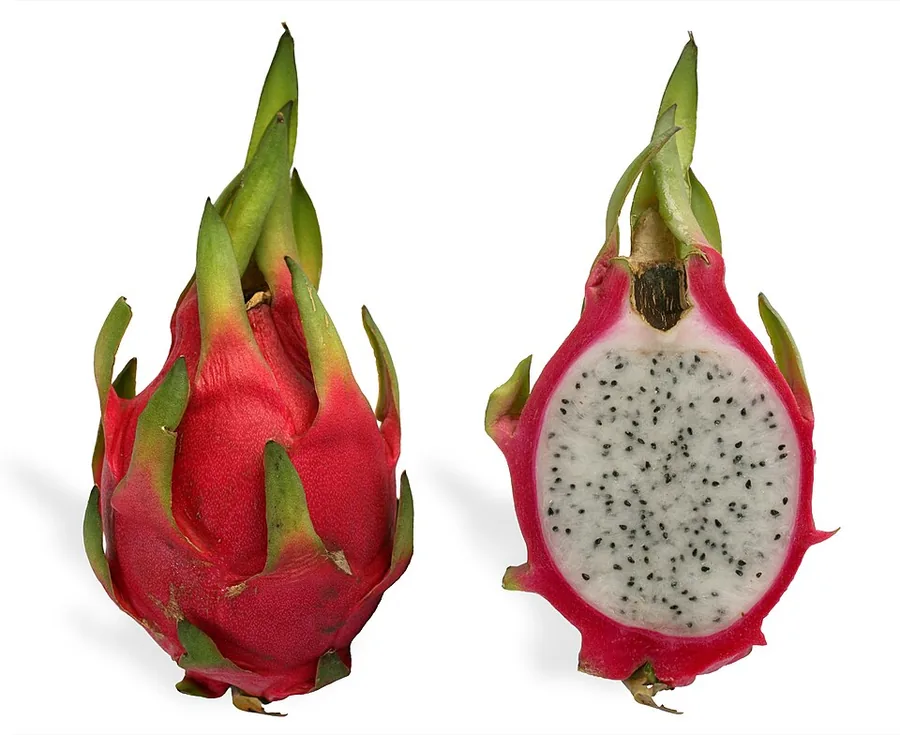
Long three-sided green stems scramble up a sturdy post, open huge white flowers for one night, and ripen into pink-skinned fruit packed with white, black-flecked pulp.
Full sun
Every 7–14 days
180–270 days
USDA 10–11
Overview
Dragon fruit is the fruit of a sprawling climbing cactus in the genus Hylocereus, grown through the warm tropics and subtropics. The plant sends out long, fleshy, three-sided green stems that scramble over whatever they touch and lean on a strong post or trellis to stay upright. The same plant answers to pitaya, pitahaya, strawberry pear, and the Honolulu queen.
The flowering is the spectacle. Huge white blooms unfurl for a single night, which is how the plant earned the name night-blooming cereus. Many of the common white-fleshed forms are self-incompatible, so a lone plant can open flower after flower and still set no fruit unless a second genetic type stands nearby to trade pollen.
The fruit itself is unmistakable: pink-to-red skin over snowy white pulp dotted with countless tiny black seeds. A cutting can spend 4 to 6 months rooting and most of a year reaching fruit, and a mature vine grows heavy enough to demand serious support. Sun, sharp drainage, and a solid frame keep those stems climbing for years.
Care
The short version: full sun, fast-draining soil, and a strong trellis for the heavy three-sided stems to climb. Water through flowering and fruiting but let the soil dry between drinks, keep it nearly dry in cool weather, and stand a second compatible clone close so those white flowers actually set fruit.
Light
Dragon fruit grows best in full sun, though it tolerates partial sun or light shade. Shade-grown cuttings scorch on their sun-facing side if pushed into bright light too fast, so hold them under about 30% shade for the first few months and ease the green stems into the sun.
Water
Water steadily while the plant flowers and fruits, then let the top half of the soil dry out before the next round, roughly every 7 to 14 days. This is a drought-tolerant cactus, so keep it nearly dry through cool winter weather, when soggy roots turn the firm green stems to rot.
Soil
Set it in well-drained sandy loam worked full of organic matter, since sharp drainage is what keeps those fleshy stems and roots from rotting. A pH of 6.0 to 7.0 suits it, sitting right around neutral.
Temperature
It runs on real warmth, anywhere from 50°F to 100°F (10°C to 38°C), and frost will injure or kill the stems. Wait to plant until the soil has warmed past about 65°F (18°C) in spring.
Humidity
Ordinary air suits it, somewhere near 40% to 60%, with no need to chase the number. Moving air does more good than damp air, since crowded, wet stems invite canker and rot on the green flesh.
Feeding
Feed through the active season from spring into fall with a balanced 6-6-6 carrying micronutrients. Keep the doses light at the start and raise them as the plant ages and hauls more stem weight.
Pruning
Prune one to three times a year to clear out weak, damaged, or diseased stems and open the plant up. Once a stem climbs to the top of the trellis, pinch the tip to drive it into the branching, fruiting growth you are after.
Repotting
Dragon fruit usually goes straight into the ground, but in a container repot every 1 to 2 years until it establishes. After that, settle it against a permanent strong post, since the mature stems grow far too heavy to move.
Size & spacing
The stems climb 6.5 to 20 feet (2 to 6 m) and the plant spreads 3 to 10 feet (1 to 3 m) across, so leave it real room. Set it 15 to 25 feet from trees, buildings, and power lines, and back the whole mass with a sturdy post and trellis.
When to plant
Dragon fruit is a tropical cactus that frost will not spare. Set the stems out in spring once the cold has lifted and the soil has warmed, watch for the huge white flowers from late spring through fall, and gather the pink-skinned fruit from summer into early winter.
Northern hemisphere
Southern hemisphere
Typical months for a temperate climate: start earlier in warm zones, later where spring frosts linger.
- Plant: After all frost danger in spring once soil is warm (above 65°F).
- Harvest: Night-blooming flowers from late spring through fall; fruit ripens summer to early winter.
Hardiness
USDA hardiness zones: 10–11
Temperature: down to -1°C
Troubleshooting
Most dragon fruit trouble shows on the fleshy green stems, whether from fungus, standing water, or scorching sun, while a stubborn lack of fruit nearly always traces to pollination. Read these signs on the stem early and you can step in before a small lesion or soft spot spreads. Match what you see below, then act while it still does some good.
Sunken orange-brown lesions pitting the green stems and fruit
Those caved-in orange-brown lesions, often crusted with reddish-orange spore masses, are stem and fruit canker, a fungus that slips in through wounds in the fleshy stem and travels on splashing water. Cut away and burn every marked stem and fruit, stop wetting the plant from overhead, and turn to a labeled fungicide if the spots keep advancing. Begin with clean, disease-free cuttings and space the stems so air moves freely between them.
Fix:
- Remove and destroy infected stems and fruit
- Avoid overhead irrigation
- Apply a labeled fungicide
Yellowing, soft stems caving in at the base
When the firm green stem turns soft and brown at the soil line, that collapsing tissue is stem and root rot, nearly always the result of standing water in soil that drains too slowly. Cut your watering right away and slice the rotted segments off until the blade meets firm green flesh again. The lasting cure is a fast-draining mix and the discipline of letting the soil dry out between waterings.
Fix:
- Reduce watering
- Improve drainage
- Cut away rotted segments back to firm green tissue
A heavy show of white flowers but almost no fruit
Plenty of dragon fruit clones are self-incompatible, so a single plant can throw its huge white blooms night after night and still set nothing. The fix is to grow two or three different genetic types side by side so their pollen can cross. Because each flower opens for only one night, you often have to carry pollen by hand after dark or at first light.
Fix:
- Plant 2 or 3 different genetic types
- Hand-pollinate flowers at night or early morning
Bleached, scalded patches on the sun-facing edge of the stems
Those pale, bleached patches on the side facing the light are sunburn, the mark of a shade-grown cutting thrown into full sun too quickly. Shelter young plants under about 30% shade for the first 3 to 4 months and step them into brighter light a little at a time. The scorched tissue will not green up again, but fresh growth comes in clean once the plant has hardened off.
Fix:
- Provide about 30% shade for the first 3-4 months
- Acclimate plants to sun gradually
Toxicity
Easy news for a home with animals: dragon fruit is non-toxic. The ASPCA lists pitaya as safe for cats and dogs, and the white-pulped fruit is grown to be eaten by people, seeds and all. The one thing to mind is the small spines set in the areoles along the stems, which prick skin, so pull on gloves to handle or harvest.
Safe for
People · Cats · Dogs · Horses · Rabbits · Livestock · Birds
Cats None
The ASPCA rates dragon fruit non-toxic to cats, so a curious nibble carries no poison. The catch is physical: the areoles along the fleshy stems hold small spines that can prick a mouth, so it is wise to keep a cat off the stems.
Dogs None
Dogs sit on the ASPCA non-toxic list as well, so the fruit and stems hold no poison for them. The only real hazard is the bristly areoles on the green stems, which can scratch a probing nose or mouth.
Horses Safe
No part of the plant poisons a horse. The thick three-sided stems do carry small spines that can catch the lips, so there is no good reason to let a horse browse on them.
Rabbits Safe
Rabbits run no toxic risk from dragon fruit. A taste of the white pulp is harmless as an occasional treat, but the spine-studded stems are not something a rabbit should gnaw.
Livestock Safe
Cattle, goats, and sheep can stand near dragon fruit with no fear of poisoning. The spines on the stems are the lone nuisance, since they prick the mouth of any animal that tries to graze the green flesh.
Birds Safe
Birds can take a bit of the ripe pink-skinned fruit with no harm. Keep them clear of the stems, where the fine bristles in the areoles can snag a beak or feet.
People Safe
The fruit is grown to be eaten and is safe down to the tiny black seeds. Pull on gloves before handling or harvesting the stems, since the areoles bear small spines that prick bare skin.
Stems are nearly spineless but bear areoles with small spines and bristles that can prick skin; wear gloves when handling, training, or harvesting.
Varieties
Growers pick dragon fruit as much for whether it will set fruit as for the white pulp inside. These are the types worth knowing before a single stem goes in the ground.
White-fleshed types (H. undatus)
The familiar pink-to-red skin wraps a snowy white pulp speckled with tiny black seeds, and because many of these clones are self-incompatible, they have to grow alongside a partner type to set any fruit.
Vietnam White ('Vietnam #1')
A chosen white-fleshed clone valued for its large pink fruit, measuring a sweetness of 13% to 19% soluble solids in CTAHR trials.
Self-fertile selections
Breeders in Taiwan and Vietnam have raised productive pitaya that set fruit on their own, sparing you the second clone that the older self-incompatible types demand.
Companions
Plant near
Second compatible dragon fruit clone: A different genetic type provides the cross-pollination needed by self-incompatible H. undatus cultivars.
How to propagate
Nearly everyone starts dragon fruit from a length of three-sided stem, which roots fast and comes true to the parent. Seed will sprout from the tiny black flecks in the pulp, but it tests your patience and never gives back the same plant.
Stem cuttingsEasy
Warm season (spring to summer) · Roots in 4-6 months; fruit in 6-9 months
Cuttings are how nearly everyone begins a dragon fruit, taken in the warm stretch from spring through summer. Slice 6 to 15 inch (15 to 38 cm) sections of the three-sided stem, let the cut wounds dry over for a few days, then press them into a well-drained mix. Roots form in about 4 to 6 months and fruit can follow within 6 to 9, and once the cutting takes hold the stems push out as much as 3 cm a day.
SeedModerate
Warm season · Up to 7 years to fruit
The tiny black seeds scraped from the white pulp can be sown in the warm season and germinate readily. Patience and luck are the cost: seedlings creep along, can take up to 7 years to fruit, and never come true to the parent, which is why seed almost never starts a serious crop.
Myths
Dragon fruit plants are toxic or dangerous to pets.
The ASPCA lists pitaya as non-toxic to both dogs and cats, so a curious pet faces no poisoning risk. The hazard is purely physical: the small spines tucked in the areoles along the stems, which can prick a mouth or paw.
A single dragon fruit plant will always fruit on its own.
Many H. undatus clones are self-incompatible and open their huge white flowers night after night without ever setting fruit alone. Plant a second genetic type within reach, and stand ready to move pollen by hand after dark, since that is often what turns a bloom into fruit.
Dragon fruit grows as a tree.
For all the height it reaches, this is a climbing, sprawling cactus rather than a tree. It pushes out long, fleshy, three-sided stems that clamber over anything within reach, so it has to lean on a strong post or trellis to stand.