Ornamental · Asteraceae
Globe Thistle
Echinops ritro
Give it full sun and lean, dry soil, and globe thistle raises perfectly round, steel-blue globes the bees crowd over.
Full sun
Every 7–14 days
USDA 3–8
3–4 ft · 0.9–1.2 m
Overview
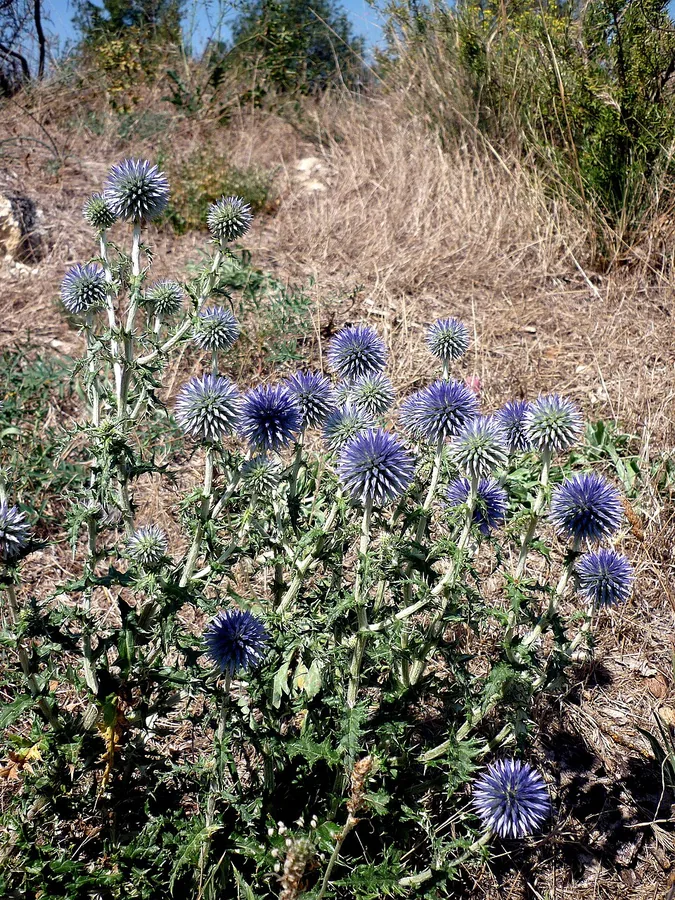
Globe thistle is named for exactly what it shows: a perfectly round, steel-blue flower head the size of a golf ball, packed tight with tiny florets and studded with fine, bristly points that catch the light with a metallic gleam. These globes ride singly atop stiff, upright stems in midsummer, and up close the whole head reads as a spiny blue sphere rather than the flat face of a typical daisy relative.
The foliage beneath is just as distinct, cut into deep, jagged lobes that end in sharp, prickly tips along coarse, thistle-like leaves. Run a hand near it and the message is clear: this plant bristles. The stems stand rigid and self-supporting on lean ground, holding each steel-blue globe aloft over the mound of spiny green leaves, and a deep taproot anchors the clump out of sight below.
By season's end the color drains and the round heads dry to a firm, seed-filled ball that keeps its shape long after cutting. In bloom, the fresh globes hum with bees and butterflies working the tightly clustered florets. It is a plant of hard edges and clean geometry, spiny leaves and a stiff frame carrying those blue spheres straight up.
Care
The short version: full sun, lean and well-drained soil, and a light hand with the water. Feed rarely, leave the deep taproot undisturbed, and deadhead the spent, drying globes to hold back the self-seeding.
Light
Globe thistle wants full sun pouring straight onto its spiny leaves and stiff stems. It will take a little light shade, but out of the sun the stems stretch thin and the globes bow and lean, so give it the brightest spot in the bed.
Water
This is a drought-tough plant that keeps its firm, upright form best in dry to medium soil once settled. Let the top half of the soil dry between waterings, roughly every 7 to 14 days, and lean toward too little. Standing wet is the fastest way to rot the roots under the crown.
Soil
Plant it in poor to average, well-drained ground, the leaner the better for stiff, self-supporting stems. It takes clay, loam, sand, and shallow rocky soil at a pH of 6.0 to 6.5, but wet or rich organic soil softens the stems into floppy growth and invites rot.
Temperature
The clump is remarkably cold-hardy, holding through winters down to -29°F (-34°C) and shrugging off summer heat up to 90°F (32°C). That range covers most temperate gardens without protection.
Humidity
Ordinary outdoor humidity suits it, so there is no figure to chase. Air moving through the spiny leaves matters more than moisture in the air, since still, crowded conditions let a powdery gray film settle onto the foliage.
Feeding
Feed it almost never. On lean, nutrient-poor soil the stems stay stiff and hold the heavy globes upright, while rich feeding pushes soft, floppy, lanky growth that bows and needs staking.
Pruning
Deadhead the spent, drying globes to tidy the plant and cut back the self-seeding. After bloom or in late fall, cut the stiff stems down to the low basal rosette of spiny leaves. For drying, cut the globes while they are still young and blue.
Repotting
It rarely needs repotting and is happiest in open ground where the thick taproot can drive deep. In a container, watch for reduced vigor or roots circling the pot, the sign it has outgrown its space.
Size & spacing
Stems rise 3 to 4 feet (91 to 122 cm) tall over a mound of spiny leaves spreading 24 to 30 inches (61 to 76 cm) wide. Give each clump that much room so air moves through the prickly foliage and keeps it dry.
When to plant
Globe thistle is a cold-hardy perennial that pushes up fresh spiny foliage from its crown each year. Start seed indoors in late winter, set plants out after the last spring frost, and the steel-blue globes swell and open from midsummer through September.
Northern hemisphere
Southern hemisphere
Typical months for a temperate climate: start earlier in warm zones, later where spring frosts linger.
- Sow: Late winter to early spring, 6-8 weeks before last frost
- Plant: After last spring frost
- Harvest: Mid-summer through September
Hardiness
USDA hardiness zones: 3–8
Temperature: down to -40°C
Troubleshooting
Globe thistle is one of the most trouble-free perennials you can grow, and almost every problem shows first in how the plant looks: softened roots, stems that lean and flop, or a powdery gray film dulling the green leaves. Match what you see below and adjust the site before it spreads.
Limp, yellowed foliage above brown, mushy roots
Leaves that sag and fade to yellow, then a whole plant that folds over, point to root rot, and on a plant this fond of dry ground it almost always means too much water. Down below, the roots turn from firm and pale to mushy and brown in soggy or heavy, rich soil. Ease off the water so the soil dries, sharpen the drainage or lift the plant to leaner, sunnier ground, and cut away any root gone soft past saving.
Fix:
- Reduce watering and allow soil to dry out
- Improve drainage or relocate to a well-drained, sunnier site
- Remove and discard severely rotted plants
Thin, overstretched stems bowing toward the ground
Stems that shoot up thin and then bow under the weight of their globes are showing floppy growth, driven by too little sun or too rich a soil. The stiff, upright stalks globe thistle should hold go soft and lean instead. Move the plant into full sun, withhold feeding to firm the stems, and prop the tallest with a stake where they still lean.
Fix:
- Move to full sun
- Avoid feeding and grow in lean soil
- Stake taller stems if needed
Leaves dusted in a chalky white bloom
A dusty white-to-gray bloom creeping over the green blades is powdery mildew, which takes hold where the air hangs still in crowded or shaded plantings. Thin and space the plants so a breeze can pass, strip off the most heavily dusted leaves, and set the plant in full sun. The coating spoils the look of the foliage but stays cosmetic and does no real harm.
Fix:
- Improve air circulation by spacing and thinning plants
- Remove affected foliage
- Site in full sun
Puckered young shoots glazed in sticky residue from tiny insects
Curled, twisted new leaves and a sticky sheen usually mean tiny clustered aphids, with the odd pale mining trail from leaf miners, thrips, or the ragged holes of slugs and snails. This is a tough, prickly, pest-resistant plant, so the damage rarely runs deep. Knock the aphids off with a jet of water, pluck slugs and snails away by hand, and let a little nibbling go.
Fix:
- Hose off aphids with water
- Hand-pick slugs and snails
- Tolerate minor damage as the plant is generally pest-resistant
Toxicity
Reassuring for a home with pets and children: globe thistle is not poisonous. NC State Extension reports it as non-toxic to cats, dogs, and horses, and nothing in the plant will harm people. The hazard is purely physical, since the leaves end in sharp spines and the globes bristle, so wear gloves around the spiny foliage and prickly flower heads.
Safe for
People · Cats · Dogs · Horses · Rabbits · Livestock · Birds
Cats None
Nothing in the plant poisons a cat. The sharp-tipped, spiny leaves are the only hazard, and they can prick a curious mouth or paw.
Dogs None
A dog can chew it with no toxic effect. The stiff, bristly leaves and the prickly globe heads are the worst it meets, and one sharp jab usually ends the interest.
Horses None
Safe for horses, with no toxins in the plant. Most steer clear of the coarse, spiny growth on their own.
Rabbits None
No poison reaches a rabbit here, and the bristling spines usually turn it away before a bite.
Livestock None
Grazing animals can browse close by unharmed. The rough, prickly foliage keeps most of them off it regardless.
Birds None
Harmless to birds, which pick over the dry, seed-filled globes for food. The fresh steel-blue heads also draw the bees and butterflies the plant is loved for.
People None
Not poisonous to touch or be near. Pull on gloves before cutting or arranging it, since the spine-tipped leaves and bristly globes scratch bare skin.
Wear gloves when handling; the spiny leaves and prickly globe-shaped flower heads can scratch or prick skin.
Varieties
The straight species carries the classic spiny blue globe, but a few named selections shift the color and size of that head and the stems that hold it.
Veitch's Blue
A more compact plant at 3 to 3.5 feet, it carries deeper steel-blue globes and holds them longer and more freely than the species.
Platinum Blue
Its stems gleam silvery-white beneath soft lavender-blue flower heads.
subsp. ruthenicus
A subspecies grown as a smaller globe thistle, marked by finely cut foliage felted white and woolly.
Companions
Globe thistle pairs best with other sun-loving, drought-tough plants that want the same lean, dry soil and bring in the same pollinators.
Plant near
Yarrow: Shares full-sun, dry, well-drained, lean-soil conditions and supports pollinators alongside globe thistle.
Russian sage: Matches drought-tolerant, full-sun growing needs and complements the steel-blue blooms.
Sedum: Thrives in the same poor, dry, well-drained soils and sunny exposure.
How to propagate
You can raise more globe thistle from seed, division, or root cuttings taken from the fleshy taproot, though that deep root makes seed the simplest route by far.
SeedEasy
Sow in spring; self-seeds readily in the garden · One to two seasons to reach flowering size
Seed is the easiest route. Sow in spring, and the plants take one to two seasons to build up to flowering size and their first steel-blue globes. Left standing, the dry heads shed seed and self-seed freely around the garden.
DivisionDemanding
Spring or early fall · One season
Division is possible in spring or early fall but hard going, since the thick, deep taproot resents being cut and disturbed and needs about a season to settle again. Most gardeners simply leave the clump where it stands.
DivisionModerate
Spring · Several weeks to root
Root cuttings work in spring, taken by slicing sections from the pale, fleshy taproot rather than the stems. Each section roots into a new plant over several weeks.
Myths
Under the steel-blue globes hides a noxious weed whose foliage poisons livestock.
Its spiny, thistle-like look invites confusion with the weedy field thistles, but it is a garden perennial that NC State Extension reports as non-toxic to cats, dogs, and horses. It is an ornamental, not a noxious or poisonous plant, though it will self-seed if the flower heads are left to ripen.
Those silvery clumps have to be dug up and split on a regular cycle or they lose strength.
Under the crown sits a thick, deep taproot that clings hard and makes lifting and dividing a wrestle. The plant does best left undisturbed in place, and it seldom needs the splitting many perennials want.