Ornamental · Crassulaceae
Sedum
Sedum
Thick, water-swollen leaves and fleshy stems give stonecrop its plump, succulent look.
Full sun
50–77°F · 10–25°C
USDA 3–9
4–24 in · 10–60 cm
Overview
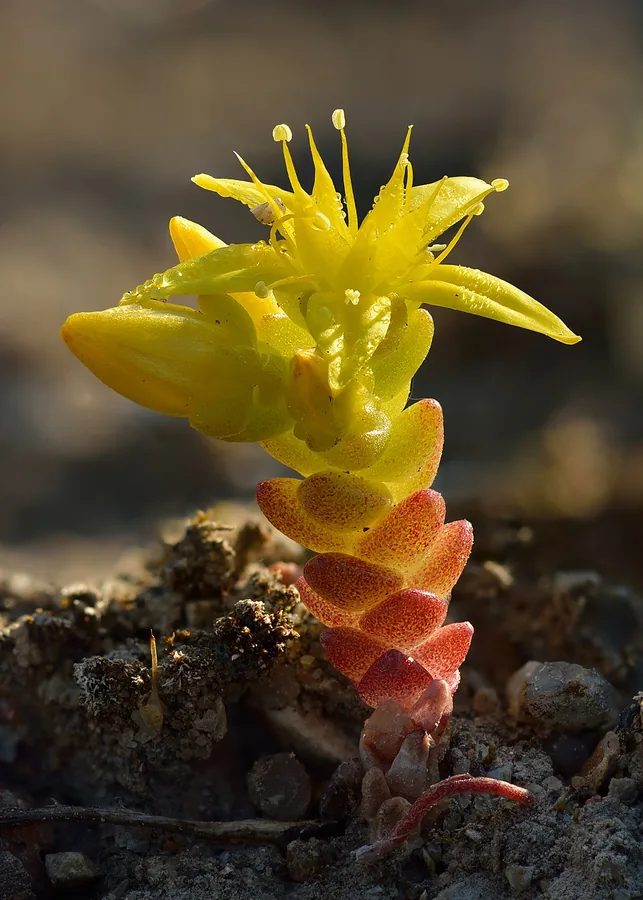
Sedum, or stonecrop, wears its succulence on the outside: thick, water-swollen leaves and fleshy stems that feel firm and plump between the fingers. It sits in the Crassulaceae family, and that stored water is what keeps the foliage taut through a dry spell. The genus runs hardy across zones 3 to 9, and the same plump, fleshy character shows on every one of its forms.
Up close, no two sedums are shaped alike. The upright kinds hold thick, fleshy stems that stand stiff and end in flat clusters of bloom. The creeping kinds press low to the ground, their small plump leaves lined along trailing stems that root where they touch. Across the genus, the plants stand anywhere from 4 to 24 inches (10 to 60 cm) tall.
The same plump tissue that makes sedum handsome is also its weak point. In firm, gritty, fast-draining soil the stems stay taut and full. In wet ground, though, those fleshy stems go soft, translucent, and mushy, blackening at the base as they collapse, the most frequent way the plant is lost. Sharp drainage is what keeps it looking solid.
Care
The short version: sedum keeps its plump, firm look on full sun and gritty, sharp-draining soil, watered only once the mix has dried out completely. A light feed while it grows, a pinch of any thin, stretched stems, and no standing water keep the foliage taut.
Light
In full sun, a few hours a day, sedum stays tight and plump, its leaves holding their deepest color. Partial sun or a bright indirect spot indoors will do, but in dim light the stems stretch thin and pale and the leaves pull apart along them.
Water
Water sedum well, then leave it until the soil has dried out completely. The plump leaves are a built-in canteen, so they stay firm through a missed watering, while a soggy pot turns the stems soft. Standing moisture is what rots the stems and roots.
Soil
Sedum sits best in a gritty, well-drained mix studded with coarse grit that water runs straight through. A pH of 6.0 to 7.0 suits it, though the grit and drainage count for far more than the number. Heavy, sodden soil is the one thing its fleshy roots cannot take.
Temperature
Sedum holds its plump form across 50°F to 77°F (10°C to 25°C). The hardy kinds take winter cold outdoors in zones 3 through 9, their crowns dying back and the fleshy tops returning in spring, while indoor plants sit at ordinary room warmth.
Humidity
Low humidity leaves sedum untroubled; the water is already inside the leaves, so dry indoor air changes nothing. No humidity number matters here. Damp, still air is the real threat, softening tissue that should stay firm.
Feeding
Feed lightly from spring through summer while the plant is filling out, about once a month, with a balanced water-soluble fertilizer at half strength. Overfeed and the new leaves come in soft and pale and swollen, easy to rot and easy for pests to pierce.
Pruning
After the flat heads finish, cut back the spent stalks to bare stem. Pinch off any thin, stretched shoots so the plant stays dense, and cut away soft, rotted tissue the moment a stem turns squishy. The cuts heal over to a dry callus.
Repotting
Move sedum to a fresh pot every 2 to 3 years, or sooner when roots coil against the walls and fill the space. Soil that dries almost overnight, and new growth that shrinks to little rosettes, both mark a plant packed tight in its pot.
Size & spacing
Grown out, sedum stands 4 to 24 inches (10 to 60 cm) tall and spreads its leafy stems to about 12 to 24 inches (30 to 60 cm) across. The creepers knit into a low carpet of leaves; the clumpers pile into a rounded, fleshy mound.
When to plant
Sedum is a hardy perennial, its fleshy crowns returning each year, so there is no seed-starting clock to mind. Plant or divide it in spring as the plump new growth swells, and the flat flower heads color up from summer into fall, the shade and timing shifting with the species.
Northern hemisphere
Southern hemisphere
Typical months for a temperate climate: start earlier in warm zones, later where spring frosts linger.
- Harvest: Summer to fall depending on species
Hardiness
USDA hardiness zones: 3–9
Temperature: down to -40°C
Troubleshooting
A sedum tells you how it feels through its stems and leaves. Firm and full means all is well; soft, stretched, or fuzzy means something needs attention. Match the look and feel below, then set it right.
Stems gone soft, translucent, and dark at the base
When the stems turn soft and translucent and blacken low down, that is rot eating through the fleshy tissue, brought on by overwatering or soil that never dries. Slice back to stem that is still firm and solid inside, let the cut faces dry to a callus, and root those pieces in dry, gritty mix with no water yet. Once the pot drains freely and the mix dries fully between drinks, the soft collapse stops.
Fix:
- Cut away all soft, rotted tissue back to firm healthy growth
- Allow healthy cuttings to callus and re-root in dry, gritty mix
- Withhold water until new roots form
Cottony white specks packed into the leaf joints
The mealybugs show up as little cottony white tufts wedged where leaf meets stem, trailing a sticky, shiny film. Roll each tuft off with a cotton bud wet with 70 percent isopropyl alcohol, and go back over the plant every few days until the leaf joints are clean. Kept apart from the other succulents for a while, it clears without the pests moving on.
Fix:
- Dab insects with a cotton swab dipped in 70 percent isopropyl alcohol
- Repeat treatment every few days until clear
- Isolate the plant from other succulents
Stems drawn long and thin, leaves spaced far apart
Stems that draw out long and thin, with the leaves set far apart and the color washed pale, are showing etiolation, the shape a sedum takes when the light is too weak. Give it a spot in direct sun for several hours and the new growth comes back short and packed. Pinch off the drawn-out tips; each one, plump and rootless, will strike roots in gritty mix and grow into a fresh plant.
Fix:
- Move the plant to a brighter location with several hours of direct sun
- Pinch or cut back stretched stems to encourage compact regrowth
- Use the trimmed tips as cuttings
Toxicity
Handling sedum is safe: the fleshy leaves and stems hold no toxins that harm cats, dogs, horses, or other animals, and the ASPCA lists the plump-leaved burro's tail as non-toxic. A bitten leaf might leave a pet with mild stomach upset, as any non-food plant would, but nothing in the tissue does real harm.
Safe for
People · Cats · Dogs · Horses · Rabbits · Livestock · Birds
Cats None
Safe around cats. Should one chew a fleshy leaf, expect no more than a little drool or a short, mild stomach upset, the usual result of eating a plant that isn't food.
Dogs None
Safe for dogs. A mouthful of the plump leaves does little more than upset the stomach briefly, and that seldom happens at all.
Horses None
Safe for horses. Nothing in the fleshy leaves or stems will harm one that grazes it.
Rabbits None
Safe for rabbits. Its thick leaves carry no toxin, though sedum belongs on the sill as a houseplant, not in a rabbit's daily greens.
Livestock None
Safe near livestock. Cattle, sheep, and goats can crop the ground beside a planting, since stonecrops are not among the plants that poison pasture.
Birds None
Safe for birds, whether kept or wild, since nothing in the fleshy tissue is toxic to them.
People None
Safe in the hand, and a few stonecrops turn up on the plate in small amounts. Even so, sedum is grown for its plump, sculptural leaves, not for eating.
Varieties
Sedum runs to hundreds of species, and their leaves and flowers look wildly different from one to the next. These three sit at the extremes and show how much the foliage can change.
Sedum spectabile / 'Autumn Joy'
An upright type of thick, fleshy stems, each capped by a wide, flat cluster of pink flowers that deepens to rust through fall.
Sedum acre
A low, creeping goldmoss stonecrop whose tiny yellow-green leaves crowd the stems, lit in bloom by a haze of small yellow flowers.
Sedum spurium
A mat-forming creeper whose small, rounded, scalloped leaves overlap into a dense, low carpet.
How to propagate
Sedum grows new plants from the smallest pieces of itself. A single plump leaf, dropped on the soil, will swell a knot of roots and a tiny rosette at its base, and one plant becomes many.
Stem cuttingsEasy
Spring through summer during active growth · 2 to 3 weeks to root
Snap off a stem tip in spring or summer while the growth is soft and active. Stand the cut end in the air a day or so until it dries to a firm callus, then seat it in gritty mix kept just damp. Fresh roots push out in about 2 to 3 weeks.
Leaf cuttingsEasy
Spring through summer · 3 to 6 weeks to form plantlets
A single plump leaf, laid on dry, gritty mix through spring or summer, does the rest on its own. At the point where it once joined the stem, a small rosette swells and sends down roots, a whole new plant, within about 3 to 6 weeks.
DivisionEasy
Early spring · 2 to 4 weeks to settle
The clump-forming border kinds pull apart in early spring. Lift the fleshy crown from the soil, break it into rooted chunks, and set each back so the leaves sit at the old soil line. New roots take hold over about 2 to 4 weeks.
Myths
A plump succulent like sedum gets by on neglect alone, never needing water.
Those fat leaves store water, true, but a growing sedum still wants a full soak now and then to keep them plump. The real threat comes from the other side. Too much water, not the odd dry spell, turns the stems to mush.