Houseplant · Crassulaceae
Jade Plant
Crassula ovata
Give it bright light and a dry-out between waterings, and the jade plant thickens into glossy, jade-green leaves the rest of your houseplants can't match.
Full sun
50–75°F · 10–24°C
USDA 10–11
1–6 ft · 0.3–1.8 m
Overview
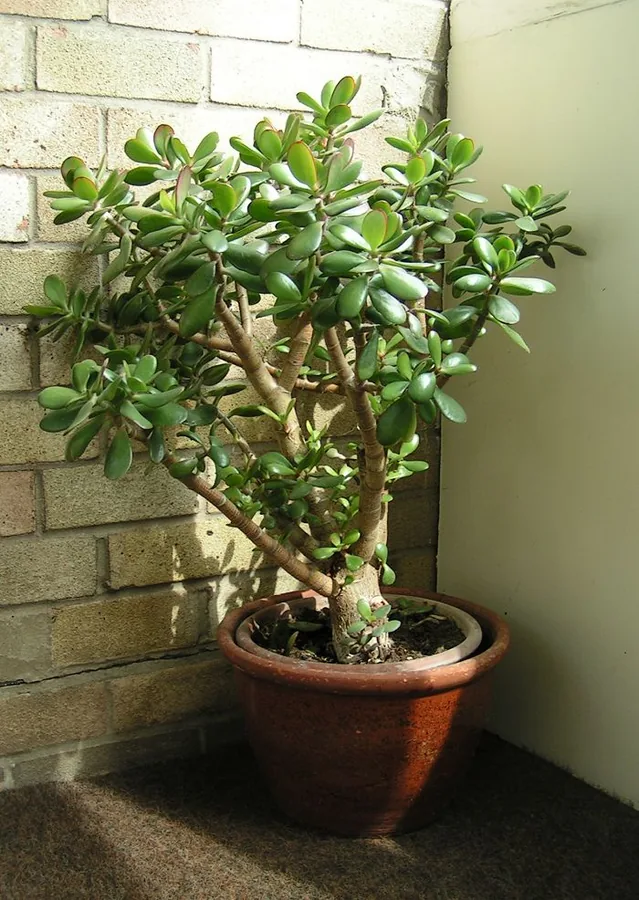
The jade plant is a succulent from southern Africa dressed in thick, glossy, oval leaves of deep jade green, each one swollen with the water it hoards. Those fleshy leaves crowd along stout stems that harden with age into a short, woody trunk the color of pale bark. In good light the leaf edges often catch a thin line of red, and that stored moisture is why the plant shrugs off the neglect that ruins thinner-leaved houseplants.
It builds slowly but lasts. A jade can live for decades and climb to 1 to 6 feet (30 to 180 cm) indoors, its trunk thickening and gnarling into a bonsai-like frame studded with plump leaves. Its folk names, money plant and lucky plant, hint at coins, though the real character is in that thick, jade-green foliage rather than any charm.
The one thing those swollen tissues cannot take is a soggy pot. Nearly every jade lost was overwatered, not underwatered, its plump stems rotting soft from the base. Get the watering and drainage right and the leaves stay firm, glossy, and full.
Care
The short version: bright light with some direct sun, a gritty fast-draining mix, and water only after the soil has dried out completely. Keep it warm, feed it lightly in the growing season, and hold back on water so the fleshy leaves stay firm rather than rotting.
Light
Jade colors up and stays dense in bright light with several hours of direct sun, so a south-facing window feeds it best, often reddening the leaf edges. In low light the stems stretch thin and lean, and the new leaves grow pale and far apart as they reach for the glass.
Water
Water it deeply, then wait until the soil has dried out completely before the next drink, with far less in winter. Overwatering rots the plump stems from the base and is the leading killer, while too little only wrinkles the leaves, which swell smooth and firm again after a soak.
Soil
Plant it in a gritty cactus or succulent mix that drains fast, always in a pot with drainage holes. A slightly acidic pH of 6.0 to 6.5 suits it, and the loose, sandy texture keeps water off the fleshy roots.
Temperature
Ordinary room warmth is ideal, roughly 50°F to 75°F (10°C to 24°C). Cold drafts and any dip below 50°F (10°C) can shock the plump leaves into dropping suddenly.
Humidity
This dry-climate plant prefers low humidity, and its water-filled leaves want no help from damp, stuffy air. Misting is unnecessary, since normal household air is plenty.
Feeding
Feed monthly through spring and summer while the leaves and stems are actively swelling, then stop for winter. A balanced or low-nitrogen succulent fertilizer diluted to half strength is all it needs, since jade grows slowly.
Pruning
Pinch or prune in spring to build a fuller, tree-like crown and to take out thin, leggy, or weak stems. Jade tolerates hard pruning, and each fleshy piece you cut roots easily as a fresh cutting.
Repotting
Repot every 2 to 3 years in spring, or when roots push through the drainage holes and the leaf-heavy crown turns top-heavy. Set it in a slightly larger pot with fresh gritty mix, and keep water light for a week or so afterward.
Size & spacing
Indoors a jade reaches 1 to 6 feet (30 to 180 cm) tall with a spread of about 1 to 3 feet (30 to 90 cm), its thick trunk and heavy leaves building real weight up top. Growth is slow, so a stable, heavy pot keeps that dense crown from tipping over.
Troubleshooting
Nearly every jade problem shows up first in the leaves and stems, in the way they feel and look. Soft, mushy, darkening growth means too much water, while wrinkled, creased, or stretched growth means too little water or too little light. Match what your fingers and eyes find below and you can usually catch it before the plant is lost.
Soft, mushy stems and yellowing at the base
When the once-firm stem base turns soft, dark, and yellow under the fingers, that collapse is root and stem rot, brought on by water lingering around the roots. Tissue this far gone will not firm up again, so cut back through the softened flesh to pale, solid growth and let the wounds dry, or grow on from a firm cutting instead. From then on the soil goes bone dry before the next watering.
Fix:
- Stop watering immediately and allow the soil to dry out
- Remove the plant, cut away rotted roots and tissue, and let cuts callus
- Repot into fresh, fast-draining gritty mix
- Propagate healthy stem or leaf cuttings if the base is lost
Leaves dropping all at once
Plump green leaves letting go all at once and scattering across the soil is the plant's response to stress from a sudden change in light, temperature, or watering. The trigger is usually a recent move, a cold draft, or a swing from dry to soaked. Held in one steady spot and routine, and kept clear of cold below 50°F (10°C), the plant slowly steadies and stops shedding.
Fix:
- Stabilize location, light, and watering routine
- Protect from cold drafts and temperatures below 10°C
- Allow the plant to acclimate gradually to new conditions
Wrinkled, shriveled, or drooping leaves
Leaves that once felt taut and swollen turning soft, creased, and floppy over dry soil is the look of underwatering, the plant spending down the water packed inside each leaf. A deep soak until it runs from the bottom refills them, and the next drink waits until the leaves soften again. Within a day or two they swell back to their smooth, rounded fullness.
Fix:
- Water thoroughly until it drains from the bottom
- Resume a regular dry-out watering cycle
- Move out of excessive heat if leaves continue to shrivel
Stretched, leggy stems with gaps between leaves
Stems that grow long and thin with pale new leaves spaced far apart, leaning toward the window, show the plant starved of light, a state called etiolation. A bright south-facing window with a few hours of direct sun feeds it, and a turn now and then keeps the growth even on all sides. The drawn-out sections stay stretched, but pruning them back coaxes the plant into its dense, thick-stemmed, tree-like shape once more.
Fix:
- Move to a brighter spot with several hours of direct sun
- Rotate the plant periodically for even growth
- Prune leggy stems to restore a compact shape
Toxicity
Keep the jade plant away from cats and dogs. The ASPCA lists it as toxic to both, and a pet that bites into the thick, sap-filled leaves can vomit, turn lethargic, walk unsteadily, and develop a slowed heartbeat. Oddly, the exact toxin in that flesh has never been identified, so the plant belongs where pets cannot reach it. For people it poses essentially no risk.
Toxic to
Cats · Dogs · Horses · Rabbits · Livestock · Birds
Safe for
People
Cats Moderate
A cat that bites into the thick, sap-filled leaves tends to vomit and turn dull and sluggish. A wobbly, uncoordinated walk can follow, and after a larger bite the heartbeat runs slower than normal.
Dogs Moderate
A dog that crunches the fleshy leaves usually throws up and goes quiet and low on energy. Some become unsteady on their feet, and a slowed heartbeat can follow a bigger mouthful.
Horses Caution
Horses are not a known target, but the toxin behind jade's effect has never been identified. Until that is clear, the plant is best kept well out of their reach.
Rabbits Caution
No solid record shows how the sappy leaves affect rabbits, and a succulent like this has no place in their diet regardless. It is best treated as off-limits.
Livestock Caution
Grazing animals have not been studied against this plant, and the active compound remains unknown. Fencing it away from goats, sheep, and cattle is the safe course.
Birds Caution
No one has confirmed what jade does to birds, and a curious parrot will gnaw at the plump leaves and stems. Keeping it clear of cages and perches is the safe move.
People Low
People face essentially no risk from touching the smooth leaves or keeping the plant nearby. It is not food, though, so there is no reason to taste it, and small children are best kept from putting leaves in their mouths.
Helpline numbers

United States
ASPCA Animal Poison Control: (888) 426-4435 (fee applies)

United Kingdom
Animal PoisonLine: 01202 509000 (fee applies)

Australia
Animal Poisons Helpline: 1300 869 738
Varieties
Beyond the common jade, a few cultivars twist the leaf shape and color into something stranger. These are the ones worth seeking out.
'Gollum'
Its leaves grow as slender green tubes finished with puckered, reddish suction-cup tips, so the whole plant reads like a knot of coral.
'Hobbit'
Its leaves curl and roll back on themselves into small trumpet shapes, packed onto a plant far more compact and dense than 'Gollum'.
'Hummel's Sunset'
Its glossy golden-yellow foliage burns to red along the margins, and that red deepens under bright light and cooler temperatures.
'Variegata' (Tricolor)
Each fleshy leaf is streaked lengthwise in creamy white and green and often flushes a soft pink along the very edge.
How to propagate
Few plants copy themselves as readily as a jade, and it starts from a single fleshy leaf or a short length of plump stem. That stored water in each piece carries it long enough to root on its own, which is why one plant soon becomes a shelf of them.
Leaf cuttingsEasy
Spring or summer during active growth · 2 to 4 weeks to root, several weeks more to form plantlets
One plump leaf is enough to raise a whole new jade. A healthy, swollen leaf pulled cleanly in spring or summer dries at the cut end and calluses over a few days, then rests on or barely into gritty mix. Fine roots creep out in 2 to 4 weeks, and tiny plantlets push up from the base several weeks after that, making this the slow but nearly foolproof route.
Stem cuttingsEasy
Spring or summer during active growth · 2 to 3 weeks to root
A short length of woody-based stem builds a real plant faster. A cutting taken during spring or summer growth calluses at the cut for several days, then sits in dry succulent mix. Roots break from the stem in about 2 to 3 weeks, and it takes hold quicker than a leaf because it already carries a length of stem rather than growing one.
Myths
The jade plant is the true money plant that brings wealth, the same one sold as a trailing vine.
Money plant is a folk name shared by several unrelated species. The jade is a thick-leaved, tree-forming succulent, while the trailing vine sold under that name is usually a pothos or a Pilea, so the two look nothing alike and are not close relatives. The name comes from folklore, not from any plant that actually grows wealth.
Jade plants are perfectly safe to keep in a home with pets.
The ASPCA lists jade as toxic to cats and dogs, and the odd part is that the exact compound in those fleshy leaves has never been identified. A pet that eats it can vomit, turn lethargic, walk unsteadily, and develop a slowed heartbeat. Keep it well out of reach of cats and dogs.