Houseplant · Crassulaceae
Hen and Chicks
Sempervivum tectorum
Give it sun, grit, and almost no water, and this tight-leaved little succulent looks after itself.
Full sun
USDA 3–8
6–12 in · 15–30 cm
Overview
Look closely and the name draws itself: a plump central rosette, the hen, sits ringed by a huddle of smaller offset rosettes, the chicks, each one a tight whorl of fleshy, pointed leaves packed spiral-tight around a low center. This is an alpine succulent from the mountains of Europe, and its botanical name, Sempervivum, means always living, a fit for leaves that stay firm and evergreen through the year. The plant was once set straight onto European roofs.
The trait that keeps it easy is the same one that undoes careless growers. Those thick, water-storing leaves want poor, gritty soil and next to no water, so the usual houseplant routine of frequent watering and rich mix rots the fleshy crown from the inside. Kept lean, the rosettes stay tight and firm. Each rosette is monocarpic: it flowers once on a tall stalk, dries to brown, and leaves its ring of chicks to fill in, so fresh green rosettes keep replacing the spent ones.
Care
The short version: bright light, a fast-draining gritty mix, and water only once the soil has dried out completely. It needs very little feeding and holds its tight rosettes better under neglect than under fussing.
Light
Under full sun the rosettes stay tight and low and the leaf tips flush their deepest red and purple. Partial sun or light shade is tolerated, but in dim light the whorls loosen and pull apart and the color drains to a flat, pale green.
Water
Water sparingly, and only once the gritty mix has dried out completely. Each fleshy leaf is a water store, so an overwatered plant swells and rots at the crown. Ease off hard in winter, when moisture lingering among the packed leaves turns them soft and dark.
Soil
Set it in a gritty cactus or succulent mix that drains fast and never stays soggy against the low crown. It is easy about pH, content anywhere from 6.0 to 8.0, and it holds firmer rosettes in lean, poor ground than in anything rich.
Temperature
Its thick leaves take an extraordinary range, from -40°F to 86°F (-40°C to 30°C), staying firm and evergreen through hard frost. The cold does not soften them. Summer heat is no trouble either, as long as drainage stays sharp.
Humidity
The fleshy rosettes prefer things on the dry side and shrug off low household humidity. Damp, still air is the real enemy, since it settles among the tight leaves and brings on rot and rust.
Feeding
Feed rarely, if at all. A dilute low-nitrogen succulent feed once or twice through spring and summer is plenty, and even that is optional. Pushed with richness, the tight rosettes soften and lose their compact shape.
Pruning
There is almost nothing to do. Once a hen flowers and dries to brown, lift out the spent rosette and pull away the papery outer leaves; the small green chicks around it soon knit over the gap.
Repotting
Repot every 2 to 3 years, or sooner once the chicks crowd and spill in a mound over the pot edge. Roots poking from the drainage holes or a mix drying faster than before signal it is time to move up into fresh gritty mix.
Size & spacing
Each rosette clump stays low and dense, reaching 6 to 12 inches (15 to 30 cm) tall and spreading 6 to 18 inches (15 to 45 cm) wide as the chicks multiply. Given room, the tight rosettes creep outward into a low, textured carpet.
Troubleshooting
Almost every problem with hen and chicks comes back to one thing, which is too much water settling into the fleshy crown. Get the drainage and the watering right and there is little left to go wrong. Match the look of the rosette below, then act before rot spreads through it.
A soft, blackened rosette caving inward at the center
A rosette gone soft, dark, and slumped at its core is showing crown and root rot, brought on by too much water or a mix that never dries. Lift out the pulpy, blackened rosettes and hold all watering until the grit dries through. Any chicks that are still firm and plump can be pressed into fresh gritty mix with sharp drainage, where they carry on.
Fix:
- Remove and discard affected rosettes
- Withhold water and let the mix dry fully
- Salvage firm healthy offsets and replant in fresh gritty mix with sharp drainage
Raised orange-brown pustules speckling the leaves
Small raised bumps in orange to brown, dusting the fleshy leaves, are the pustules of rust, a fungus that settles onto foliage left damp and packed tight. Peel away the speckled leaves and rosettes, then loosen the clump so air slips between them. Keeping the leaves dry and dividing a dense mat clears the spotting for good.
Fix:
- Remove and dispose of affected leaves and rosettes
- Improve airflow and spacing
- Avoid wetting the foliage when watering
A rosette raises a tall stalk, blooms, then dries to nothing
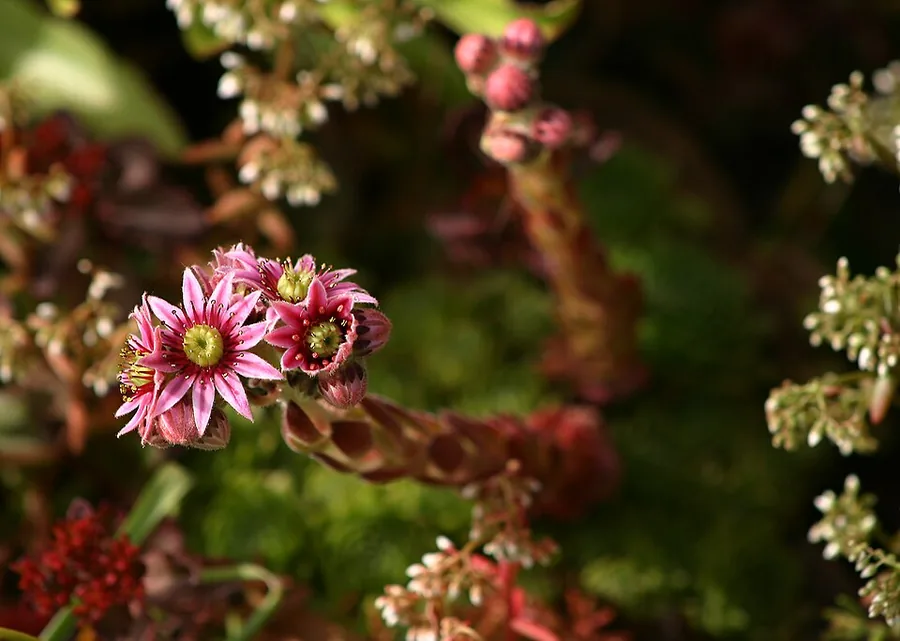
When a rosette stretches up a tall stalk topped with reddish-purple bloom and then shrivels, it is running its monocarpic life cycle. That hen flowers a single time and dries away, but a tight ring of small green chicks is already clustered around its base. Twist out the withered rosette and let the chicks knit over the gap, or lift them and set them elsewhere.
Fix:
- Remove the spent flowered rosette
- Allow surrounding offsets to fill the space
- Replant detached offsets if desired
Toxicity
The verdict is reassuring: hen and chicks is non-toxic across the board. The ASPCA lists Sempervivum among its safe succulents, and no harmful compound is on record for its thick leaves. You can keep it around cats, dogs, and children without worry, though the plump rosettes are for looking at, not eating.
Safe for
People · Cats · Dogs · Horses · Rabbits · Livestock · Birds
Cats None
Cats can sit right beside the fleshy rosettes safely, since no toxic compound is on record. A bored cat that chews a plump leaf might get a brief, mild stomach upset, but nothing worse.
Dogs None
Dogs are safe alongside these thick-leaved rosettes. Bolting down a big mouthful of any plant can loosen the stomach for a day, yet no poison hides in the leaves here.
Horses None
No toxic principle reaches horses, so a stray mouthful of the succulent leaves from pasture or a planter does no harm.
Rabbits None
Rabbits are safe near hen and chicks, and the plump, water-filled leaves carry nothing harmful. It is still better kept as a houseplant than dropped in the feed bowl.
Livestock None
Cattle, goats, and sheep face no risk from grazing the fleshy rosettes. No toxin inside them would trouble a ruminant gut.
Birds None
Pet and backyard birds can pick at the tight rosettes without harm, since nothing in the thick leaves is poisonous to them.
People None
Grown on rooftops and windowsills for generations, the fleshy-leaved plant poses no danger to people, and curious children need no barrier from it.
Varieties
Most hen and chicks are told apart by the color their fleshy rosettes take on through the season. A few named cultivars are worth knowing if you want a particular shade in the leaves.
Sempervivum tectorum 'Rubin'
Its tight rosettes flush a deep ruby-red that deepens toward purple and holds that saturated color through the season.
Sempervivum tectorum 'Sunset'
As the leaves mature, they warm into glowing orange-red sunset tones that spread across the rosette.
Sempervivum tectorum subsp. tectorum 'Triste'
Its leaves wear a muted, dull reddish-brown wash instead of any bright or saturated hue.
How to propagate
This is one of the simplest plants to multiply, and most of the time the plant does it for you by ringing each hen with small green chicks. You can split a clump or sow seed too, depending on how fast you want results.
Offsets & pupsEasy
Spring to early summer · 2-4 weeks to root
The small chicks clustered around each hen make offset propagation the easy route most growers take. From spring into early summer, twist a rooted chick free of the mother rosette and press its plump base into gritty mix, where fine roots grip in about 2 to 4 weeks. The habit is monocarpic: the hen dries away after flowering, and these tight little rosettes are how the colony carries on.
DivisionEasy
Spring · 2-4 weeks
A mat that has thickened into a dense carpet of rosettes divides cleanly. In spring, lift the whole clump and tease it into single rooted rosettes, then replant each fleshy button on its own. New roots take hold within about 2 to 4 weeks.
SeedModerate
Spring · Several months to a year
Seed is the slow road, worth it mainly for raising many tiny rosettes at once. Sow in spring and wait, since the pinhead seedlings need several months to a year to swell into recognizable rosettes, and named cultivars seldom come true from seed.
Myths
The ASPCA Hens and Chickens listing proves Sempervivum tectorum was tested and cleared as pet-safe.
That entry actually belongs to Echeveria elegans, a tender Mexican succulent from another genus with its own pale, spoon-shaped leaves. The cold-hardy Sempervivum, the true houseleek, sits on its own on the ASPCA's roster of non-toxic succulents. Both are safe, listed separately.
Houseleeks have to come indoors for the winter.
The thick, water-filled rosettes are among the toughest of any succulent, rated RHS H7 and holding their form well below freezing across USDA zones 3 to 8. They stay green and firm outdoors all year in cold country. Wet, not cold, is what rots them, so the winter concern is keeping standing moisture off the crowns.
The whole plant is dying when the central rosette throws up a stalk and collapses.
Only that one flowered rosette is drying to a papery brown. Each hen is monocarpic and dies once it blooms, but a ring of small, plump green chicks is already crowded around its base. The colony lives on through those offsets, often knitting fuller than before.