Houseplant · Crassulaceae
Ghost Plant
Graptopetalum paraguayense
Powder-dusted, chalk-blue rosettes ask only for strong sun and a true dry spell between drinks, then fend for themselves.
Full sun
Every 10–21 days
50–86°F · 10–30°C
USDA 9–11
Overview
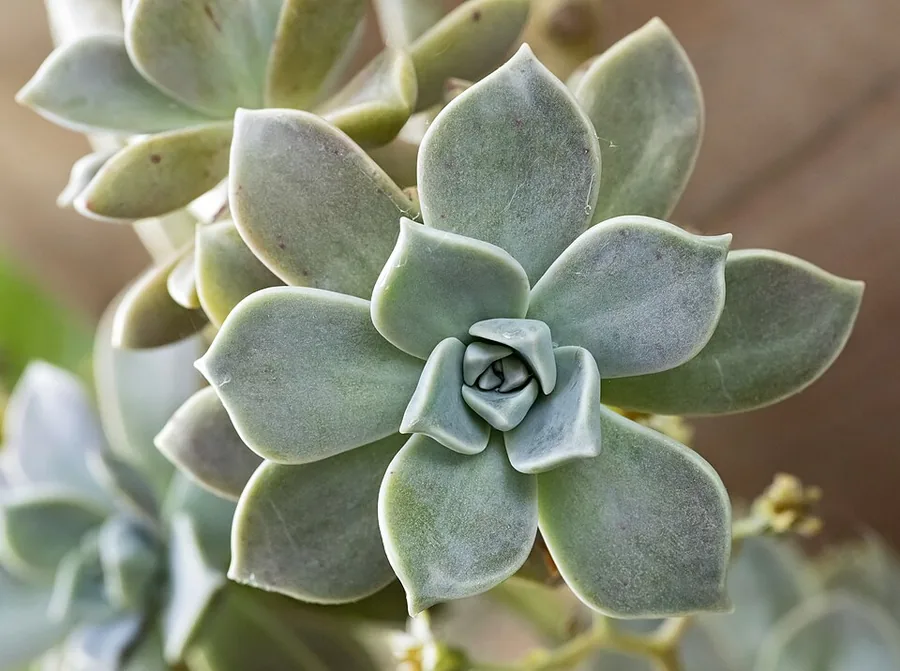
The ghost plant grows as a low succulent from Mexico, its name drawn from the pale, powdery film that dusts each rosette in a chalky, ghostly gray. The leaves are thick and fleshy, tapering to a soft point and packed tight in a spiral, and their surface carries that fine bloom over a base that shifts from cool gray-blue to a gentle pink. Rubbed with a fingertip, the powder lifts away and leaves a smooth, waxy leaf beneath.
As the stems lengthen, the plant sends its low rosettes trailing and spreading, so the fleshy leaf spirals ride along thickening stems that lean and drape. The leaves are held so loosely that the lightest brush shakes them free, and they land plump and whole. Each fallen leaf takes root where it settles and pushes up a tiny new rosette of its own.
Set in strong light, the leaves stay short, fat, and tightly stacked, their color deepening at the tips. Starved of that light or left in a sodden, dim spot, the same leaves pale, thin, and drift apart along a stretching stem, while the plump base loses its firmness and turns soft.
Care
The short version: bright light or full sun, a gritty mix that drains fast, and a deep soak only once the soil has dried out completely. Ease off and it firms up on a little neglect.
Light
In full sun or very bright light the leaves stay short and fat and the rosette holds tight, its color richest at the tips. In bright indirect light it survives, but anything dimmer thins the leaves, stretches the stem, and pulls the rosette open.
Water
Water deeply, then let the soil turn bone dry before the next drink, usually every 10 to 21 days. The plump leaves store their own reserve inside that thick tissue, so too much water, not too little, is the real threat. Overwatering is what softens them into rot.
Soil
Set it in a gritty cactus or succulent mix that drains in seconds, never a heavy potting soil that clings wet around the base. A pH from 6.0 to 7.5 suits it, so the coarse, open texture matters far more than the chemistry.
Temperature
The leaves stay firm between 50°F and 86°F (10°C to 30°C) and take summer heat in stride. The plant is not frost hardy, and cold turns the fleshy tissue to mush, so it needs shelter before a freeze.
Humidity
This is a low-humidity plant with no number to hit, at ease in the dry air of most homes. Damp, stagnant air settles on the powdery leaves and invites rot, so moving air suits it far better than misting.
Feeding
Feed it monthly through spring and summer while new leaves are forming, using a diluted balanced or low-nitrogen succulent feed at half strength. Ease off in the cooler months, since rich feed swells the leaves into soft, pale, weak growth.
Pruning
Pruning stays light. Pull away the shriveled lower leaves and trim any leggy, bare-stemmed stretch to keep the rosettes packed, and behead a rosette that has reached up on a long neck so its tight top can be replanted.
Repotting
Repot it every 2 to 3 years, or sooner once the rosettes spill over the rim, in spring. Roots pushing through the drainage holes or soil that dries almost at once show the plant has filled its pot.
Size & spacing
Each plant stays low, around 6 to 12 inches (15 to 30 cm) tall, while the trailing stems and their leaf spirals fan out to 12 to 24 inches (30 to 60 cm) across. Leave room for that spread and for new rosettes to crowd in around the base.
Troubleshooting
Most of what goes wrong with a ghost plant shows in the leaves and stems themselves: too much water or too little light. Both leave visible marks early, in slack tissue or a stretching stem. Match the look below and fix it before the rot or the stretch sets in.
Glassy, slack leaves collapsing around a mushy base
The plump leaves turn glassy and slack, and the base goes soft to the touch, the clear look of root and stem rot. Behind it lies too much water or a mix that stays wet. Slip the plant free and read the roots and lower stem for tissue gone black, soft, or sour, pare all of it away, let the firm rosettes or cuttings dry into a callus over a few days, and set them into dry gritty mix.
Fix:
- Stop watering immediately
- Remove the plant and cut away all rotted tissue
- Let healthy cuttings or rosettes callus for several days
- Replant in dry gritty succulent mix
Pale, drawn-out stems with leaves pulled wide apart
The stems draw out long and bare with pale leaves strung far apart, the mark of etiolation as the plant strains after light it lacks. The stems tilt toward the window and the once-packed rosette opens and lies flat. Give it several hours of direct sun, behead the drawn rosette to replant its tight top, and the naked stem answers with small fresh offsets.
Fix:
- Move to a brighter location with several hours of direct sun
- Behead the stretched rosette and replant the top
- Propagate the bare stem to produce new offsets
Papery brown burn patches on freshly sun-exposed leaves
Dry brown blotches burn into the fleshy leaf faces, the plain look of sunburn after a leap from soft indoor light into full sun. The scorch settles on the surfaces that catch the most light, showing within a day or two of the move. Draw the plant back into bright but shaded light, lift the sun over a week or two, and let the marked leaves hang on until the plant drops them.
Fix:
- Move to bright but slightly shaded light temporarily
- Acclimate gradually to stronger sun over one to two weeks
- Leave scarred leaves in place until they are naturally shed
Toxicity
Good news for a home with animals or small children. The ghost plant is non-toxic across the board, with the ASPCA listing it as safe for cats and dogs, and no toxin in its fleshy leaves that would trouble other pets or people. The worst a stray nibble on that plump tissue brings is a bit of passing stomach upset from the bulk.
Safe for
People · Cats · Dogs · Horses · Rabbits · Livestock · Birds
Cats None
Cats stay safe around the plant. A cat that bites into a thick leaf may feel briefly full from the fleshy bulk, yet nothing inside it is poisonous.
Dogs None
Dogs come to no harm here. The ASPCA lists it non-toxic, and a leaf crushed between the teeth brings a passing bit of stomach upset at worst.
Horses None
Horses meet no toxin in these plump leaves, odd a mouthful as they make. A stray bite passes without harm.
Rabbits None
Rabbits stay safe beside it. The water-filled leaves hold no toxin, so a curious nibble comes to nothing.
Livestock None
Goats, sheep, and other grazers face no poison in the fleshy foliage. A few leaves stripped away amount to a non-event.
Birds None
Birds meet nothing toxic in the plant. A pecked leaf may smear a chalky, powdery mark on the beak, which brushes off and means nothing.
People None
People, children among them, stay safe handling it or after a nibble. The powdery bloom lifts onto the fingertips as a pale dust, but it does no harm.
The powdery (farinose) coating on leaves rubs off easily when handled, which is cosmetic and harmless.
Varieties
Only a couple of forms turn up often, and each shifts the plain gray-blue rosette toward more color. These are the ones worth a close look.
Graptopetalum paraguayense 'Pink Form'
Its fleshy rosettes wash pink to rose under strong light or cool nights, where the plain form keeps a matte, chalky gray-blue.
×Graptosedum (Graptopetalum × Sedum hybrids)
These sedum crosses hold the ghost plant's rosette shape while turning up brighter leaf colors on faster, more trailing stems.
How to propagate
Few plants remake themselves as readily as this one. A single plump leaf, an offset, or a beheaded rosette will each root with almost no help from you.
Leaf cuttingsEasy
Spring through summer during active growth · 3 to 6 weeks to root and form new rosettes
In spring or summer, a whole plump leaf twists cleanly off the stem, and its torn end dries into a callus over a few days before it rests on dry gritty mix. Fine roots and a bud-sized rosette push out in about 3 to 6 weeks, the same feat dropped leaves manage on their own wherever they fall.
Offsets & pupsEasy
Spring through summer · 2 to 4 weeks
Through spring and summer, small rosette offsets crowd along the stems. One snapped free and left to callus a moment plants easily, then knits into the soil within 2 to 4 weeks.
Stem cuttingsEasy
Spring through summer · 2 to 4 weeks
In the warm months, a rosette beheaded with a short stub of stem seals its cut into a callus. Set back in soil, that stub roots readily and takes hold in roughly 2 to 4 weeks.
Myths
Those pale, dust-coated leaves prove the plant is parched and craving frequent water.
That pale, chalky film across the leaves is a natural waxy bloom, a fine powder rather than a sign of thirst. The plant packs its water into thick, taut leaves and would rather run dry between drinks. Watering to answer that dusty coat is the fastest way to rot it.
Like so many plump-leaved succulents, it is poisonous to household pets.
Many succulents carry a toxin worth avoiding, but this fleshy one does not. The ASPCA lists the ghost plant as non-toxic to cats and dogs, so a curious nibble at a leaf is no cause for alarm.