Houseplant · Crassulaceae
Echeveria
Echeveria
Give it bright light and a soil that dries out fast, and this plump rosette succulent looks after itself.
Full sun
50–77°F · 10–25°C
USDA 9–11
3–12 in · 8–30 cm
Overview
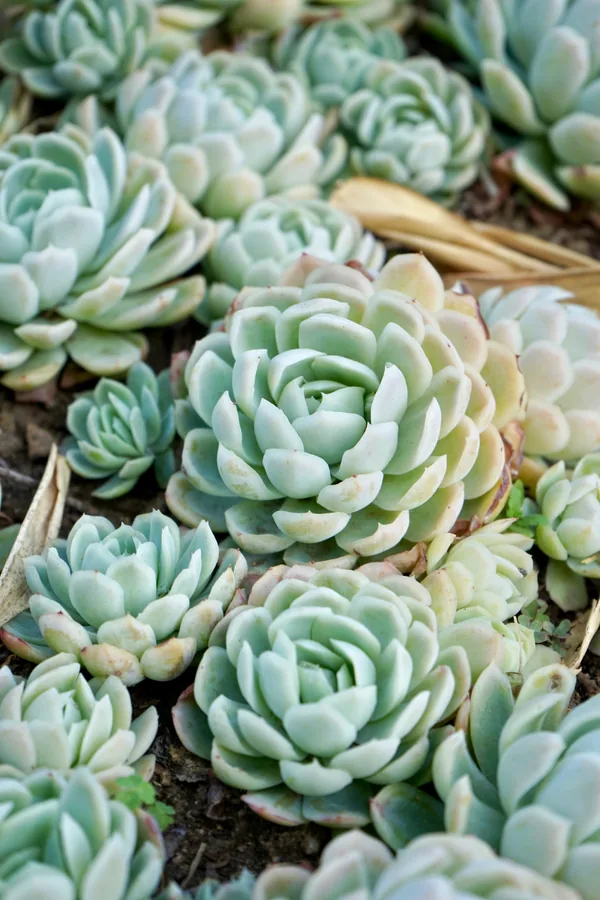
Echeveria is a rosette-forming succulent from the dry highlands of Mexico and Central America, built from thick, fleshy leaves that overlap in a tight spiral around a central point. Up close the rosette looks almost carved, each smooth leaf swelling toward a rounded or pointed tip in shades of blue-green, lavender, and silver. Many wear farina, a fine powdery dust that frosts the surface and rubs away to a glossy patch under a fingertip.
Those plump leaves are the whole story of how it lives. Each one is a water store, firm and cool to the touch, so the plant rides out a missed watering on the moisture packed inside its tissue. Set it in strong light against a gritty mix and the leaves stay tight and saturated, their edges and tips often flushing pink or red at the leaf tips where the sun strikes hardest.
The whole plant stays small, usually 3 to 12 inches (8 to 30 cm) across, a low cushion of leaves rather than anything tall. Around its base, miniature copies of the rosette bud and swell into offsets, so one plant slowly rings itself with smaller ones. The two things that ruin the firm, colored leaves are too much water and too little light, and both are simple to head off.
Care
The short version: bright light, a gritty fast-draining mix, and a deep soak only once the soil has dried out completely, with light feeding through the warm months.
Light
Echeveria wants full sun to very bright light, several hours of it a day, to keep the leaves packed tight and deeply colored. A sunny south or west window is ideal indoors. Starve it of light and the rosette draws out tall while the leaves thin and fade to pale.
Water
Soak the soil through, then wait until it has dried out completely before watering again. This is a desert plant that rots fast in wet soil, so water at the base and never let water settle in the cupped center of the rosette. When in doubt, leave it another few days.
Soil
Plant it in a gritty cactus or succulent mix that drains in seconds rather than holding water around the roots. A pH between 6.0 and 7.0 suits it. Sharp drainage matters most of all, so work in perlite or coarse sand if your mix feels dense and heavy.
Temperature
It does best between 50°F and 77°F (10°C to 25°C) and is happy at normal room warmth. The fleshy leaves have no tolerance for frost, which bursts their watery cells, so bring any outdoor plants in well before the first cold snap.
Humidity
Low, dry air is exactly what this plant likes, so there is no humidity to chase. Steamy bathrooms and kitchens are the wrong spot, since moisture trapped against the leaves invites rot.
Feeding
Feed lightly through spring and summer, while the plant is actively growing and the rosette is filling out. A dilute balanced or low-nitrogen succulent fertilizer a few times across the season is plenty. Skip feeding in winter when growth slows.
Pruning
There is little to do here. Pull off the spent lower leaves, the soft brown ones at the base, and snip faded flower stalks to keep the rosette clean. If a rosette has stretched and gone leggy, behead the top and re-root it to bring back the tight, layered shape.
Repotting
Move it into a slightly larger pot every 2 to 3 years, or sooner if offsets crowd the rim and roots push through the drainage holes. Use the chance to refresh the gritty mix and look the pale roots over for any soft, rotted spots.
Size & spacing
A mature rosette stays small, reaching 3 to 12 inches (8 to 30 cm) tall and about as wide depending on the species, a flat or domed cushion of overlapping leaves. Its slow, compact growth makes it an easy fit for a windowsill, a small pot, or tucked into a mixed succulent dish.
Troubleshooting
Almost every echeveria problem shows itself in the leaves and the base, and traces back to one of two things: not enough light or too much water. The look of the rosette tells the story, from pale stretched leaves to a soft pulpy core. Match what you see below, then act early.
Glassy, mushy leaves above a soft and blackening base
Leaves that turn soft and translucent, almost glassy, above a stem base going dark and pulpy are showing root and crown rot. Too much water in soil that holds it lets the rot creep up through the core, and once it reaches the crown the original plant cannot be revived. Watering stops, every softened leaf and section gets cut back to firm flesh, and a clean top cutting or a plump pup re-roots in dry gritty mix.
Fix:
- Stop watering and let the plant dry
- Cut away rotted tissue and dust with no further water until callused
- Re-root healthy top growth or offsets in dry gritty mix
Cottony white tufts wedged where leaf meets stem
Small fluffs of white, like specks of cotton wool packed into the angles where the leaves meet, along with a faint sticky film, are mealybugs. They tuck into the deepest folds of the rosette and feed on the sap there. A cotton swab soaked in 70 percent isopropyl alcohol pressed onto each tuft clears it, and the rinsed plant is kept apart from the others. A weekly look into those tight crevices catches any that return.
Fix:
- Dab insects with a cotton swab dipped in 70 percent isopropyl alcohol
- Rinse and isolate the plant
- Repeat treatment weekly until clear
Rosette pulled tall, its leaves pale and far apart
When the once-flat rosette lifts onto a long bare stem and the leaves drift apart and grow pale, that is etiolation. The plant leans its whole body toward the brightest window, the tidy whorl opens out, and the firm leaves thin and lose their saturated color. Stronger light or a grow lamp halts it, and the drawn-out top can be cut off and re-rooted to reform a compact rosette.
Fix:
- Move to a sunnier spot or add grow lighting
- Behead the stretched rosette and re-root the top
- Propagate usable leaves from the bare stem
Toxicity
Good news for a home with pets and children. Echeveria carries no known toxins, and the ASPCA lists it as safe for both cats and dogs. A bite of a fleshy leaf might cause a brief stomach upset, the way any odd plant might, but there is nothing here to poison anyone.
Safe for
People · Cats · Dogs · Horses · Rabbits · Livestock · Birds
Cats None
It is safe to keep where a cat lives. A cat that bites into one of the fleshy leaves may get a brief, mild stomach upset, the same as with any non-food plant, and nothing toxic.
Dogs None
There is no toxic effect for dogs. A dog that crunches a plump rosette might drool or pass a loose stool from the strange, watery plant matter, and that is all.
Horses Safe
It poses no poisoning risk to horses, though the small rosettes are houseplants and have nothing to offer as forage.
Rabbits Safe
It is safe around rabbits, with no toxin in the thick leaves. A nibbled plant is a loss to you rather than a danger to the rabbit.
Livestock Safe
It carries no poison for grazing animals such as goats, sheep, or cattle.
Birds Safe
Pet birds take no toxicity from it, so a stray peck at a leaf does no harm.
People Safe
It is risk-free for adults and children to handle and grow. It is not grown to be eaten, but a curious taste of the leaf will not cause poisoning.
Varieties
The genus runs to hundreds of species and hybrids, but a few turn up again and again. These are the ones worth knowing by name.
Echeveria elegans
Called Mexican snowball, it builds tight pale blue-green rosettes whose rounded leaves thin to almost translucent margins at the edge.
Echeveria 'Perle von Nurnberg'
This hybrid shows dusty lavender-pink leaves sheathed in a soft, powdery farina coating that dulls the surface to a matte bloom.
Echeveria agavoides
Its stiff, sharply triangular leaves mimic a small agave and taper to a fine point flushed bright red at the tip.
How to propagate
Echeveria is one of the most rewarding plants to multiply, growing whole new rosettes from a single fallen leaf or from the small pups that swell up around its base.
Leaf cuttingsEasy
Spring through summer during active growth · Several weeks to a few months to form roots and a new rosette
A single fleshy leaf can grow into a whole new plant. In spring or summer during active growth, a whole healthy leaf twists free so none of it tears, the cut end dries to a firm callus over a few days, and the leaf then lies on dry gritty mix under a light mist. Over several weeks to a few months, fine pink roots and a knot of tiny new leaves push out from the leaf base.
Offsets & pupsEasy
Spring through summer · A few weeks to root once separated
Miniature rosettes, the offsets or pups, cluster tight around the base of the mother plant through spring and summer. One snaps off cleanly, the cut face calluses over, and it nestles into dry succulent mix, where it roots within a few weeks.
Myths
Echeveria is the same plant as true hens and chicks.
The shared nickname hides two plants in different genera. True cold-hardy hens and chicks is Sempervivum, which pushes through hard winters and dies after flowering once, while Echeveria is tender and frost will kill it.
Succulents like echeveria never need watering.
The water held in the thick leaves carries the plant through a dry spell, but it still wants a deep soak once the soil has dried out completely. Leave one thirsty too long and it shrivels, the leaves caving soft and wrinkled as the plant slowly declines.