Ornamental · Begoniaceae
Wax Begonia
Begonia semperflorens
Thick waxy leaves and small bright flowers carry the wax begonia through nonstop bloom from spring to frost.
Partial shade
Every 2–4 days
50–75°F · 10–24°C
USDA 9–11
Overview
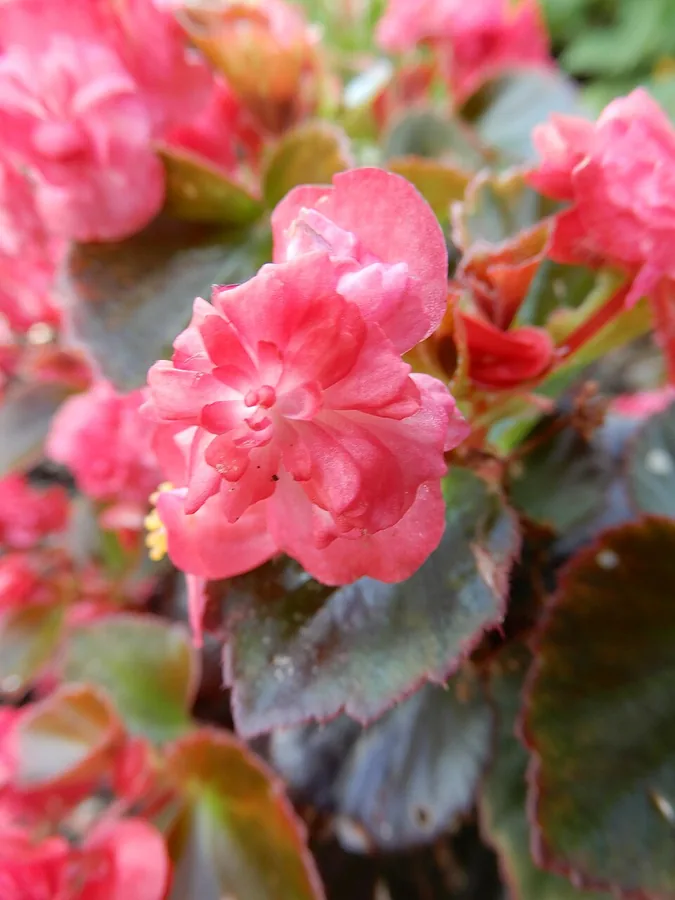
The wax begonia wears thick, waxy leaves so glossy they look almost polished, each one holding a clean green or a deep, coppery bronze. Small flowers in pink, red, or white sit just above that foliage. The blooms open in a steady run from spring until the first hard frost.
The whole plant stays low and compact, seldom taller than a foot, its dense leaves layering into a full, cushioned look. Bronze-leaved forms deepen almost to mahogany, while green-leaved forms hold a fresh, glossy green. It is a tender perennial, though most gardeners set it out fresh in spring and let frost take it.
Up close the leaves feel thick and firm, their waxy surface beading water rather than soaking it in. The flowers stay small and simple, scattered thickly in pink, red, or white across the top of the plant. Bronze foliage takes in more sun and green foliage keeps to the shade, yet both keep flowering without any tidying, since the spent blooms drop on their own.
Care
The short version: dappled light or morning sun with afternoon shade, soil kept evenly moist but never soggy, a monthly feed through the season, and 6 to 12 inches of space between plants so air moves around the leaves.
Light
Wax begonias sit best in partial shade or morning sun with afternoon shade, though they take a wide range. The dark, bronze-leaved types hold up to full sun, their pigment shrugging it off, while the green-leaved ones burn and pale in it and want shade through the hottest hours.
Water
Keep the soil evenly moist but well drained, wetting it every 2 to 4 days as the surface dries. Water low at the base in early morning, since droplets left on the leaves under hot sun scorch them and standing wet invites fungal disease. The thick, waxy leaves store enough moisture to carry the plant through a brief dry spell.
Soil
Root it in moist, well-drained soil rich in organic matter, on the slightly acidic side at a pH of 5.5 to 6.5. Drainage counts for the most, since waterlogged ground turns the roots soft and rotten.
Temperature
The plant holds its color and vigor in mild air, between 50°F and 75°F (10°C to 24°C). It wilts and stalls in real heat and blackens at the first frost, which is why it is grown as an annual.
Humidity
Ordinary outdoor air suits it, so there is no level to chase. Air moving over the leaves matters far more, since still, humid, crowded growth is where the powdery and gray molds settle onto the foliage.
Feeding
Feed monthly through the growing season with a balanced fertilizer for flowering bedding plants. Light, steady feeding keeps the flowers thick and the leaves firm, without the soft, floppy growth that heavier feeding brings.
Pruning
Pinch or shear any stem that stretches and thins to keep the plant compact and densely leaved and to push out new branches. The small flowers drop on their own as they fade, so no deadheading is needed.
Size & spacing
The plant stays low, reaching 6 to 12 inches (15 to 30 cm) tall and a similar width of overlapping leaves. Set plants 6 to 12 inches (15 to 30 cm) apart so air slips between the mounds and disease finds less damp foliage to grip.
When to plant
Frost blackens this tender plant, so it waits for warmth. Sow the dust-fine seed, barely more than powder, indoors in late winter, move the young plants out only after the last frost and once nights hold above 50°F (10°C), and the small flowers then open in a steady run from early summer until frost ends them.
Northern hemisphere
Southern hemisphere
Typical months for a temperate climate: start earlier in warm zones, later where spring frosts linger.
- Sow: About 8 to 12 weeks before the last spring frost; do not cover the tiny seed.
- Plant: After all danger of frost has passed and night temperatures stay above 50°F.
- Harvest: Blooms continuously from spring or early summer until frost.
Hardiness
USDA hardiness zones: 9–11
Temperature: down to -7°C
Troubleshooting
Almost every mark on a wax begonia, whether a dusty film on the leaves or a soft dark patch at the base, comes back to moisture sitting too long. Catch the first blemish and better spacing and careful watering usually undo it. Match what you see on the plant below, then act before it spreads.
A wilting plant with a soft, blackened stem at the soil line
When a plant sags with wet soil at its feet, look at the base for stem or Pythium root rot, a decay that sets in where the ground never drains. The crown and roots go soft, dark, and slimy, past saving. Lift the worst plants, open up the drainage, and cut back the watering before the rot creeps outward.
Fix:
- Remove severely affected plants
- Improve soil drainage
- Reduce watering frequency
White powdery dust filming over the leaves and stems
That chalky, white film is powdery mildew, a fungus that coats the leaf surface when the air is humid and still. It smears off under a finger at first, then whitens whole crowded plantings. Space the plants 6 to 12 inches apart, pull the worst leaves, and water at the base in the morning so the foliage dries.
Fix:
- Improve spacing and air circulation
- Remove affected foliage
- Water at the base in the morning rather than overhead
Gray fuzz on the flowers as they brown and slump
This is botrytis blight, or gray mold, creeping in through cool, damp, still air. The petals and leaves turn tan to brown, go soft, and end up furred with gray spores. Cut away the fuzzed, rotting parts, open the planting for airflow, and keep water off the leaves.
Fix:
- Remove and discard infected plant parts
- Increase air circulation
- Avoid overhead watering
Cottony white clumps or slender specks with pitted, twisted growth
Small tufts of cottony white on the stems point to mealybugs, while thin, slivered crawlers are usually thrips, both clinging to the stems and leaf undersides. The thrips leave the deepest mark, stippling the leaves and carrying viruses such as INSV and TSWV. Rinse off the light ones with water, wet the rest with insecticidal soap, and cut out any growth that is thick with them.
Fix:
- Spray off light infestations with water
- Treat with insecticidal soap
- Remove heavily infested plant parts
Toxicity
The glossy leaves hide a bite. Every part of the wax begonia holds calcium oxalate crystals, tiny and needle-sharp, packed most densely into the roots, and chewing sets them loose to sting the mouth. Keep it from cats, dogs, horses, and grazing animals, and note that no part is safe for people to eat.
Toxic to
Cats · Dogs · Horses · Rabbits · Livestock · Birds · People
Cats Toxic
A cat that bites the glossy leaves or digs at the roots gets a mouthful of sharp crystals, so watch for ropey drooling, pawing at the mouth, and vomiting. The roots pack the most and burn the hardest.
Dogs Toxic
Dogs that dig up and chew the roots take the sharpest sting. Look for a raw, burning mouth, heavy strings of saliva, repeated vomiting, and visible trouble swallowing soon after a bite.
Horses Toxic
The same fine crystals rake a horse's mouth and gut, drawing out drooling, mouth pain, and colic-like discomfort. A grazing animal that swallows a large amount is hit hardest of all.
Rabbits Toxic
The crystals scour a rabbit's mouth and gut just as they do other animals, so keep the plant well beyond reach and never set any out as forage.
Livestock Toxic
Cattle, goats, and sheep that crop begonia can swallow enough oxalate to leave the mouth raw and drooling and the gut upset, with a large mouthful the real danger.
Birds Caution
Firm bird data is thin, but the crystals that sting other animals would prickle a curious bird's mouth too, so keep the plant out of reach.
People Caution
No part of the wax begonia is food, and a bite leaves the mouth stinging. The sap can redden sensitive skin, so wash your hands after pruning and keep the plant away from small children.
Toxicity is oral and gastrointestinal irritation rather than systemic in pets; grazing animals eating large amounts are at greater risk.
Helpline numbers

United States
ASPCA Animal Poison Control: (888) 426-4435 (fee applies)
Poison Control: (800) 222-1222



Canada
Poison Centres: 1-844-764-7669
Varieties
Wax begonias reach the market mostly as named series rather than single cultivars, sorted by the color of their leaves and how much sun those leaves will take. These are the ones you will see most.
Cocktail Series
A compact group of deep bronze leaves, with selections such as 'Whiskey', 'Vodka', and 'Gin', whose dark foliage stands full sun better than most wax begonias.
Ambassador Series
Clear green-leaved plants bred for heat, showing their best color in morning sun with shade through the hot afternoon.
Doublet Series
Its flowers are full and layered, double and rose-like, in place of the small single blooms most wax begonias carry.
How to propagate
Stem cuttingsEasy
Spring or fall, including from overwintered plants · Roots typically form in about 2 to 4 weeks
Cuttings root easily, taken in spring or fall, even off a plant held over winter indoors. Cut a firm, healthy stem, or pull a single waxy leaf, and press it into a moist, well-drained medium. Roots form in about 2 to 4 weeks, growing on into a plant identical to its parent.
SeedModerate
Indoors about 8 to 12 weeks before the last frost · Several weeks from sowing to transplant size
Seed is slower and finer work. Start it indoors 8 to 12 weeks before the last frost, dust the near-invisible seed across the surface without covering it, and warm it gently from below. Several weeks pass before the seedlings are big enough to move, and they never go straight into the garden.
Myths
Wax begonias need deep shade and scorch in any sun.
Once rooted in, the plant takes a broad sweep of light. The dark, bronze-leaved cultivars color up and flower in full sun, their pigment holding off the burn, while only the green-leaved forms truly need afternoon shade.
A single nibble of those glossy leaves cannot hurt a pet.
Every part carries needle-fine calcium oxalate crystals, thickest in the roots. One bite drives them into the mouth, setting off burning, drooling, and vomiting in cats, dogs, and horses, so keep curious pets away from the plant.