Houseplant · Begoniaceae
Rex Begonia
Begonia Rex Cultorum Group
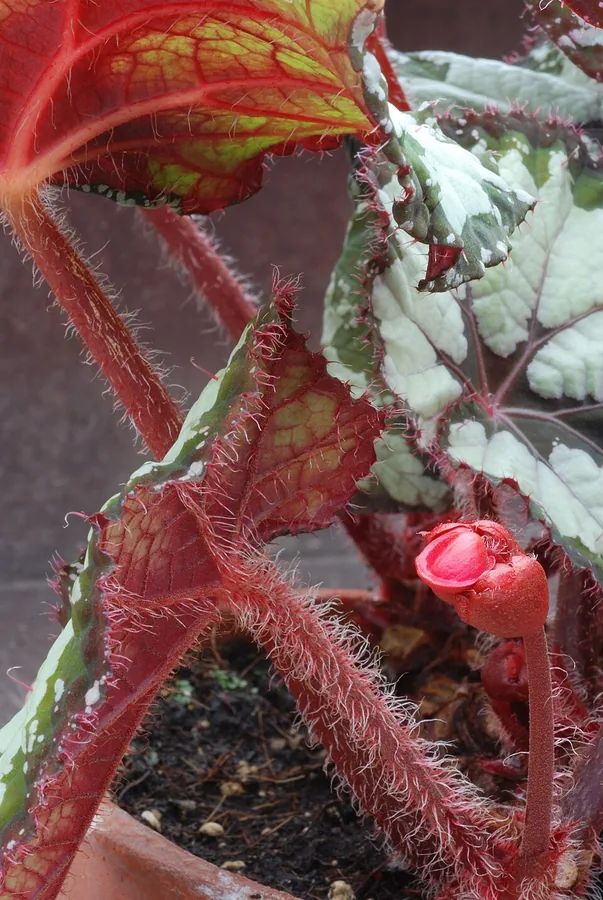
Every rex begonia leaf is a spiral of silver, plum, rose, and deep green, puckered and painted-looking to the touch.
Bright indirect
66–73°F · 19–23°C
USDA 10–11
12–18 in · 30–46 cm
Overview
Up close, a rex begonia leaf is a swirl of color: silver washes across plum and rose over a base of deep green, and the surface often twists into a spiral or lifts into a puckered, blistered texture. Beside that painted foliage the flowers are almost nothing, just small clusters of pink-white that sit low and quiet. The plant is part of the Rex Cultorum Group, a line of hybrids drawn from a wild begonia of the eastern Himalayan foothills.
The whole plant rises from a thick, creeping rhizome that runs along the soil surface rather than standing upright, so it never grows tall. Leaves and stems push up from that rhizome to a modest 12 to 18 inches (30 to 46 cm), spreading about as far across as it climbs. The stems stay short and low, holding each leaf out where its markings can be seen.
For all that surface drama, the rex begonia is a demanding plant. Its leaves react visibly to conditions: they want steady warmth, humid air, and moving air around them, and they lose their crisp color and firmness when any of that fails. Kept right, the foliage holds its silver-and-plum patterning, but soggy roots and stale air quickly show up as spotting and collapse in the leaves.
Care
The short version: the rex begonia holds its painted color best in bright, indirect light, with evenly moist soil in a porous mix that never turns to muck, warmth around 66°F to 73°F (19°C to 23°C), and high humidity carried on the surrounding air rather than laid on the leaves themselves.
Light
In bright, indirect light the leaves keep their full run of silver, plum, and rose, while hot, direct sun scorches and bleaches the surface. The plant holds on in partial to full shade, but the colors dim and flatten there, and a fluorescent tube brings back some of the brightness where a window is dark.
Water
The soil should feel evenly moist, drying just at the surface between waterings and never staying wet to the touch. Water reaches the plant best at the soil or from below, keeping the leaves themselves dry, since water sitting on that puckered surface turns to rot. Watering slows as the plant rests in winter.
Soil
The roots want a porous, well-drained mix loose with organic matter, a light soilless or African-violet blend that water runs straight through. A slightly acidic pH of 5.5 to 6.5 suits it, and a shallow pot holds the flat, creeping rhizome the way a deep one cannot.
Temperature
Warmth between 66°F and 73°F (19°C to 23°C) keeps the leaves firm and growing, and they slow and soften once nights fall much below that. Cold drafts and sharp chills mark the foliage.
Humidity
The plant drinks in high humidity, around 50% to 75%, and the leaf edges brown and crisp when the air runs dry. A pebble tray or a spray of the surrounding air lifts it, though the leaves stay dry themselves, since moisture held on that textured surface breeds fungus.
Feeding
Through the spring-to-fall growing stretch, a balanced liquid fertilizer at half strength at alternate waterings keeps the new leaves coming in strong and well colored. Feeding stops as the plant rests through fall and winter.
Pruning
The plant needs little cutting. Dead or spotted leaves are lifted off as they appear, which clears the fungus and opens the air around the crowded, overlapping foliage. A pinch at the soft growing tips sets it branching into a fuller mound.
Repotting
Come spring, once the roots have filled the pot, it moves into a shallow container that fits the flat, spreading rhizome. Roots winding around the outside of the root ball are the visible sign it is time.
Size & spacing
Fully grown, the plant is a low mound 12 to 18 inches (30 to 46 cm) tall and about as wide, its leaves layered out from the center. A little clear space around each side lets air pass between the leaves and keeps their surfaces dry.
Troubleshooting
Trouble usually shows first in the leaves, in a change you can see. Soggy soil and damp, still air raise fuzzy mold and powdery film, while a dark corner drains the silver and plum until the surface goes flat. The symptoms below match what appears on the plant, so a close look points to the cause.
A blackened, mushy base under a wilting plant
When the thick rhizome at the base turns dark, soft, and mushy and the plant above it wilts, that is crown and root rot from soil kept too wet. Watering stops and the mix is left to dry. The plant moves into fresh, porous media in a shallow pot, every soft and rotted part is trimmed away, and water returns slowly.
Fix:
- Stop watering and allow the mix to dry
- Repot into fresh porous, well-draining mix and a shallow pot, trimming away rotted tissue
- Resume careful watering, avoiding waterlogged soil
A dry white dust clinging across the leaf surface
That white, floury film is powdery mildew, a fungus that grows over the leaf where the air is still and damp. It coats the surface and can curl or warp the leaf beneath it. The marked leaves come off, the air around the plant is opened up, and the foliage is kept dry so the fungus cannot spread.
Fix:
- Remove and discard affected leaves
- Improve air circulation around the plant
- Avoid wetting foliage; spray the surrounding air rather than the leaves to raise humidity
A grey-brown fuzz over soft, water-soaked patches
This fuzzy grey-brown growth is botrytis, or grey mold, and it spreads across leaves that have gone soft and water-soaked in stale, damp air. The infected tissue is cut out and destroyed rather than composted. Water goes to the soil from then on, and more air around the plant dries the surface out.
Fix:
- Remove and destroy affected plant parts
- Increase air circulation and lower ambient moisture on foliage
- Stop misting/wetting leaves; water at the soil
White tufts, fine webs, or speckled, silvered leaves
Three small pests leave marks you can spot. Soft white cottony tufts sit in the joints where leaf meets stem for mealybugs, fine webbing strung over yellow-speckled leaves marks spider mites, and a scatter of tiny insects lifting off the leaf when it is touched means whiteflies. The mealybugs are wiped with rubbing alcohol, the plant is set apart, and treatment repeats until the leaves are clean.
Fix:
- Dab mealybugs with rubbing alcohol on a cotton swab
- Isolate the plant to prevent spread
- Treat repeatedly until pests are gone, raising humidity to discourage spider mites
Pale, flattened color on stretched, thin stems
As the silver and plum wash out to a flat pale green and the stems stretch long and thin toward the light, the plant is short of it, a case of too little light. A brighter spot with plenty of indirect light restores the color, kept clear of hot, direct sun. A fluorescent fixture stands in where daylight is thin.
Fix:
- Move to a brighter spot with plenty of bright, indirect light (avoid direct, hot sun)
- Supplement with fluorescent lighting if natural light is limited
Leaves dropping as growth stops in winter
A rex begonia that stops pushing new leaves and lets the old ones fall through the cold months is in winter dormancy, set off by shorter days and cooler air. The rhizome under the soil stays thick and firm even as the top thins out. Watering drops, feeding pauses until spring, and full leaves return once growth restarts.
Fix:
- Reduce watering and keep the soil barely moist
- Stop fertilizing until new spring growth appears
- Resume normal care when active growth resumes in spring
Toxicity
The rex begonia is toxic, and the danger is inside the tissue rather than anything you can see. Every part carries soluble calcium oxalate, packed most densely in the thick rhizome at the base. Leaves chewed by an animal bring drooling and vomiting, grazing animals can take kidney damage, and the sap can leave skin itchy, so the plant stays away from pets, livestock, and small children.
Toxic to
Cats · Dogs · Horses · Rabbits · Livestock · Birds · People
Cats Moderate
A cat that bites into the leaf soon drools and vomits as the calcium oxalate stings the soft tissue of the mouth and gut. The thick rhizome under the soil carries the most, so a cat clawing down to the base takes in a heavier dose.
Dogs Moderate
A dog mouthing the foliage drools, paws at its lips, and turns queasy as the crystals irritate the mouth. The buried rhizome is the sharper danger, holding the toxin at its most concentrated.
Horses Severe
Grazing animals come off worst of all. The soluble oxalates slip into the bloodstream and press on the kidneys, so a horse cropping the plant can grow far sicker than the mouthful taken would suggest.
Rabbits Toxic
Rabbits crop low plants steadily, which turns the same kidney-stressing oxalates into a true danger. The plant is kept well above them, and no leaf or stem is ever handed over as food.
Livestock Toxic
Goats, sheep, and cattle meet the same whole-body oxalate risk as horses, with a stinging mouth and the chance of kidney trouble after a graze. The plant is fenced away from them for good.
Birds Caution
The oxalates that harm mammals make the plant a poor thing to keep near pet birds. A bird pecking at the leaves is at risk, and inquisitive birds are kept clear.
People Caution
No part of the plant is food, and the sap can leave itchy skin or a raised rash on some hands that handle it. Hands are washed after pruning, and small children are kept from carrying leaves to the mouth.
NC State and UConn note the sap contains calcium oxalate and can cause skin irritation/contact dermatitis in some people when handling
Helpline numbers

United States
ASPCA Animal Poison Control: (888) 426-4435 (fee applies)
Poison Control: (800) 222-1222



Canada
Poison Centres: 1-844-764-7669
Varieties
The Rex Cultorum Group runs to countless hybrids, each one a different arrangement of leaf color and curl. One is set down by name in the record.
Begonia rex-cultorum 'Super Curl'
A named cultivar in the much-hybridized Rex Cultorum Group, grown like the others for its patterned, curling leaves rather than any bloom.
How to propagate
A single rex begonia leaf holds the makings of many plants along its veins. The time to work is spring and summer, while the plant is in active growth and the leaves are firm and full.
Leaf cuttingsModerate
Spring to summer · Plantlets form in 1-3 months
A whole leaf can be turned into new plants in spring or summer while it is firm and growing. The cut is made across the thick veins on the underside, and the leaf is laid flat on moist media or split into wedges that each hold one main vein. Tiny plantlets rise from the cut veins over the next one to three months.
DivisionEasy
At repotting in spring · Several weeks
The easiest way is to break the plant apart while repotting in spring. The creeping rhizome pulls into pieces, each carrying its own roots and a few leaves, and each piece goes into its own pot. They take hold within a few weeks.
Stem cuttingsModerate
Spring to summer · Several weeks
A stem cutting taken in the spring and summer season roots readily as well. Set into moist media, the cut stem forms roots within a few weeks.
Myths
Rex begonias are grown mainly for their flowers.
The leaves are the reason, not the flowers. Each one carries silver, plum, and rose over deep green, often spiraled or puckered into real texture, while the flowers are only small pink-white specks held low on the plant. What you look at on a rex begonia is the leaf.
A begonia's calcium oxalate is the same harmless mouth-irritant found in aroids.
The two are different toxins. Aroids hold sharp, insoluble oxalate crystals that sting the mouth and pass, but the ASPCA names the begonia's toxin as soluble calcium oxalate, which the body takes in. That soluble form can bring on kidney failure in grazing animals, not just a sore mouth.
Misting the leaves is the best way to give a rex begonia the humidity it wants.
Wetting the leaves is the wrong move. Rex begonias want humid air, yet water left sitting on that puckered surface feeds the powdery mildew and botrytis that scar them. The humidity belongs in the air around the plant, raised with a pebble tray or a spray of the nearby space. The leaf surface stays dry.
Sources
- ASPCA Animal Poison Control
- NC State Extension Gardener Plant Toolbox
- Clemson Cooperative Extension HGIC
- Missouri Botanical Garden Plant Finder
- University of Connecticut Home & Garden Education Center
- Pet Poison Helpline
- University of Illinois Extension
- Plants of the World Online, Royal Botanic Gardens Kew