Houseplant · Gesneriaceae
African Violet
Streptocarpus ionanthus
Hand it soft indirect light and a warm drink drawn up from below, and the velvety rosette stays studded with small flowers nearly all year.
Bright indirect
60–80°F · 16–27°C
USDA 11–12
6–9 in · 15–23 cm
Overview
The African violet is built low and round: a flat rosette of leaves pressed close to the soil, with short flower stalks that rise from the center and never get tall. It traces back to the cool, mist-fed highland forests of Tanzania. The name misleads, since not a strand of it connects to the true violets. It belongs instead with the Gesneriads, the soft-leaved relatives of the streptocarpus seen on many windowsills. A later reclassification pulled it into the genus Streptocarpus, so a label reading Saintpaulia and one reading Streptocarpus ionanthus mark the same plant.
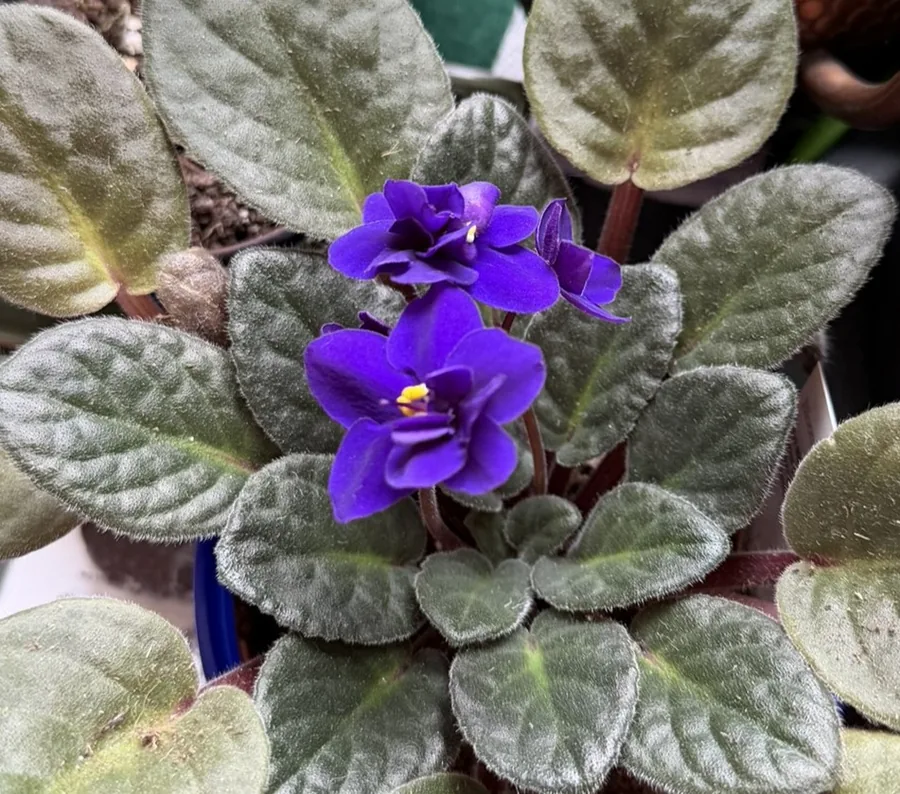
Up close the leaf is the giveaway. Each blade is thick, near-circular, and coated in fine hairs that give the surface a dull velvet nap and a soft give under a fingertip, deep green on top and often paler beneath. Out of the crown rise loose sprays of small five-petalled flowers in deep purple, soft pink, clean white, or cool blue, some single and flat, some doubled and ruffled. The whole rosette holds tight to a 6 to 9 inch (15 to 23 cm) spread, so even a mature one stays a compact disc of leaf and bloom.
The moderate rating comes down to two thin-skinned weaknesses, not real fuss. Let cold water bead on the furred leaves and a pale ring etches into the surface where the drop sat. Let the mix stay sodden and the fleshy crown softens and darkens to rot. Draw water up from below with tepid water, keep an eye on the light, and the plant pushes out flush after flush of color.
Care
The short version: soft indirect light from an east or north window, steady warmth between 60°F and 80°F (16°C to 27°C), and an open, crumbly soilless mix kept evenly moist. Draw the water up from below with room-temperature water, feed thinly through the growing season, and leave the roots a touch pot-bound to coax out more bloom.
Light
Stand it in soft indirect light at an east or north window, where the velvety blades catch a steady glow but dodge the hard white midday sun. The rosette gets by in medium light and a touch of shade, though the bloom thins out once the corner turns too dim. Run a fluorescent or LED light over it for 14 to 16 hours a day and the flowers keep opening through the dark months.
Water
Hold the mix evenly damp and crumbly, never a sodden mass, and let the top inch dry to a paler shade before the next drink. Draw the water up from below: stand the pot in warm or room-temperature water for about 30 minutes, then let it drain off. Cold water and stray beads burn pale rings into the furred, hair-coated leaves, so keep that surface dry, and bear in mind that too much water is the chief cause of a soft, rotting crown and root.
Soil
Pot it in an open, crumbly, free-draining soilless mix rather than dense garden soil. A bagged African violet blend does the job, or fold together 3 parts sphagnum peat moss, 2 parts vermiculite, and 1 part perlite with a pinch of lime. The roots settle best in a faintly acidic pH of 6.2 to 6.5.
Temperature
Warm, even rooms keep the foliage plump, somewhere between 60°F and 80°F (16°C to 27°C). Cold drafts and chilly nights slow its growth and clamp the flowers shut. Keep it well off frosted glass and the dry blast of a heating vent.
Humidity
Ordinary indoor air suits it, with 40% to 60% humidity sitting in the easy zone. Push the moisture too high in still air and a chalky powdery mildew and the gray fuzz of Botrytis take hold. A little gap between plants does more good than any daily misting.
Feeding
Feed it once a month while it grows and flowers, from spring into fall, with a balanced or African violet fertilizer. Keep the mix thin, at a quarter to half the label strength, since a strong dose swells leaf at the cost of flower. Rinse the pot through with plain water every so often to carry off the white salt crust that builds on the surface.
Pruning
Pick off faded, browning flowers and any soft or yellowed leaf to hold the rosette neat and head off the gray mold of Botrytis. For a single clean crown, pinch out the offset suckers as they bud at the base. That bit of grooming is the whole task, since the plant never wants any hard cutting back.
Repotting
Renew it once a year with fresh mix to freshen the soil and rinse off built-up salts. Hold it a little pot-bound, in a pot near half the width of its leaf spread, which tips it toward fuller flowering. When an older plant raises a bare, palm-like neck, seat it lower in the new pot and bury that stem to its lowest leaves.
Size & spacing
This stays a small, low-built plant, near 6 to 9 inches (15 to 23 cm) in height and the same across the rosette. Give each one a little air on the sill so a draft can pass between the leaves. That breathing room keeps the chalky mildew and the unseen mites from creeping plant to plant.
Troubleshooting
Most African violet trouble surfaces on the leaves themselves, or in a packed green rosette that lifts no buds. Catching those first signs lets you act before a faint mark hardens into rot or a stalled, leafy plant. Find the picture that matches what sits on your sill, then move while the change can still help.
A slack, darkening crown above leaves that sag and fold
What you see is crown and root rot, and it almost always tracks back to soaked soil or wet mix packed against the crown. Tip the plant out and the roots come away brown and slick, the base soft and stained dark. A plant rotted this deep rarely pulls through, so let it go, then start over in a clean pot of open, crumbly mix with the crown riding above the soil line.
Fix:
- Discard severely affected plants to prevent spread
- Use sterilized soilless mix and clean, sanitized containers (1:9 bleach soak)
- Plant with the crown above the soil surface and improve drainage
Gray, crumpled center leaves with rolled edges and shriveled buds
A cyclamen mite infestation sits behind it, though the mites themselves run far too tiny for the eye to catch. They swarm the new growth at the heart of the rosette and leave it gray, stunted, and curled tight while the buds dry up and abort. Pull the plant aside at once, bin it if the center is badly chewed, and treat any keepers with a labeled miticide near every 3 days.
Fix:
- Isolate infested plants immediately
- Discard badly affected plants
- Treat with a labeled miticide (insecticidal soap, sulfur, or tau-fluvalinate) at about 3-day intervals
A thick green rosette with no buds rising from its center
Blame too little light first, since the rosette needs bright indirect light or a long lamp-lit day before flower stalks lift from the crown. A heavy feeding hand also fattens the leaf blades while starving the bloom, so trim the fertilizer down. Shift it to an east or north window, or run 14 to 16 hours of light a day, and hold the room warm.
Fix:
- Move to bright indirect light or add fluorescent/LED light for ~14-16 hours/day
- Reduce fertilizer to a low/dilute rate and flush accumulated salts with plain water
- Maintain warm temperatures (about 60-80°F) and improve air/soil conditions
White cottony knots or a silvered, scraped sheen on the leaves
White cottony knots wedged into the leaf joints give away mealybugs, while a silvery, rasped sheen across the tissue gives away thrips. Both twist and shrink the leaf where they feed. Pick the mealybugs off on an alcohol-soaked swab, follow with insecticidal soap or a labeled systemic, and keep the plant off on its own as it heals.
Fix:
- Remove mealybugs with an alcohol-soaked cotton swab
- Treat with insecticidal soap, or a soil-applied systemic (e.g., imidacloprid granules) per label
- Isolate the plant while treating
A chalky white bloom dusting the leaves and petals
That chalky film is powdery mildew, a fungus that grips wherever the air sits still and damp. It powders leaf and petal alike once plants stand jammed up against each other. Loosen the air around the rosette, cut off the worst-coated leaves and flowers, and bring the humidity down.
Fix:
- Improve air circulation around the plant
- Remove affected flowers and leaves
- Reduce excess humidity
Fuzzy gray-brown mold spreading on leaves or faded petals
This fuzzy growth is Botrytis blight, a fungus that roots into dead or fading tissue and rides on damp, motionless air. It tends to surface first on a spent bloom or the back of a leaf before it spreads outward. Strip away the dead matter, hold the foliage dry, and open up the air around the plant.
Fix:
- Remove and discard dead plant material and affected leaves/flowers
- Improve air circulation
- Keep foliage dry
Bleached spots and rings sunk into the hairy leaf surface
These pale blots come from cold water settling on the fur, usually one drop that lingered and stripped the green from the patch under it. The damage runs only across the surface, yet the bleached mark sets and never greens over again. Move to watering from below or to room-temperature water, hold the leaf surface dry, and snip off the most marred blades.
Fix:
- Switch to bottom (sub-irrigation) watering or use room-temperature water
- Keep foliage dry when watering
- Damaged leaves will not recover; remove the worst-affected ones
A bare, palm-like stalk lifting the rosette off the soil
This is plain age showing in the stem, as the lowest leaves wither and drop and leave a length of woody neck exposed. The remedy is quick, and the plant shrugs it off. Repot and seat it deep in the pot, sinking that bare neck right up to its lowest whorl of leaves.
Fix:
- Repot and set the plant low in the container, burying the stem up to the lowest set of leaves
Toxicity
A reassuring note for homes with pets and small children: the African violet carries no toxins in any part. The ASPCA lists it as safe for cats, dogs, and horses, and a curious nibble brings nothing worse than a mild, passing bout of stomach upset. The single real caution is any pesticide or systemic insecticide a grower might apply, so keep those off a plant that pets or children can reach.
Safe for
People · Cats · Dogs · Horses · Rabbits · Livestock · Birds
Cats Safe
Cats can sit right beside it. The downy leaf blades carry no toxin, so a stray nibble leaves a cat unharmed.
Dogs Safe
Dogs are clear of any risk too. A leaf mouthed by a nosy pup yields nothing worse than a brief, mild churn of the gut.
Horses Safe
Horses face no danger from it, a plant the ASPCA marks as non-toxic to them.
Rabbits Safe
Rabbits can take a stray leaf and come to no harm, though any houseplant is best left an odd bite rather than fodder.
Livestock Safe
Cattle, goats, and sheep run no poisoning risk near it, though an indoor plant rarely lands within their reach.
Birds Safe
Pet birds and backyard hens stay safe around it, with not one toxic part across the whole plant.
People Safe
People are in no danger either, which makes it a fitting choice for a home with small children and curious toddlers.
Although the plant itself is non-toxic, pesticides or systemic insecticides applied to the soil or foliage could be harmful, and chewing fibrous leaves may cause mild, non-toxic stomach upset
How to propagate
The African violet copies itself with next to no effort, and a single picked leaf is the whole of what you need. An older clump that has thrown several crowns also breaks apart at repotting, turning one plant into two.
Leaf cuttingsEasy
Any time during active growth · Plantlets form in 1-3 months
A leaf is all it takes to copy an African violet, and any time it is actively growing will serve. Pick a firm, healthy blade, snap it off with the stalk still attached, push that stalk into damp mix, and hold it warm. Small plantlets break the surface at the base in 1 to 3 months, and each one fills out into a fresh plant ready to pot up alone.
DivisionEasy
At repotting · Several weeks
An older plant that has built up several crowns splits cleanly into separate plants when you repot it. Work the clump apart, free any rooted offset suckers, and settle each piece into a pot of its own. The pieces find their feet within a few weeks and grow on with barely a check.
Myths
The African violet is a true violet, a relative of the wild Viola.
The name throws people off, but no kinship ties the two plants together. The African violet stands among the Gesneriads, the same clan as streptocarpus, while the wild violets fall under Viola. What links them is nothing more than the shape of the bloom.
Never let a single drop of water touch the leaves.
The true culprit is cold water resting on the furred surface, which is what bleaches in those pale spots and rings. Water at room temperature does no such harm, and drawing the drink up from below skirts the danger for good. Use warm water and the leaves keep their even green while the mix stays damp.
Its botanical name is still Saintpaulia ionantha.
The classification has shifted since then. Kew's Plants of the World Online now sets Streptocarpus ionanthus as the accepted name, once the old genus Saintpaulia was absorbed into Streptocarpus. The 1893 name Saintpaulia ionantha holds on as the synonym, so each label still names the one plant.
Sources
- NC State Extension Plant Toolbox
- Clemson Cooperative Extension HGIC
- Missouri Botanical Garden Plant Finder
- University of Wisconsin-Madison Division of Extension
- Iowa State University Extension and Outreach
- University of Minnesota Extension
- ASPCA Animal Poison Control
- Plants of the World Online, Royal Botanic Gardens Kew