Houseplant · Gesneriaceae
Goldfish Plant
Nematanthus gregarius
Give it bright filtered light and steady warmth, and the goldfish plant hangs arching stems with small, puffed orange blooms.
Bright indirect
50–81°F · 10–27°C
USDA 10–11
4–20 in · 10–50 cm
Overview
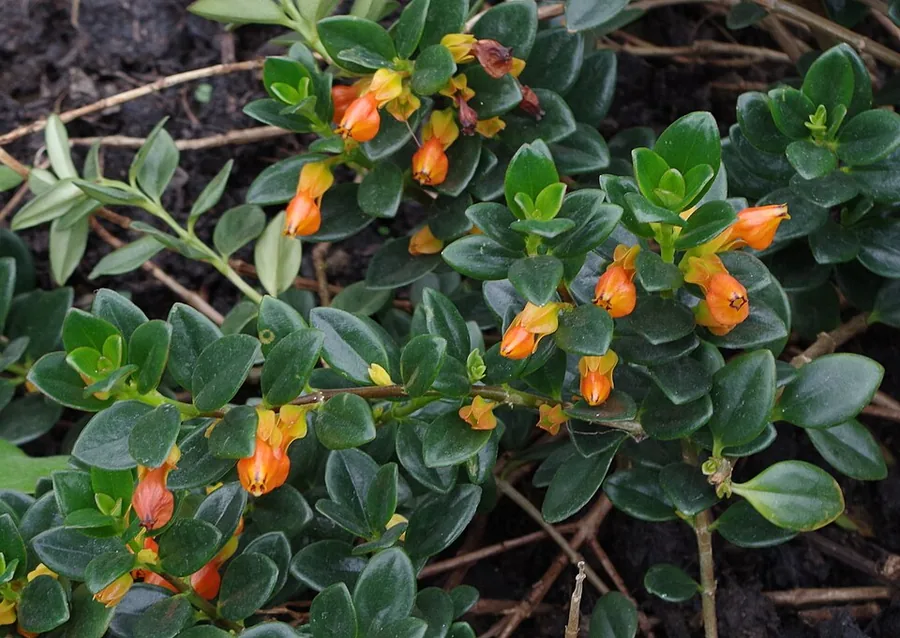
The name lives in the flowers: each pouched orange bloom is a short tube, curved and swollen at the belly so it really does look like a tiny fish caught mid-swim. They open through summer, dotting the plant with warm orange against a deep green ground. Every one hangs from an arching stem, tucked among the leaves rather than held up on show.
The leaves themselves are small, thick, and glossy dark green, an evergreen sheen that catches the light along the whole length of the arching, trailing stems. Those stems lengthen and bow under their own weight, spilling down in a dense curtain of foliage. The plant stays low at 4 to 20 inches (10 to 50 cm) tall, its width coming from how far the trailing stems reach rather than any upright height.
Run a hand through it and the picture is a compact tumble of shining leaves lit here and there by the little orange flowers. Bright indirect light, warmth, and humid air keep that foliage plump and glossy, and a pinch after flowering thickens the trailing stems. The whole plant is safe around cats, dogs, and other animals, from the glossy leaves to the orange blooms.
Care
The short version: it wants bright filtered light out of harsh sun, warmth, and humid air to keep the leaves glossy. Hold the peat-free mix moist while letting the surface dry a touch between waterings, feed monthly through the growing season, and pinch the stems back once the orange flowers fade.
Light
Set it in bright, filtered light near a window but out of harsh direct sun, which scorches the leaves and dulls their gloss. An east- or west-facing spot suits it, and a south window works behind a sheer curtain. In too little light the stems keep trailing but the orange flowers stop appearing.
Water
Keep the mix moist but well drained, letting the top inch or so dry before the next drink. Soft water suits it best, since it dislikes the salts in hard tap water that can mark the leaves. Ease off in winter, when growth slows.
Soil
Pot it in a loam or sand-based, peat-free mix that holds moisture yet drains freely. It sits happily across a wide pH band of 5.5 to 7.5, so anything from slightly acidic to neutral keeps the foliage in good color.
Temperature
Warmth keeps the leaves plump and growing, ideally between 50°F and 81°F (10°C to 27°C). It cannot take a chill, so keep it well above 50°F (10°C) and away from cold drafts and frosty windowpanes.
Humidity
This rainforest plant wants high humidity to hold its glossy sheen. Dry indoor air leaves the leaves looking tired and the buds reluctant, so group it with other plants, set it on a pebble tray, or run a humidifier nearby.
Feeding
Feed it monthly through spring and summer while the stems are in active growth, using a balanced dilute liquid houseplant fertilizer. Stop feeding over the cooler months, when growth rests.
Pruning
Pinch the stems back after flowering to keep the plant thick with leaves and stop it going bare and leggy at the base. It is low maintenance otherwise, and the glossy-leaved trimmings root easily into new plants.
Repotting
Move it up a pot size every 2 to 3 years, or once it outgrows its container. This slow to moderate grower takes about 2 to 5 years to reach full size, so it rarely needs disturbing. Roots circling the drainage holes or soil that dries out fast are the cue.
Size & spacing
Expect a compact plant, 4 to 20 inches (10 to 50 cm) tall, with glossy-leaved stems trailing out to a spread of 1.5 to 3 feet (50 to 100 cm). Hang it or set it high so the stems can hang in a full curtain of foliage.
Troubleshooting
The goldfish plant rarely goes wrong, and when it does the clue is written on the plant itself: a dulled, sticky sheen on the leaves or a stretch of stem with no orange flowers among the green. Match what you see below and correct it before the plant loses ground.
A sticky shine and small clustered insects on the tender tips
The tiny pear-shaped insects packed along the soft new tips are aphids, and that glassy, sticky shine coating the leaves is the honeydew they leave. A firm stream of water washes the clusters off the stems, and insecticidal soap finishes the survivors over a few repeat treatments. Setting the plant apart from its neighbors keeps them from crawling across.
Fix:
- Rinse plant with a stream of water to dislodge aphids
- Apply insecticidal soap to affected areas, repeating as needed
- Isolate the plant from other houseplants until controlled
Dark glossy leaves but no orange flowers among them
When the dark glossy foliage runs on with no orange blooms tucked in, the plant is almost always starved of light. A brighter position with bright, filtered light near a south, east, or west window brings the flowers back, kept off the scorching midday sun. A pinch after each flush thickens the stems into a fuller, more flower-studded shape.
Fix:
- Move to a brighter spot with bright, filtered light (e.g., near a south-, east-, or west-facing window out of harsh direct sun)
- Pinch after flowering to encourage bushier, flowering growth
Toxicity
For a home with animals the news is easy: this glossy-leaved plant is safe. Both the ASPCA and NC State Extension list it as non-toxic, so a curious nibble of leaf or flower will not poison a pet. At most a nibble brings the mild stomach upset that eating any houseplant can cause, and it fades on its own.
Safe for
People · Cats · Dogs · Horses · Rabbits · Livestock · Birds
Cats None
The ASPCA lists the glossy-leaved goldfish plant as non-toxic to cats, so a chewed leaf carries no poison. A cat that shreds and swallows a good bit of foliage may get a brief bout of stomach upset, and no more.
Dogs None
For dogs the plant is non-toxic by the ASPCA, so a bitten stem is harmless. A large mouthful of the fleshy leaves may bring some mild, short-lived digestive upset.
Horses None
NC State Extension records the plant as non-toxic to horses, so a stray dark green leaf grazed in passing does no harm.
Rabbits None
The trailing stems and leaves hold no toxins that put a rabbit at risk. As with any new green, a small first taste lets the gut adjust before more.
Livestock None
This tender indoor plant rarely reaches livestock, and its leaves and stems carry no compounds known to harm grazing animals.
Birds None
A pet bird is safe among the foliage, with no toxic parts on the plant if one pecks or nibbles a leaf.
People None
The plant holds no poisoning risk for people. Its tubular orange flowers and glossy leaves are not grown to eat, yet a child who tastes one is in no danger.
Varieties
Most goldfish plants show the plain deep green leaf, but a couple of variegated forms carry lighter markings for anyone who wants patterned foliage.
'Golden West' (variegated)
An RHS-recognized variegated selection whose dark leaves are streaked and splashed with cream, so the foliage reads two-toned up close.
'Variegatus'
Another RHS-listed variegated form, its leaves patterned with lighter markings instead of the solid green blade of the plain species.
How to propagate
The goldfish plant is simple to multiply from its own stems, and a short soft cutting grows into a fresh curtain of glossy foliage with a little patience.
Stem cuttingsEasy
Spring · Several weeks to root; reaches full size in about 2-5 years
A short length of soft new stem taken as a softwood tip cutting in spring roots readily, the method both the RHS and NC State Extension record. Roots form over several weeks, and the young plant then lengthens its glossy-leaved stems slowly toward full size in about 2 to 5 years.
Myths
The goldfish plant is poisonous to cats and dogs and must be kept away from pets.
The record says otherwise. The ASPCA lists it as non-toxic to cats and dogs, and NC State Extension adds horses to the safe list. The glossy leaves and orange flowers are safe around pets, and the worst a nibble brings is the mild stomach upset that eating any houseplant can cause.