Houseplant · Begoniaceae
Angel Wing Begonia
Begonia coccinea
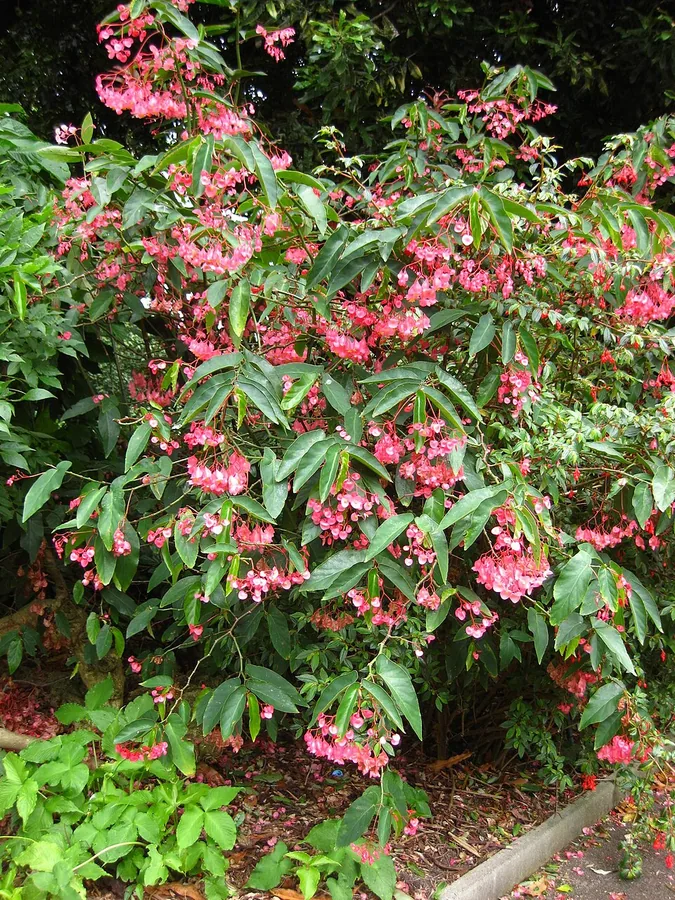
Given bright light and a regular pinch, the angel wing begonia shows off silver-spotted leaves and dangling red flowers.
Bright indirect
50–86°F · 10–30°C
USDA 10–11
1–3 ft · 0.3–0.9 m
Overview
The angel wing begonia is named for its wing-shaped leaves, each one lopsided like a single wing, lined up the length of tall canes and many of them dusted and freckled with silver. It is a cane-type begonia, its stems thickened and jointed like upright lengths of bamboo, a form it brought with it from the forests of Brazil where the group has grown for well over a century in cultivation.
Two features stand out up close. The leaves carry the plant through the year with their patterned, asymmetric blades, and in the warm months pendulous clusters of red or pink flowers dangle in sprays from the leaf joints, hanging clear of the foliage. The canes stretch fast to 1 to 3 feet indoors, lengthening between the leaf nodes as they climb.
The plant's character changes with care. With bright light, even moisture, and a regular pinch, the canes stay clothed in leaves from base to tip and look full and dense. Without pinching the same canes run tall and bare at the base, leaving a crown of leaves up top above lengths of naked, jointed stem.
Care
The short version: the silver-flecked, wing-leaved begonia wants bright indirect light with a little morning sun, soil kept evenly moist but never wet, warmth above 50°F (10°C), high humidity, and a regular pinch to keep its canes leafy.
Light
Give it bright indirect light with a little direct morning sun, like an east-facing window. It takes some partial shade, but harsh afternoon sun scorches brown patches into the leaves, while too little light draws the canes out long and leaves the leaves sparse.
Water
Keep the soil evenly moist and let only the surface dry between waterings, watering just enough to keep the leaves crisp and firm rather than limp. Ease off through winter, and never let the pot sit in water, since wet soil rots the roots and the thickened stem bases fast.
Soil
Plant it in a loose, humus-rich potting mix that drains freely around the roots. A pH anywhere from 5.5 to 7.5 works, on the acidic to neutral side, and good drainage matters more than the exact number.
Temperature
It is happiest between 50°F and 86°F (10°C to 30°C) and is not frost hardy at all. A cold draft below 50°F yellows the leaves and makes them drop, so keep it clear of chilly windows in winter.
Humidity
This plant likes high humidity, more than most rooms offer in winter, which keeps the broad blades from crisping at the edges. Group it with other plants or set it on a pebble tray, but keep the air moving so damp, still conditions do not powder the leaves with mildew.
Feeding
While it is in full growth from spring through summer, feed with a balanced liquid fertilizer at half strength every other watering, so roughly every couple of weeks. Stop feeding in the darker, slower months when the canes barely lengthen.
Pruning
Pinch the growing tips of the canes early and often to force side branches and keep the plant bushy rather than leggy, so the leaves cover the stems. Once it is as full as you want, stop pinching and let the flower sprays form.
Repotting
Repot every 1 to 2 years, or sooner once roots push through the drainage holes, growth stalls, or water runs straight through. Move it up just one pot size into fresh, well-drained mix.
Size & spacing
Indoors it grows fast to about 1 to 3 feet (30 to 91 cm) tall on its upright canes and spreads 1 to 2 feet (30 to 61 cm) wide. Give it room and a little airflow so the broad leaves dry off and mildew stays away.
Troubleshooting
Most trouble shows on the plant itself, in the canes, the leaves, or the stem bases. Too much water blackens the base, too little light draws the canes out long and thin, and stale air dusts the leaves with mildew. Match the look of the plant below, then fix the cause before it spreads.
Slimy blackened bases below a slumping plant
The thickened stem bases turn soft, brown, and mushy in root and stem rot, almost always from soil that stays too wet, and cool damp air can fur the tissue with botrytis on top. Once the base goes soft and the roots turn dark and slimy, stop watering and let everything dry out. Cut away the rotted tissue, take firm, healthy tip cuttings to save the plant, and repot into fresh, fast-draining mix.
Fix:
- Withhold water and allow the soil to dry
- Cut away rotted tissue and take healthy tip cuttings to start a fresh plant if rot is advanced
- Repot into fresh, well-drained mix with adequate drainage
Dusty white film on the leaves
A chalky white coating across the leaf surfaces is powdery mildew, a fungus that films over the foliage in still, humid air. Open up the air around the plant, pull off the most coated leaves, and keep water off the foliage. Easing the humidity down a notch slows it before it dusts the rest of the leaves.
Fix:
- Improve air circulation around the plant
- Remove and discard affected foliage
- Avoid wetting the foliage and reduce ambient humidity around the plant
Yellowing leaves that wilt and fall
The blades go soft and yellow and drop, usually from soggy soil, and overwatering is behind most cases, though a cold draft below 50°F (10°C) brings on the same droop. Let the surface dry between waterings, never leave the pot standing in water, and move it away from chilly spots. Keep it in the 50°F to 86°F (10°C to 30°C) range and cut back on water through winter.
Fix:
- Let the soil surface dry between waterings and never let the pot sit in standing water
- Move the plant away from cold drafts and keep it above 50°F (10°C)
- Ensure the pot has drainage and a loose, well-drained mix
Sticky sheen, cottony tufts, and clouds of gnat-sized bugs
Several pests mark the plant itself: mealybugs pack white cottony tufts into the leaf joints, spider mites stipple the blades with pale dots and string fine webbing across them, whiteflies lift off in a pale cloud when the plant is brushed, and thrips scrape silvery scars into the surface. Isolate the plant first, then wipe off the mealybugs and rinse the leaves to dislodge mites and whiteflies. Follow up with insecticidal soap or horticultural oil, and repeat until they are gone.
Fix:
- Isolate the affected plant
- Wipe off mealybugs and rinse foliage to dislodge mites and whiteflies
- Treat with an appropriate insecticidal soap or horticultural oil, repeating as needed
Naked lower canes topped by a crown of leaves
In low light without pinching, the jointed canes draw out long and leggy, with wide gaps between the leaf nodes and foliage only at the tips. Move the plant to a brighter spot with morning sun, and pinch the growing tips so side branches break from lower down. Cut the tallest canes right back and root the cut pieces as cuttings to clothe the plant in leaves again.
Fix:
- Move to a brighter spot with bright indirect light and some direct morning sun (e.g. an east window)
- Pinch the tips of branches to promote lateral growth and a fuller habit
- Cut back overly tall canes and use the removed shoots as cuttings
Toxicity
Keep this one away from animals. Every part holds soluble calcium oxalates, and the thick roots beneath the soil hold the most of all, so the same compound that upsets a dog or cat can damage the kidneys of a grazing horse or goat. The clear sap can also leave human skin red and itchy, so wash up after pruning.
Toxic to
Cats · Dogs · Horses · Rabbits · Livestock · Birds · People
Cats Moderate
A cat that bites into the fleshy leaves or juicy stems will generally drool and vomit. The calcium oxalates cause it, and because the buried roots concentrate the most, the pot belongs beyond a cat's reach.
Dogs Moderate
Watch for heavy drooling and vomiting soon after a dog nibbles the plant. The same oxalates are at work, and a dog that digs up and chews the thick roots gets the strongest dose.
Horses Toxic
Grazing on begonia is dangerous for horses, since the soluble oxalates can damage the kidneys. The buried parts carry the most toxin, so do not let a horse pull at a planting.
Rabbits Toxic
Rabbits should be kept away from this plant altogether. Its tiny oxalate crystals rasp at their mouth and gut lining, and the roots hold the sharpest concentration.
Livestock Toxic
Goats, sheep, and cattle meet the same kidney threat as horses that crop the leaves or roots. Keep it fenced from any grazer that might browse.
Birds Caution
Pet birds may respond to the oxalates with a raw mouth and a churning stomach. Keep prying beaks away from every leaf and stem.
People Caution
The plant is not eaten, and the sap can leave the skin red and itchy from contact. Wash your hands after pruning and keep small children from chewing the leaves.
Sap can cause skin irritation (contact dermatitis); the underground parts (roots) are the most toxic part. Keep the plant out of reach of pets and children, and avoid letting animals graze on it
Helpline numbers

United States
ASPCA Animal Poison Control: (888) 426-4435 (fee applies)
Poison Control: (800) 222-1222



Canada
Poison Centres: 1-844-764-7669
Varieties
Angel wing is really a family of cane begonias, and a few named selections stand out by their leaves and flowers. These are the ones worth knowing.
'Argenteo-guttata'
The leaves of this founding selection are shaped like uneven wings and dusted with silver spots, the very look that named the group; it appeared in 1888 from crossing B. aconitifolia and B. coccinea.
'Canary Wings'
This cane type carries bright chartreuse-yellow foliage, against which it hangs heavy clusters of red flowers that glow off the pale leaves.
'Corallina de Lucerna'
A vigorous old favorite, it bears large silver-spotted leaves and long dangling sprays of red flowers down its tall canes.
'Gryphon'
Unlike the others, this one is grown for its big palmate leaves, streaked silver across the top and deep orange-red underneath, rather than for any show of flowers.
How to propagate
Angel wing begonias are among the easiest houseplants to multiply, and a single jointed cane gives you plenty of material to work with.
Stem cuttingsEasy
Spring to summer · Roots in a few weeks
Stem cuttings are the standard way to multiply cane begonias, and they are about as easy as propagation gets. Cut a tip or length of jointed stem in spring or summer, stand it in water or a pot of moist mix, and it puts out roots within a few weeks into a plant identical to its parent.
Leaf cuttingsModerate
Spring to summer · Several weeks
Leaf cuttings are a slower second option, taken in spring or summer like stem cuttings. The single blades take several weeks to root and ask for a bit more care, so most growers reach for stem cuttings first.
DivisionEasy
At repotting · Several weeks
When you next repot a mature, crowded clump of canes, you can split it into separate plants. Each division settles in over several weeks and grows on as its own begonia.
Myths
On a begonia, its leaves and stems above the soil most threaten pets.
The visible leaves and canes seem like the worst of it, but the ASPCA points the other way. The roots underground hold the most toxin, which is one more reason to keep pets from digging in the pot.
Inside a begonia, the oxalates are the identical insoluble crystals, no different from those in aroids.
They are not the same. Begonias carry soluble calcium oxalates, which behave differently from the insoluble crystals in many aroids and can reach the kidneys of a grazing animal that eats enough.