Houseplant · Begoniaceae
Polka Dot Begonia
Begonia maculata
Give it bright indirect light, careful watering, and humid air, and the polka dot begonia shows off spotted, silver-flecked leaves.
Bright indirect
USDA 10–11
2–3 ft · 0.6–0.9 m
Overview
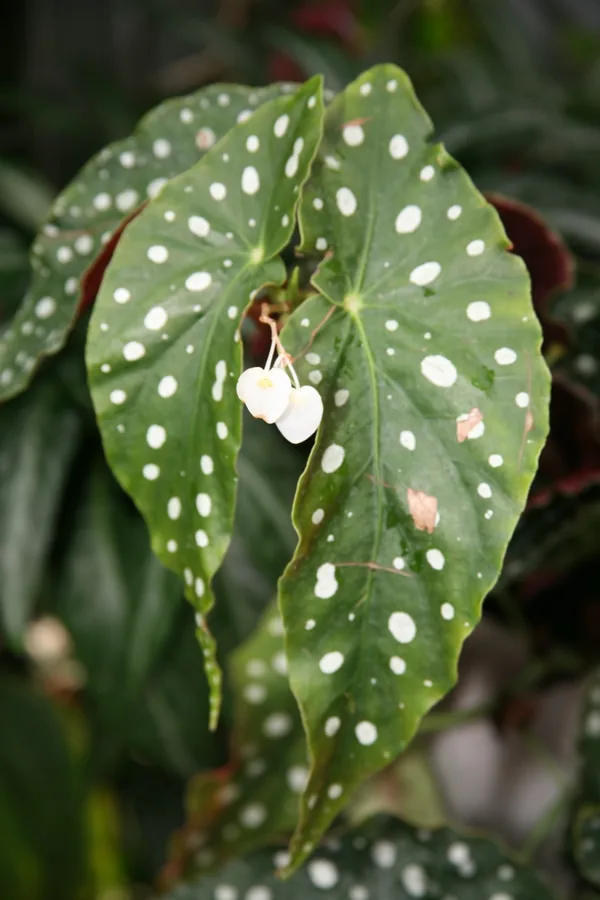
Up close, the polka dot begonia makes its name literal. Each long, angel-wing leaf is olive to deep green and scattered with rows of raised silvery-white spots, and turning one over reveals a flushed, deep crimson-red underside. The leaves ride on upright, bamboo-like canes, jointed and segmented like slim green rods. It is a cane-stemmed begonia, native to the forests of southeast Brazil.
The whole plant stays fairly compact, the canes climbing to about 2 to 3 feet (61 to 91 cm) tall over a few seasons. In the warmer months slender stalks let down drooping clusters of small pale pink to white flowers that dangle below the leaves. That spotted, red-backed foliage is what first catches the eye, and it holds attention.
Behind the look sit two plain needs: water and air. The fleshy canes and roots rot fast in soil left soggy, yet the plant still drinks in the high humidity of its native understory. Given steady moisture and air stirring around the leaves, the spots stay crisp and the foliage fills out fuller and brighter each year.
Care
The short version: the spotted begonia wants bright indirect light, water only once the top of the soil dries, and humid air kept moving. Light feeding through the growing season and pinched tips keep the canes leafy and full.
Light
The spotted leaves hold their best color in bright, indirect light near a window where direct sun never strikes them. In medium light or partial shade the plant survives, but the silvery spots dim and the canes stretch long and thin. Harsh midday sun scorches brown patches into the foliage.
Water
Water moderately while the canes are growing, then let the top of the soil dry before the next drink, since the fleshy roots rot in standing wet. This begonia rots easily, so it never sits in soggy soil or a saucer of water. Watering slows in winter as growth quiets.
Soil
The roots want a light, well-drained mix rich in dark organic matter, loose enough to hold a little moisture and let the rest run through. A slightly acidic pH of 5.5 to 6.5 suits them. Good drainage matters more than anything else in the pot.
Temperature
Warmth keeps the leaves on the canes, and the plant should never sit below 55°F (13°C). Cold drafts and chilled glass make the spotted leaves yellow and drop, so it moves clear of doors and vents in winter.
Humidity
The thin, spotted leaves crave high humidity, more than dry indoor air offers, so a humidifier or a pebble tray raises it. Still, moist air also breeds the powdery white film of mildew across those leaves, so the moisture pairs with steady airflow.
Feeding
Through the growing season, spring into summer, a balanced liquid fertilizer at alternate waterings, roughly every two weeks, keeps the canes leafy and the spots bright. Feeding stops in autumn and winter while the plant rests.
Pruning
Pinching the growing tips of the canes forces side shoots and keeps the plant full instead of leggy, its leaves spread down the stems rather than bunched at the top. Regular pinching also holds its size and keeps the lower canes clothed.
Repotting
Every one to two years, or once roots snake from the drainage holes and water runs straight through, the plant moves to a fresh pot. The pale dug-up roots and tubers stay away from pets, since that hidden tissue carries the most toxin.
Size & spacing
Indoors the canes rise to about 2 to 3 feet (61 to 91 cm) tall and the leafy spread reaches 1 to 2 feet (30 to 60 cm) wide. Room and airflow on every side keep the mildew film off the leaves.
Troubleshooting
Nearly everything that mars a polka dot begonia leaves a visible mark, and almost all of it traces back to water or air. Read the leaves and canes closely and the trouble shows early. Match the sign in front of you below, then act while the plant can still recover.
Slumped canes rising from a black, pulpy base
The canes sag while the soil stays soaked, and the base of the stem turns soft and blackened to the touch, the hallmark of root and stem rot from overwatering. It is the most serious thing that strikes this plant. The plant lifts free, and the mushy, darkened root and stem tissue is cut back to firm, pale growth. Fresh, quick-draining mix and watering only once the surface dries hold the rot off.
Fix:
- Remove the plant and cut away rotted roots and stems
- Repot into fresh, well-drained mix
- Water only after the top of the soil dries
Flour-like white specks blanketing the spotted leaves
The trouble shows as a chalky white dusting over the green leaf surface, and that powder is powdery mildew, a fungus that settles where humid air hangs motionless. It spreads leaf to leaf until the spots blur into a pale film. Moving air, the worst leaves picked off, and dry foliage push it back. The plant still wants high humidity, so airflow keeps that moisture from clouding the leaves.
Fix:
- Improve air circulation around the plant
- Remove and discard affected leaves
- Avoid wetting the foliage when watering
Leaves yellowing and falling off
The spotted leaves lose their green, pale to a sickly yellow, and drop from the canes. Overwatering is the usual cause, most often when the soil sits wet and never dries. Cold does the same, so a spell below 55°F (13°C) or a steady draft strips leaves too. Letting the top of the soil dry, holding warmth away from cold air, and free drainage bring the color and the leaves back.
Fix:
- Let the top of the soil dry before watering again
- Move away from cold drafts and keep above 55°F (13°C)
- Ensure the pot drains freely
Snowy fluff, a varnish-like stickiness, or gossamer threads across the foliage
Several sap-sucking pests leave marks across the spotted leaves and canes, each one distinct to the eye. White cottony tufts wedged in the joints are mealybugs, small clouds of white flies are whiteflies, fine webbing over stippled, speckle-damaged leaves is spider mites, and thin silvery scars are thrips. The plant is drawn apart from the rest, wiped clean of what shows, and treated with insecticidal soap or horticultural oil until the leaves come clear.
Fix:
- Isolate the affected plant
- Wipe off or wash off visible pests
- Treat with insecticidal soap or horticultural oil and repeat as needed
Skinny bare stalks crowned by a few leaves at the very top
A leggy plant reads clearly in the canes: they lengthen into long bare stretches with the spotted leaves bunched only at the tips, and the lower stems stand naked and green. Too little light drives the stretch, and unpinched tips let it run. Brighter light, pinched tips, and a cane cut back to a swollen node bring the leaves lower down again as the plant thickens into fuller, bushier growth.
Fix:
- Move to brighter indirect light
- Pinch the growing tips to force branching
- Prune back leggy canes to a node to encourage bushier regrowth
Toxicity
For all their beauty, the spotted leaves and canes are not safe around pets or grazing animals. Every part holds calcium oxalate crystals, sharp microscopic needles, and the pale tubers and roots underground hold the most, so a chewed leaf stings the mouth and a dug-up root does worse. No part is edible, so keep it clear of small children too.
Toxic to
Cats · Dogs · Horses · Rabbits · Livestock · Birds · People
Cats Moderate
A cat that bites into the fleshy leaf or cane releases sharp calcium oxalate crystals against its mouth, and drooling, pawing at the mouth, and vomiting follow. The pale tubers underground hold the most, so repotting debris stays out of reach.
Dogs Moderate
A dog meets the same crystals in a chewed leaf or stem, with drooling and a churning stomach close behind. A dog that digs down to the thick tubers and gnaws them takes a stronger dose.
Horses Moderate
The same oxalates cut at the mouths of horses and other grazing animals, leaving irritation and an upset stomach. Larger or repeated mouthfuls of the foliage can strain the kidneys.
Rabbits Caution
The crystals that sting cats and dogs would prickle a rabbit's soft mouth and gut just the same, so every part of the plant, leaf and cane alike, is off limits.
Livestock Caution
Grazing stock face the risk horses do, since the oxalates in the leaves and roots do not soften from one animal to the next. Cattle, goats, and sheep stay clear of the foliage and any unearthed roots.
Birds Caution
A pet bird gains nothing from pecking the spotted leaves, and the irritant crystals inside them make it unwise. Curious beaks are kept away from the plant.
People Caution
No part of this begonia is edible, and a bite of the crisp leaf or cane sets the mouth burning and stinging from the crystals within. It stays out of reach of small children who taste what they touch.
Most toxic part is underground; keep the plant and any repotting debris (tubers/roots) away from pets and grazing animals
Helpline numbers

United States
ASPCA Animal Poison Control: (888) 426-4435 (fee applies)
Poison Control: (800) 222-1222



Canada
Poison Centres: 1-844-764-7669
Varieties
Most plants sold as polka dot begonia trace back to one well-known cultivar, and its markings are worth learning by sight.
Begonia maculata 'Wightii'
A vigorous, free-flowering cane-stem cultivar whose long, narrow green leaves are stippled with silvery-white spots above deep crimson-red undersides.
How to propagate
Polka dot begonias grow readily from a piece of themselves, no special equipment required. A cutting taken in the growing season roots on its own with very little coaxing.
Stem cuttingsEasy
Spring to summer · Roots in a few weeks (often in water)
A cut length of the bamboo-like cane roots readily, which makes stem and tip cuttings the simple route to new plants. Taken in spring or summer during active growth and stood in water or pressed into moist mix, the cut stem pushes out fine white roots and roots within a few weeks.
Leaf cuttingsModerate
Spring to summer · Several weeks
A single spotted leaf can raise a whole new plant, though the wait runs longer. Set the leaf cutting in spring or summer and give it several weeks for roots and a tiny plantlet to form at its base before it is potted on.
Myths
The begonia's danger to pets is minimal, confined entirely to its leaves.
The spotted leaves are the least of it. Begonia is genuinely toxic to cats, dogs, and horses through calcium oxalate crystals, and those leaves carry the mildest share. The real danger lies in the pale tubers and roots underground, the very tissue a digging pet or a careless repotting drags up into the light.