Ornamental · Commelinaceae
Spiderwort
Tradescantia virginiana
Open in sun or shade, spiderwort unfurls fresh three-petaled flowers each and every morning.
Full sun
USDA 4–9
2–3 ft · 0.5–0.9 m
Overview
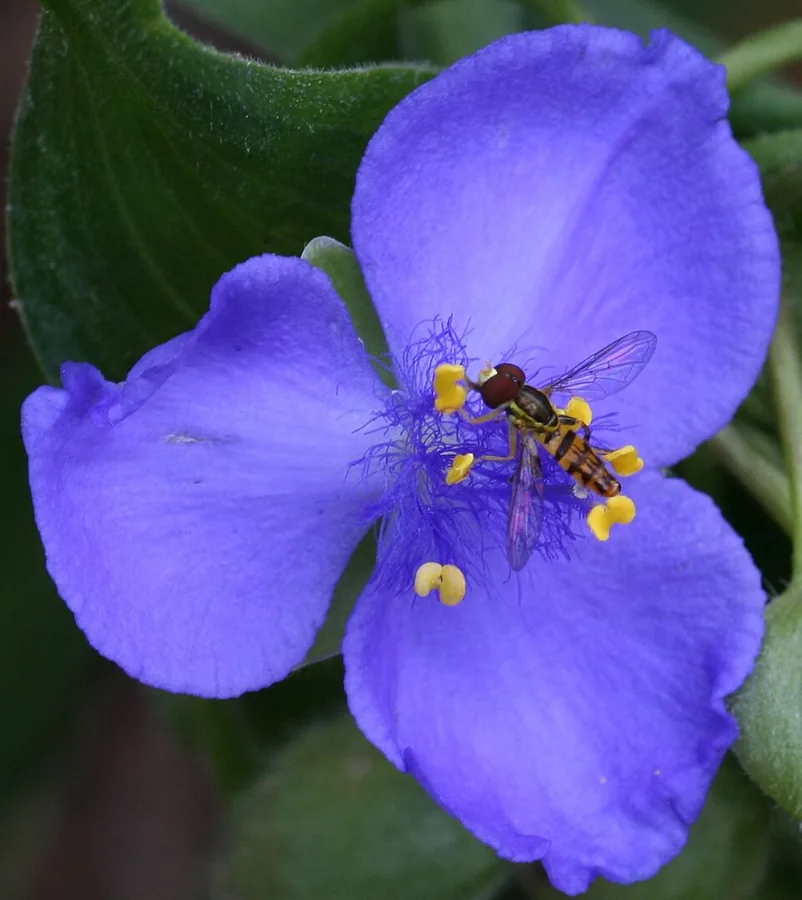
Spiderwort forms a dense, upright clump of long, grassy leaves that arch outward, a perennial native to eastern North America. From late spring into summer it raises clusters of three-petaled flowers, each one opening flat in blue, violet, purple, pink, or white. A single flower unfolds with the morning and closes by afternoon, only for another to take its place the next day. The narrow blades give the whole plant a soft, sheaf-like outline.
The clump is built for endurance as much as looks. Its flowering runs heaviest in full sun, where the blooms open most thickly, yet the same grassy foliage holds up in partial and even deep shade, and the roots take hold in clay, sand, chalk, or wet ground. Hardy to zone 4, the crown survives hard winters and pushes up a fresh clump of blades each spring.
By midsummer the look changes. Once the first flush of flowers passes, the stems lengthen and lean and the blades brown and collapse toward the ground, more so in heat. Cut hard to the base, the crown answers with a fresh mound of green blades and often a scattering of new flowers late in the season.
Care
The short version: set spiderwort in moist, fertile soil in sun to shade, water it through dry spells, and shear the whole clump of tired blades back hard after the first flush so fresh green growth takes their place.
Light
Spiderwort opens the most flowers in full sun, where the blooms stud the clump thickly, but the grassy blades keep their color in partial and even deep shade. In hot regions a little afternoon shade keeps the leaves from browning and slumping through midsummer.
Water
Spiderwort wants soil that stays consistently moist to occasionally wet, matching the damp ground it favors. Watered through dry spells, and again after a cutback, the crown pushes up a fresh flush of firm green blades.
Soil
The roots take to almost any ground, clay, loam, sand, or chalk, along with wet soil and the earth beneath black walnut. Fertile, moist but well-drained soil brings out the fullest clump, and it grows across a pH from 6.0 to 8.0.
Temperature
The crown is tough enough to survive cold to about -29°F (-34°C) and heat to 95°F (35°C). It is that upper heat that drives the blades to sprawl, brown, and flatten by midsummer.
Humidity
Ordinary outdoor air keeps the foliage healthy, so no set level applies. Moving air counts for more than humidity, since still, packed clumps are where rust flecks and leaf spots settle on the blades.
Feeding
This is a vigorous grower that asks for little at the root. A light feed of balanced fertilizer or compost as the first blades push up in spring is enough, and heavier feeding only draws out soft, leaning stems.
Pruning
Snip the faded flowers, each a small spent knot, to draw a second late-summer flush from the clump. Once the blades sprawl and brown after the first flush, shear the stems back hard, then cut every leaf to the ground as the season ends.
Repotting
In the ground the clump is split rather than potted on. Lift and divide it every 3 to 4 years, especially once the middle opens into a bare, dead patch and the flower count falls.
Size & spacing
A full clump stands 1.5 to 3 feet (46 to 91 cm) tall on its flowering stems and spreads 12 to 18 inches (30 to 46 cm) of arching blades. That much space lets air slip between the leaves and keeps them clean.
When to plant
Spiderwort keeps to the temperate seasons. Young clumps go in during spring once frost has passed, or in autumn from containers, and the three-petaled flowers open from late spring through early July, with many plants raising more blooms into late summer.
Northern hemisphere
Southern hemisphere
Typical months for a temperate climate: start earlier in warm zones, later where spring frosts linger.
- Plant: Spring after frost; container plants can also be set out in autumn
- Harvest: Late spring through early July (May-July), often reblooming into late summer; cultivars can flower June-September
Hardiness
USDA hardiness zones: 4–9
Temperature: down to -34°C
Troubleshooting
Spiderwort seldom shows real damage, and what marks the leaves is nearly always cosmetic. Browning blades in midsummer, chewed edges on new shoots, and rusty flecks make up almost all of it. Match the look below to its cause and act before it spreads.
Blades brown, flatten, and collapse through midsummer
What looks like failure is the plant's natural fade after blooming, quickened by summer heat and dry soil. The stems lengthen and lean, the older blades dull to brown, and the clump splays open at the center. Shear the tired growth to the base and water through any dry spell, and a fresh mound of green blades rises to carry the plant into fall.
Fix:
- Shear or cut the stems back hard after flowering
- Water during dry spells to encourage fresh basal regrowth
- Allow the plant to reflush in late summer and fall
Torn, ragged holes eaten into the young blades
The soft new shoots come up scalloped and holed, the work of slugs and snails that leave glistening slime trails across the leaves. The chewing runs deepest in damp, shaded corners. Pick the culprits off the blades by hand after dark, clear the wet debris they shelter beneath, and set out traps or barriers if the damage keeps coming.
Fix:
- Hand-pick slugs and snails, especially in the evening
- Reduce moist hiding spots and debris near the crown
- Use slug traps or barriers if damage is heavy
Rusty pustules and dark spots flecking the leaves
Orange-brown pustules and discrete dark spots break out across the blades where rust and fungal leaf spot settle in damp, crowded clumps. Strip the marked leaves off and bin them, then thin and cut back the clump so air slips through the foliage again. Kept dry on the surface, the leaves shed most of the trouble before it takes.
Fix:
- Remove and dispose of affected foliage
- Cut back and thin congested clumps to improve airflow
Toxicity
The sap inside spiderwort's stems is the part to respect, more an irritant than a poison. A snapped stem releases a sap that can draw out in fine threads and leave an itchy rash on bare skin, so gloves belong on the job when you cut or divide the clump, and a leaf chewed by a pet can bring on a mildly upset stomach. Keep animals from grazing the blades, but a stray nibble does little harm.
Toxic to
Cats · Dogs · Horses · Rabbits · Livestock · Birds · People
Cats Mild
A cat that chews the blades or stems gets a mild churn in the stomach, and the sap can leave its mouth or skin reddened and sore. Drooling and pawing at the face are the tell.
Dogs Mild
A dog that mouths the foliage may drool or run through a brief, mild bout of stomach upset. Where the sap touches, the skin around the muzzle can flush red.
Horses Caution
The ASPCA marks the genus for horses, with skin irritation the main mark it leaves. Keep grazing horses from working through the foliage as a habit.
Rabbits Caution
The irritant sap can leave a rabbit with a raw mouth and a churned stomach, so the blades are no treat to hand over.
Livestock Caution
Goats, sheep, and cattle rarely crop it, but a mouthful of the sappy stems can leave the mouth and gut sore. A stray nibble marks little.
Birds Caution
That same stinging sap makes spiderwort a poor plant to keep near pet birds, which can react to even a small taste.
People Caution
The sap reads as a skin allergen and can flare an itchy rash across bare skin, so glove up before cutting or dividing the clump. No part is eaten, so the mark is on your skin, not in your stomach.
Sap can cause contact dermatitis and is a skin allergen; wear gloves and protective equipment when cutting back or dividing.
Helpline numbers

United States
ASPCA Animal Poison Control: (888) 426-4435 (fee applies)
Poison Control: (800) 222-1222



Canada
Poison Centres: 1-844-764-7669
Varieties
Garden spiderwort comes in a handful of named selections, and the differences are all in the coloring, from the tint of the petals to the shade of the leaves. These are the ones to look for up close.
'Sweet Kate' (syn. 'Blue and Gold')
Deep blue-purple petals sit above bright golden-chartreuse blades on a compact clump 12 to 24 inches (30 to 60 cm) tall.
'Concord Grape'
Rich grape-purple flowers open over foliage in a cool blue-green.
'Zwanenburg Blue'
A vigorous Andersoniana Group form with large flowers in a deep blue-purple.
'Satin Doll'
Soft pink petals open across a low, compact clump.
'Billberry Ice' / white-flowered forms
Clear white petals form crisp three-petaled flowers that stand out in shade.
How to propagate
Spiderwort multiplies with little effort. A mature clump pulls apart into rooted pieces, and the plant also drops seed that comes up on its own around the garden.
DivisionEasy
Spring, or in autumn after flowering · Reaches full size in 1-2 years
Division is the surest way to more clumps, done in spring or in autumn once the flowers finish. Lift a crowded clump and tease or cut it into pieces, each with a knot of roots and a tuft of shoots. Set back in the ground, the divisions swell to full size within 1 to 2 years, and splitting every few years keeps the parent clump dense and firm.
SeedModerate
Sow seed in spring; plants also self-sow readily in the garden · 1-2 years to mature, flowering-size clumps
Spiderwort drops seed freely, so a spring sowing comes up and grows on with little help, reaching flowering size in 1 to 2 years. Named cultivars are the exception, since their seedlings do not carry the parent's coloring and are better divided. Cutting the spent flower stems off early keeps the self-sown seedlings from crowding in.
Myths
The grassy garden spiderwort is the same plant as the trailing inch plant houseplant.
Set them side by side and they grow quite differently. Tradescantia virginiana and the x andersoniana garden hybrids grow as cold-hardy, clump-forming border perennials, upright and hardy to zone 4. The trailing houseplants, tender tropicals like T. zebrina and T. fluminensis, trail rather than form clumps. The hardy garden spiderworts stay as tight clumps of blades, while tropical T. fluminensis runs invasive across the warm southern states and is best avoided.
Spiderwort only flowers in full sun.
Full sun does bring out the thickest show of blooms, but the plant flowers well and holds its blades in partial and even deep shade. In hot-summer regions a little afternoon shade actually helps the foliage, keeping the leaves from browning and slumping so early.