Houseplant · Commelinaceae
Tradescantia 'Nanouk'
Tradescantia albiflora 'Nanouk'
Plump, cream-and-green leaves brushed with pink and deep purple, packed onto low, fleshy stems.
Bright indirect
50–81°F · 10–27°C
USDA 9–12
4 in · 10 cm
Overview
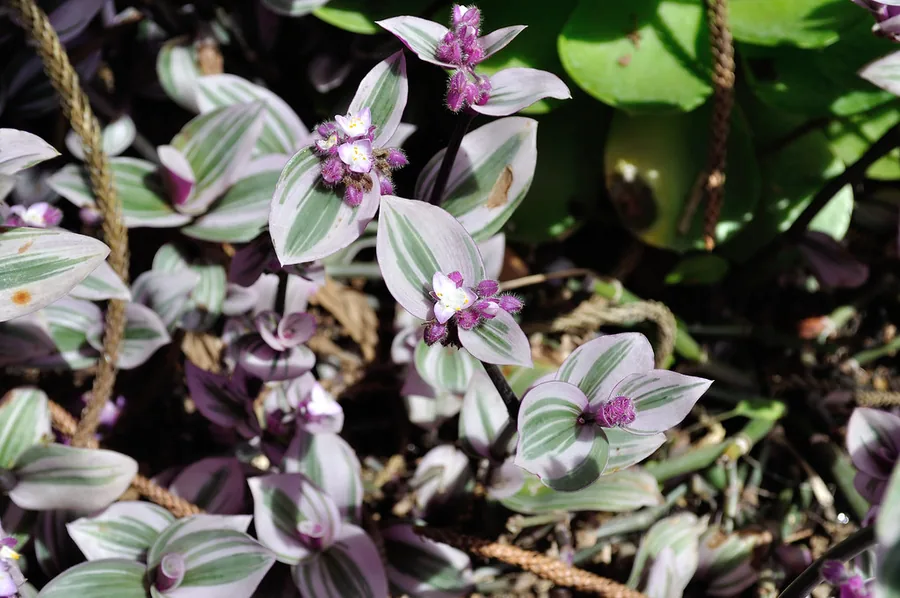
Up close, Tradescantia 'Nanouk' is all color and substance. Each leaf is small, plump, and roughly ovate to elliptical, its surface running lengthwise in bands of pink, green, and cream, while the underside glows a deep purple. The leaves clasp thick, fleshy stems that stay short and crowded rather than stretching out into vines.
The color ranges from pale pink to deep purple, threaded between broader stripes of green and clean white, so no two leaves look quite alike. Those succulent stems branch again and again near the base and root wherever they touch, building a dense, low mound of overlapping foliage rather than a few long runners.
Everything about it stays compact and close to the pot. The habit is upright at first and then broadly spreading, so the plant builds into a low, rounded cushion of striped, fleshy leaves. That whole mix of pink, green, cream, and purple depends on bright light, and the color flattens to plain green when the light runs short.
Care
The short version: bright, filtered light keeps the pink and purple in the leaves, water once the top of the soil dries and less in winter, keep it warm in free-draining soil, and pinch the tips often so the fleshy stems stay dense and full.
Light
Keep Nanouk in bright, filtered light by a window, because that light is what fills the leaves with pink and purple. In a dim spot the color drains out to flat green and the fleshy stems stretch and thin. Harsh midday sun burns brown marks into the foliage.
Water
Water it thoroughly while it grows, then let the top inch (3 cm) of soil dry before the next drink, easing off in winter. The plump, water-filled stems turn to mush in soggy ground, so the pot has to drain and never sit in standing water.
Soil
Grow it in a free-draining, loam-based mix or a peat-free houseplant compost. Drainage is everything here, since the swollen stems rot in soil that stays wet. A scatter of perlite or grit keeps a dense mix loose and airy.
Temperature
Ordinary room warmth of 50°F to 81°F (10°C to 27°C) keeps the leaves firm and full. The plant carries no frost hardiness, so cold glass and winter drafts will damage the soft foliage.
Humidity
Average household humidity keeps the leaves plump, with no set level to reach. In very dry air the fine leaf tips brown and crisp, and spider mites move onto the undersides, so a little extra moisture helps.
Feeding
Feed with a liquid houseplant fertilizer once a month through spring and summer, while fresh striped leaves keep unfurling. Hold off in winter when growth stops, since the unused feed just leaves salt behind in the soil.
Pruning
Pinch the soft growing tips often and the plant answers with side branches, staying thick and full instead of bare. Watch for shoots that come in solid green with no pink or white, and pull them, or they overrun the striped growth.
Repotting
Repot only once the roots have truly filled the pot, as this compact plant is slow to get there. The signs show at the base: roots pushing through the drainage holes, water sliding straight past the soil, and growth that has stalled.
Size & spacing
Nanouk stays low and small, only about 4 inches (10 cm) tall while the mound spreads 4 to 20 inches (10 to 50 cm) across. Up close that reads as a tight cluster of short, leaf-packed stems rather than a tall or trailing plant.
Troubleshooting
Nanouk shows trouble right on its leaves and stems, in changes you can see at a glance. Washed-out color, long naked stems, or soft blackened bases each read as a specific problem. Look closely, match the appearance below, and act while the plant still looks mostly sound.
Blackened, mushy stems slumping over
When the plump stems turn soft, brown, and slick, that is root and stem rot from waterlogged soil, and it is the one thing that truly kills the plant. Watering stops, the soil dries, and the plant comes out of the pot so the rotten tissue can be cut back to firm, healthy stem. If little is left to save, a few clean tip cuttings can restart it.
Fix:
- Stop watering and let the soil dry out
- Remove rotted roots and stems and repot into fresh, free-draining mix
- Take healthy tip cuttings to start a fresh plant if rot is advanced
Webbing, pinprick speckles, or white cotton
Fine webbing, pale speckling, and small cottony wads are the marks of spider mites, aphids, and mealybugs. Webbing with dotted stippling is mites, soft insects packed along a stem are aphids, and white fluff wedged into the leaf joints is mealybugs. A rinse and wipe, then insecticidal soap or horticultural oil, clears them, with the plant kept apart from others until the leaves are clean.
Fix:
- Rinse/wipe off pests and treat with insecticidal soap or horticultural oil
- Isolate the plant to prevent spread to other houseplants
- Repeat treatment as needed until clear
Pink draining out to flat green
The washed-out look is not enough light, not illness. The pink and white parts of each leaf hold little green pigment, so in low light the plant leans on its green tissue and the new leaves come in plain green. Bright, filtered light brings the color back, and any solid-green shoots should be cut off before they swamp the striped ones.
Fix:
- Move to a spot with bright, filtered/indirect light
- Avoid harsh direct midday sun, which can scorch the leaves
- Remove any fully plain green reverted shoots so variegated growth is not overtaken
Long naked stems with leaves only at the ends
Legginess shows as bare, elongated stems, and it worsens in low light as they stretch toward the window. Cutting the fleshy tips back forces the plant to branch and refill. The severed pieces root within a week, so they can be pushed straight back into the pot to close the gaps.
Fix:
- Pinch or cut back the growing tips to force branching and bushier growth
- Propagate the trimmed tip cuttings to fill in the pot
- Increase light if the plant is stretching
Brown, crisped edges and bleached blotches
Strong midday sun bleaches and browns the leaf surface as scorch, worst on the faces turned to the glass, while dry air and uneven watering crisp the fine tips. Moving the plant out of that direct sun into bright, filtered light, trimming the marked leaves, and watering evenly settles it down.
Fix:
- Move out of harsh direct sun into bright filtered light
- Trim badly damaged foliage
- Keep watering consistent and maintain average humidity
Toxicity
Behind the pretty striping, this is a mildly toxic plant. The sap inside the fleshy stems irritates skin and can raise a rash on people, and a pet that chews a leaf may drool or get a mildly upset stomach. Nothing is life-threatening, but the cut stems are worth handling with gloves.
Toxic to
Cats · Dogs · Horses · Rabbits · Livestock · Birds · People
Cats Mild
A cat that bites into the fleshy leaves may drool or get a mildly upset stomach, and the sap can raise a red, itchy patch where it meets skin. The reaction stays mild, but a leaf-chewing cat is best kept clear of the plant.
Dogs Mild
Dogs meet the same irritant sap. It can redden a muzzle or paws on contact, and a chewed stem brings a little drooling or a brief bout of mild stomach upset.
Horses Mild
The ASPCA lists the plant as toxic to horses, with skin contact the main concern. The sap can irritate exposed skin, even though a small potted plant rarely comes within a horse's reach.
Rabbits Caution
No rabbit-specific data exists, so it counts as a caution rather than a safe nibble. The same irritant sap that troubles other animals keeps this out of the hutch.
Livestock Caution
Grazing animals are little studied here, and the irritant sap alone is reason for caution. As a potted plant it seldom comes near cattle, goats, or sheep.
Birds Caution
Birds have no clear data either, so pet birds are best kept from pecking the striped leaves. The sap that irritates skin could bother a curious beak just as easily.
People Caution
On skin, the sap is a known irritant that can raise a contact-dermatitis rash on anyone handling the cut stems. Gloves while pruning or taking cuttings, and a wash afterward, keep it off the hands.
Sap can irritate skin; the RHS advises wearing gloves when handling. The toxic principle is irritant sap (contact dermatitis / mild GI irritation), NOT calcium oxalate
Helpline numbers

United States
ASPCA Animal Poison Control: (888) 426-4435 (fee applies)
Poison Control: (800) 222-1222



Canada
Poison Centres: 1-844-764-7669
Varieties
The pink-striped plant is the Nanouk most people picture, but one close relative wears a very different coat.
Tradescantia 'Green Nanouk'
'Green Nanouk', a form the RHS recognizes, wears the same small, plump leaves and compact shape but in plain green, with none of the pink and purple striping.
How to propagate
Snap a fleshy stem and it roots almost at once. A single tip cutting takes hold in a few days, so one plant readily becomes many.
Stem cuttingsEasy
Spring to summer · Roots in about 1 week in summer (~21°C), 2 weeks in winter (~18°C) per the plant patent
Almost any piece of this plant will grow. Take a fleshy tip cutting in spring or summer, set it in water or moist soil, and roots appear in about a week at 70°F (21°C), or nearer two weeks in the cooler light of winter around 64°F (18°C). The stems fork freely and root at every node, so a handful of cuttings soon knit into a full pot. One catch: Nanouk is a patented cultivar, so propagating it for sale is restricted.
Myths
Nanouk is a harmless plant to have around pets and people.
It is not. The ASPCA lists the inch plant as toxic to dogs, cats, and horses, and both NC State and the RHS mark the sap as a skin irritant that brings on contact dermatitis and mild stomach upset. The problem is the irritant sap, not the calcium oxalate carried by many other houseplants, so gloves are enough to handle the cut stems safely.
Nanouk keeps its pink coloring in any spot indoors.
It will not. In a dim corner the leaves lose their pink and settle into plain green. That coloring is built by light, so bright, filtered light is what holds the pink, green, and white together. A place close to a well-lit window, just out of harsh direct sun, keeps the stripes bright.