Houseplant · Commelinaceae
Purple Heart
Tradescantia pallida
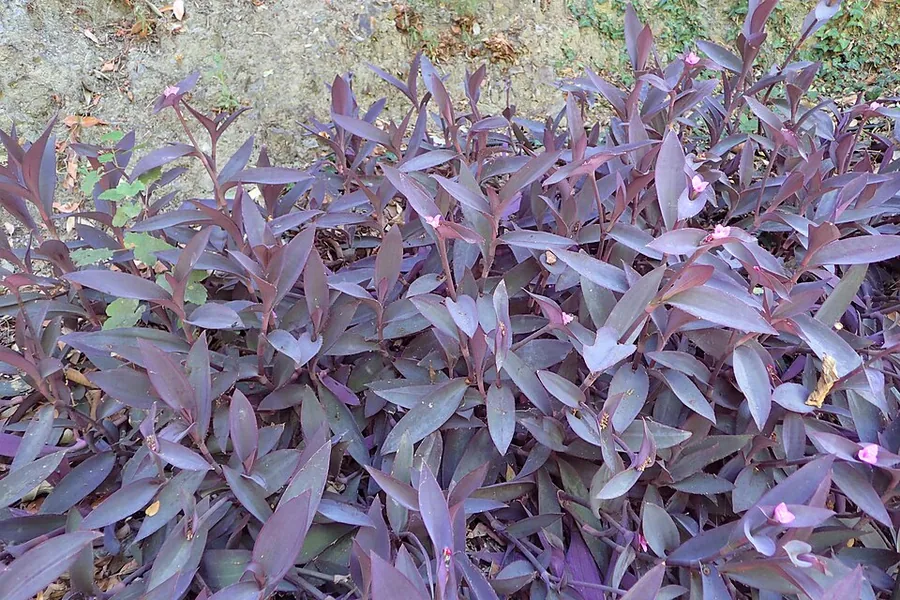
Long, trailing stems and pointed leaves in a saturated violet-purple, lit here and there by small pink blooms, that is purple heart up close.
Full sun
USDA 10–11
8–12 in · 20–30 cm
Overview
Up close, purple heart is defined by its color. The narrow, pointed leaves and the slim stems that trail beneath them share the same deep violet-purple, a tone so even across the plant that leaf and stem look cut from one cloth. Through the warmer months small pink flowers open against that dark backdrop. Native to Mexico, it sits among the spiderworts, kin to the inch plants.
Run a hand along it and the stems feel brittle, snapping cleanly at the joints where new roots form. Growth is fast, the trailing stems lengthening quickly and spilling over any edge. Light writes itself onto the leaves: under strong sun the violet turns deep and saturated, but in shade the color thins to green and the stems stretch pale and lanky, their leaves set wide apart along the stem.
Indoors the plant reads as a low mound of violet, stems spilling over the rim and pointed leaves catching the light. Break a stem and it weeps a sap that is a mild skin irritant, enough to redden and itch the skin, so gloves are worth wearing when cutting, and the plant is best set out of reach of pets and young children.
Care
The short version: strong light to keep the violet deep and saturated, well-drained soil left to dry between waterings, warmth above 50°F (10°C), and an occasional pinch to keep the stems dense.
Light
Light is what colors this plant. Under full sun or a very bright window, the leaves and stems deepen to a rich violet, but in shade that pigment drains away, the foliage turning green and the stems drawing out thin and pale. Indoors, a south-facing window keeps the color at its darkest.
Water
Once established, purple heart is highly drought-tolerant, riding out a dry spell without wilting. Let the surface dry out before watering again, since it takes drought far better than wet feet. In soggy soil the base turns soft and dark as rot sets into the roots and stems.
Soil
The plant is easy about soil provided it drains freely. A rich, organic mix gives the best growth, though clay, loam, or sand all suit it, across acid to alkaline ground. Only a mix that holds water and stays heavy causes trouble, souring the roots.
Temperature
Cold marks this plant fast. Held above 50°F (10°C) it stays firm and colored, but a frost turns the soft top growth limp and black. Ordinary room warmth suits it all year, and below that line it lives indoors or moves in before winter.
Humidity
Humidity leaves no mark on this plant. Ordinary room air is enough, and dry indoor air does nothing to dull the leaves or the color.
Feeding
A monthly feeding through the spring and summer growth keeps the leaves coming thick and deeply colored, given as a balanced general-purpose fertilizer. As the weather cools and growth slows, the feeding stops.
Pruning
Pinch the growing tips and the plant answers with denser, bushier stems and fresh shoots; cut the flower stems off once the pink blooms brown. Each pinched tip, brittle and full of latent roots, becomes a cutting rather than waste.
Repotting
Every 1 to 2 years, or once the roots crowd the pot, purple heart wants fresh ground. Roots creeping out of the drainage holes, new shoots coming in thin and few, and soil that dries almost as fast as it is wetted all mark a plant ready to move up.
Size & spacing
This is a low, mounding plant, 8 to 12 inches (20 to 30 cm) tall, its trailing stems reaching 12 to 18 inches (30 to 45 cm) as they spill sideways and down. That low, cascading shape shows the violet off best over a pot lip or a hanging edge.
Troubleshooting
Most of what goes wrong with purple heart shows first in the look of the plant, in the color of the leaves or the state of the stems, and traces back to light or water. Read the change you can see below, then match it to its cause.
Stems going soft, dark, and mushy at the base
The base of the plant turning soft, dark, and mushy is root and stem rot, set off by soil that stays wet. Down in the pot the roots go from firm and white to brown and slimy, and the stems collapse under their own weight. It is the one thing that kills this plant, so cut away every soft part and root a few firm stems in fresh, quick-draining mix.
Fix:
- Stop watering and allow soil to dry out
- Cut away rotted tissue and re-root healthy firm stem cuttings in fresh well-drained mix
- Discard severely rotted plants and soil
Top growth going limp and black after cold
A night below 50°F (10°C), or an outright frost, leaves the top of the plant limp and blackened, the once-firm stems slumping and the violet gone to black. The plant has no cold hardiness at all. Cut off the ruined growth and bring it into warmth, and where frost is a risk, shelter the pot indoors or hold a few cuttings for spring.
Fix:
- Remove damaged top growth
- Bring containers indoors or take cuttings to overwinter where frost occurs
- Where roots survive in mild climates, allow the plant to resprout from the base
Leaves stippled or sticky, sometimes finely webbed
Leaves gone dull and stippled, a sticky film, or thin webbing across the growth all point to sap-feeders: spider mites, mealybugs, aphids, or scale. Each leaves a mark of its own, fine webbing, cottony white tufts, clusters of soft-bodied insects, or hard little bumps stuck along the stems and under the leaves. Rinse and wipe the plant clean, treat with insecticidal soap or horticultural oil, and hold it away from the rest until clear.
Fix:
- Rinse plant and wipe off pests
- Treat with insecticidal soap or horticultural oil, repeating as needed
- Isolate affected plants to prevent spread
Leaves greening over on long, thin stems
When the leaves shift from violet toward flat green and the stems run long and thin, the plant is short of light. The violet only holds under strong sun; in weaker light the color washes out and the leaves sit widely spaced along stretching stems. Set it in the brightest window or full sun, and pinch the drawn-out stems so the deep color and tight form return.
Fix:
- Move to a spot with full sun or as much bright direct light as possible
- Pinch back leggy stems to encourage compact, well-colored regrowth
Stems gone long and bare below their leafy tips
Left unpinched, the trailing stems run out long and bare, the pointed leaves crowding only near each tip, and dim light stretches them further. The stems themselves stay brittle and easy to break. A pinch at the tips forces new side branches, and the pieces you break off root and fill it out again.
Fix:
- Pinch or cut stems back to encourage branching and bushier growth
- Root the removed tips as cuttings to fill in the plant or start new ones
Skin turning red where the cut sap touched
The sap that wells up from a broken leaf or stem is a skin irritant, and where it meets skin it raises a red, itchy patch, a mild contact dermatitis. It is only skin-deep and washes off under soap and water. Gloves worn while pinching, pruning, and cutting keep it off the hands entirely.
Fix:
- Wash the affected skin with soap and water
- Avoid further bare-handed contact with cut stems
Toxicity
Purple heart carries a mild irritant in its sap, the fluid that beads at a cut leaf or stem. On skin it raises redness and an itch, and a pet that bites into a leaf may drool and grow queasy. Wear gloves at the cutting, and keep the plant clear of animals and children.
Toxic to
Cats · Dogs · Horses · Rabbits · Livestock · Birds · People
Cats Mild
A cat that bites the leaves drools and turns queasy in the stomach, and where the sap wets its skin the spot goes red and itchy. The upset is small and short-lived, though a cat set on chewing is better kept away.
Dogs Mild
A dog goes much the same way. A mouthful brings drool and a brief bout of stomach upset, and the sap reddens whatever skin it touches.
Horses Caution
A horse gets the same soreness in the mouth and on the skin from the sap, so it is best kept from grazing on the plant at all.
Rabbits Caution
No trustworthy record covers rabbits feeding on it, and its irritant sap alone is cause to keep it off their food. It should never be set out as forage.
Livestock Caution
Grazing animals take on the same soreness of mouth and stomach from the sap, so a fence between them and the plant is the safe course wherever they range.
Birds Caution
Small and easily hurt, pet birds are a poor match for a plant whose sap irritates. Keep it well away from the cage and the perches.
People Caution
On skin, the cut sap raises contact dermatitis, a red, itchy flush right where it lands. Gloves at pruning and cutting stop it, and children should be kept from mouthing the leaves.
Cell sap is a skin irritant (contact dermatitis); wear gloves when pruning, pinching, or taking cuttings
Helpline numbers

United States
ASPCA Animal Poison Control: (888) 426-4435 (fee applies)
Poison Control: (800) 222-1222



Canada
Poison Centres: 1-844-764-7669
Varieties
You will almost always find purple heart as one named form, the one whose leaves and stems hold the deepest, most even color.
'Purpurea'
Nearly every plant labeled Purple Heart is this form, its leaves and stems saturated with a deeper, steadier violet-purple than the wild species.
How to propagate
Purple heart roots so readily that a single snapped stem, brittle at the joint, becomes a whole new plant.
Stem cuttingsEasy
Any time during active growth · Roots in 1-2 weeks
Few plants root as willingly. The stems are brittle and snap at the joints, and each joint is a node ready to root, so a broken tip or length of stem pressed into soil or left standing in water throws out roots within a week or two. Take cuttings whenever it is growing strongly.
Myths
Purple heart needs constant watering or it shrivels in a dry spell.
The plant does the opposite. Once established it holds firm through dry soil, and it is standing water that ruins it, softening the roots to brown mush and folding the stems. Give the soil time to dry between waterings.
The purple stays just as deep wherever the plant grows.
The color tracks the light. Strong sun pushes the violet to its darkest, while shade thins it toward green and pulls the stems out long and pale as they lean for light.