Houseplant · Cactaceae
Prickly Pear
Opuntia ficus-indica
Flat green paddles, ringed with spines and fine barbed bristles, that open into cups of yellow, orange, and pink.
Full sun
USDA 8–11
3–16 ft · 1–5 m
Overview
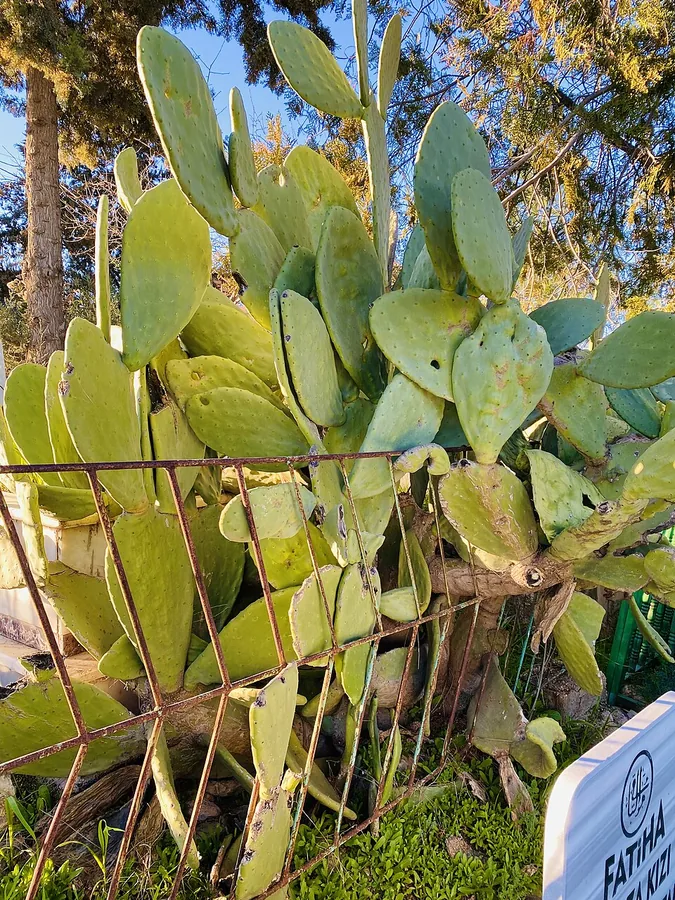
Prickly pear grows as a stack of flat, green, paddle-shaped pads, a cactus from the Americas now found across warm regions worldwide. Each paddle is a stem, not a leaf, thick and firm with stored water that keeps it plump through long dry spells. Set in a bright window or a hot, open site, the pads build one upon another into a broad, segmented plant.
Up close the plant carries color as well as form. Through late spring and summer it opens cup-shaped flowers in yellow, orange, or pink, and by late summer these give way to ripe red fruit. The young pads and that red fruit are edible, eaten as nopales and tunas.
The surface of every pad tells you to keep your distance. Scattered across the green skin sit large, rigid spines, and around them cluster glochids, tiny barbed bristles fine as hair that pull loose at the lightest touch and drive into skin. Those bristles are the hard part to see and the hardest to pull back out.
Care
The short version: full sun, a gritty fast-draining mix, and water only when the soil is bone dry. The pads stay firm and plump on the dry side, while too much water turns them soft and rotten from the base.
Light
Prickly pear wants full sun, the strongest light on offer, which keeps the pads thick, firm, and deep green. Starved of light, the pads grow thin and pale and the plant stretches into a leaning, floppy shape.
Water
Water it deeply, but only when the mix is bone dry, and far less through the cool months when growth stops. Wet soil turns the pads soft and mushy at the base, so the firm, plump look you want comes from staying dry.
Soil
Plant it in a gritty, sharp-draining sandy or cactus mix, coarse and open so water runs straight through. It grows well at a pH of 6.0 to 7.5, though the loose, fast-draining texture matters more than the reading.
Temperature
The pads endure a wide range, 23°F to 104°F (-5°C to 40°C), wider on the cold end than most cacti manage. A hard frost still scars the green pads, leaving soft, damaged patches, so shelter it from a deep freeze.
Humidity
Low humidity suits the plant, and the dry air of a heated room leaves the pads firm and healthy. Damp, stagnant air is the threat, since it breeds the rot and pests that soften and mark the pads.
Feeding
Feed only through spring and summer, and keep it weak. A dilute, low-nitrogen cactus fertilizer now and then is enough, because heavy nitrogen swells the pads soft and weak rather than firm.
Pruning
Cut away damaged or crowded pads with a clean knife to open the plant. Thick leather gloves and tongs are essential, since the spines and loose glochids stud the surface and catch bare skin at once.
Repotting
Move it up a pot only every 2 to 4 years, or once the roots crowd the container and the plant grows top-heavy on its stacked pads. Set it in dry mix and hold off water for a few days so disturbed roots can seal.
Size & spacing
In time the stacked pads climb from 3 to 16 feet (1 to 5 m) tall and spread 3 to 10 feet (1 to 3 m) wide into a broad, branching mass. Give it room, and keep the spined pads clear of where anyone passes.
Troubleshooting
The pads themselves show every problem on their surface. Firm and green means all is well, while soft and darkening, wrinkled and thin, or dusted with white fluff each points somewhere different. Read the pad in front of you against the descriptions below and act before the rot spreads.
Soft, mushy pads blackening at the base
When the base of the plant turns soft and the pads go mushy, yellow, then black, the tissue is dying from root and stem rot, brought on by overwatering or a pot that holds water. Stop watering, lift the plant, and cut back to firm, healthy flesh with a clean blade, removing every soft, discolored piece. Let the cut faces dry into a hard callus, then set the firm pads back in dry, gritty mix.
Fix:
- Stop watering immediately
- Unpot and cut away all soft, rotted tissue with a clean blade
- Let cuts callus, then repot healthy pads in dry gritty mix
Wrinkled, thin pads that have lost their plumpness
Pads that go thin, wrinkled, and slack have run low on stored water, the mark of underwatering or roots lost to a long drought. A single deep soak refills them, and the wrinkles smooth back to a firm, plump surface within a day or two. Afterward, let the mix dry out completely before watering again, and check that the roots below are firm rather than soft and rotted.
Fix:
- Water deeply once
- Let the mix dry completely before watering again
- Check that roots are intact and not rotted
White cottony tufts that smear bright red
The white, cottony tufts clinging to the pads are cochineal scale, an insect hidden under a waxy coat that smears bright crimson when crushed. Knock the colonies off the green surface with a strong jet of water, then coat the pads with insecticidal soap or horticultural oil. Repeat every week or so until the pads stay clear.
Fix:
- Blast off colonies with a strong jet of water
- Treat with insecticidal soap or horticultural oil
- Repeat treatments until clear
Toxicity
Nothing inside prickly pear is poisonous, and the green flesh of the pads and the red fruit are ordinary foods. What you can see on the surface is the whole hazard: the large spines and fine barbed glochids can pierce a mouth, paw, or eye, so keep pets and children back from the pads and handle them with care.
Safe for
People · Cats · Dogs · Horses · Rabbits · Livestock · Birds
Cats Non-toxic
No part of prickly pear will poison a cat, so the green flesh is harmless to swallow. The danger sits on the surface: a cat that paws a pad can drive spines or fine glochids into a paw, lip, or tongue.
Dogs Non-toxic
A dog can bite through a pad or swallow a piece with no chemical harm. The spines and barbed glochids are what wound it, catching in the mouth and gums where the barbs hold fast.
Horses Non-toxic
Horses crop prickly pear without poisoning, and pads singed clear of spines feed stock in dry country. Left raw, the spines and glochids drive into the lips and mouth.
Rabbits Non-toxic
The soft green flesh of the pads holds no toxin and is safe for a rabbit to nibble. Every spine and glochid comes off first, since a rabbit's tender mouth has no defense against the barbs.
Livestock Non-toxic
Cattle, goats, and sheep crop prickly pear readily once ranchers burn the spines from the pads for safe winter feed. Left on, the spines and glochids tear the mouth and gut.
Birds Non-toxic
Birds tear into the ripe red fruit and carry off the seeds with no poisoning at all. Only the surface spines and glochids threaten them, so they feed on the soft, ripe pulp.
People Non-toxic
The green pads, sold as nopales, and the red fruit, the tunas, are common, safe foods. The one hazard is on the outside: the spines and glochids are scrubbed or singed off before the flesh reaches skin or mouth.
The real danger is physical, not chemical: besides large spines, prickly pear bears glochids, tiny barbed bristles that detach easily and lodge painfully in skin, eyes, and mouth, where they are very hard to remove. Always handle with thick gloves and tongs.
Varieties
Opuntia takes many forms, and a few are easy to tell apart by sight. These three show up most often.
Opuntia ficus-indica (spineless forms)
These near-spineless cultivars show smooth green pads grown commercially for nopal pads and tuna fruit, yet fine glochids still dot the surface and need scrubbing off.
Opuntia microdasys (bunny ears)
This small houseplant carries soft-looking pads covered in dense clusters of white or yellow glochids, tufted so thickly that the surface looks furred rather than spined.
Opuntia stricta
This upright, branching prickly pear is known mostly as an aggressive invasive weed through parts of Australia and Africa.
How to propagate
A single flat pad is all it takes to grow a whole new plant, and the pad itself does the work.
Stem cuttingsEasy
Spring to summer · 4 to 8 weeks to root
A single pad roots into a new plant, and spring through summer is the time to start. Twist a firm pad off at the joint, let the cut end dry into a callus over several days, then stand it upright in dry, gritty mix, where roots push out in 4 to 8 weeks. Wear thick gloves throughout, since the glochids cover the pad you are holding.
SeedModerate
Spring · Several months to a year
Seed is the slow route, sown in spring. The small seeds sprout unevenly and a seedling can take several months to a year to build its first pads, so most growers root a pad instead.
Myths
A cactus this spiny must be poisonous.
The spines look dangerous, but nothing in prickly pear is poisonous, and it is eaten worldwide. The green pads are sold as nopales and the red fruit as tunas, both common foods. The hazard is the spines and glochids on the surface, not any poison in the flesh.
A pad with no big spines is safe to grab bare-handed.
The big spines stand out on the surface, but they are not the worst of it. Even a pad that looks smooth is peppered with glochids, tiny barbed bristles that lift away at a touch and sink into skin. Handle prickly pear with thick gloves and tongs, spines showing or not.