Shrub · Hamamelidaceae
Witch Hazel
Hamamelis virginiana
Set in moist, acidic soil with room to spread, witch hazel unfurls thin, ribbon-like petals once the rest of the garden stands bare.
Full sun
Every 5–10 days
USDA 3–8
15–20 ft · 4.6–6.1 m
Overview
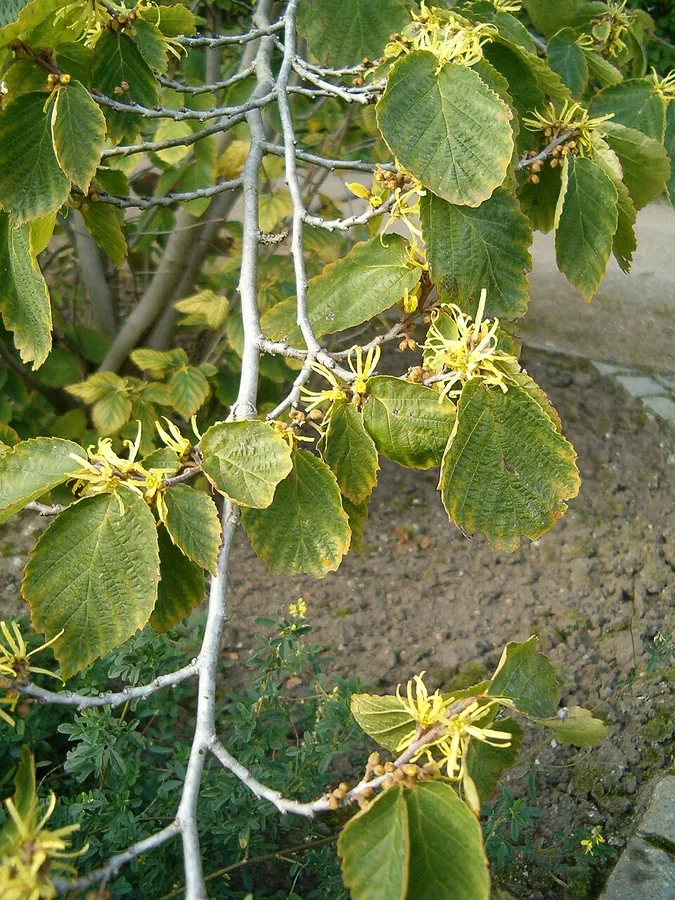
Witch hazel flowers when the branches are all but bare. Native to the woodlands of eastern North America, it opens its blooms from mid-October into December, and each flower is a small burst of narrow yellow petals, crimped and curling like thin ribbon straps unrolled along the twig. They give off a clean, sweet scent that hangs in cold air, and the shrub holds firm through winters as low as -35°F (-37°C).
The plant builds a large, multi-stemmed shrub or small tree, its pale, smooth-barked stems fanning out to 15 to 20 feet (4.5 to 6 m) tall and as wide in an open, vase-shaped spray. The broad, wavy-edged leaves turn a warm, clear yellow in fall before they loosen and drop. Both that leaf and the bark are what gets distilled into the astringent witch hazel toner, pressed for use on the skin.
For all its late-season drama it is an easy, low-fuss plant once rooted. It wants acidic, steadily moist ground beneath it and a place with decent light overhead, and it shrugs off cold, dense clay, and browsing deer. Its single hard limit is drought, so the roots of a young plant need water through any dry stretch.
Care
The short version: full sun to part shade, in moist, acidic, rich soil that never dries out. Water through dry spells, especially while the plant is young, feed once in early spring, and give it plenty of room to reach its full spread.
Light
Witch hazel does best in full sun, where the flowers set thickest along the twigs and the fall leaves burn a deeper yellow. It takes partial shade in stride, though thin light means fewer blooms and a pale film of mildew more readily settling on the leaves.
Water
Keep the soil consistently moist around the roots, since this is a plant with no tolerance for drought. Water every 5 to 10 days during dry spells, and keep close watch on a young shrub through its first summers until the roots run deep enough to draw their own.
Soil
Plant it in moist, acidic, rich earth that still drains freely. A pH of 5.0 to 6.0 suits it best, and, unlike many shrubs, its roots grip heavy clay without protest, so a damp, stiff corner can hold it.
Temperature
Few shrubs stand the cold like this one. Witch hazel weathers the full span from -35°F to 100°F (-37°C to 38°C), and that toughness is what lets its petals open in late fall while the wood around it goes dormant.
Humidity
Ordinary outdoor air suits it, so there is no figure to chase. Air moving between the leaves matters more than moisture in the air, since still, crowded growth is what lets a powdery mildew film creep over the foliage.
Feeding
One feeding carries it. Work in a balanced or acidic slow-release fertilizer in early spring, and let the shrub draw on it slowly through the season.
Pruning
The shears can mostly stay hung up. Cut only to shape the frame, and do it in early spring, remembering that the flower buds form on old wood, so a hard cut strips next fall's ribbons of bloom.
Repotting
As a landscape shrub, witch hazel rarely needs repotting. If a young one grows in a container, move it up when roots begin circling the walls or slipping out the drainage holes, or the top growth stalls despite steady water and feeding.
Size & spacing
Leave this shrub real room. Its stems climb 15 to 20 feet (4.5 to 6 m) tall and spread just as far, so set it well clear of walls and neighbors and let the open, vase-shaped spray of branches fill the space.
When to plant
Witch hazel keeps its own calendar, opening its ribbon-petaled flowers in late fall while the rest of the garden stands bare. Plant it in spring or fall so the roots can grip before summer heat or deep winter, and watch for the fragrant blooms from mid-October onward, often clinging to leafless twigs after the foliage has dropped.
Northern hemisphere
Southern hemisphere
Typical months for a temperate climate: start earlier in warm zones, later where spring frosts linger.
- Sow: Sow seed after warm then cold stratification; germination usually within a year.
- Plant: Spring or fall
- Harvest: Fragrant yellow flowers mid-October to December, often as or after leaves drop
Hardiness
USDA hardiness zones: 3–8
Temperature: down to -40°C
Troubleshooting
Witch hazel stays remarkably clean, and almost everything that marks it is skin-deep on the leaves rather than serious. Most of it surfaces on the foliage in late summer, written across the leaf as film, knob, or torn edge. Match what you see below, then judge whether it is worth a hand at all.
A chalky white bloom dusting the leaf surface
That flat, chalky coating is powdery mildew, a fungus that films over the upper leaf like a smear of talc where the air stalls and the shade deepens. Thin the crowded stems so a draft can pass between the leaves, pick off the ones most heavily coated, and keep water from beading on the foliage. The dusting looks stark against the green, but a healthy shrub carries it lightly and grows on.
Fix:
- Improve air circulation by thinning crowded stems
- Remove and dispose of heavily infected leaves
- Avoid overhead watering
Hard cone-shaped or spiny knobs raised off the leaf
Those firm, pointed knobs standing proud of the leaf are galls, raised by witchhazel gall aphids as they feed and coax the tissue to swell around them into cone or spiny shapes. Odd as the studded surface looks, the leaf keeps working and the shrub takes no real harm, so the galls can simply stay. Snap off and destroy the most knobbly leaves if their texture bothers the eye.
Fix:
- Tolerate damage, which is largely cosmetic
- Remove and destroy heavily galled leaves if desired
Ragged bites torn from the leaf edges
Ragged notches and holes torn through the green mark the feeding of caterpillars and Japanese beetles, which chew inward from the margins and leave a lace of gaps. While only a few are working the foliage, plucking them off by hand keeps the leaves whole. A mature witch hazel wears a scatter of chewed leaves without any loss of vigor, so light nibbling barely shows.
Fix:
- Handpick beetles and caterpillars when populations are small
- Tolerate minor feeding, which rarely harms established plants
Toxicity
For any household with animals, the news is easy: witch hazel is safe around pets, livestock, and people. The ASPCA does not list it as toxic, and the worst a curious nibble tends to bring is a brief, mild stomach upset. Its bark and leaves are distilled into the familiar astringent skin toner, a liquid meant for the skin rather than the stomach.
Safe for
People · Cats · Dogs · Horses · Rabbits · Livestock · Birds
Cats None
Cats are safe near it. Should one bite into a leaf, expect at most a thread of drool or a brief, mild stomach upset.
Dogs None
Dogs come to no harm. A curious mouthful of the foliage tends to bring nothing worse than passing stomach upset.
Horses Safe
Horses can crop the growth beside it without trouble, since the plant holds no toxin known to harm them.
Rabbits Safe
Rabbits are safe around witch hazel. Nibbling the leaves does no harm beyond, at most, a softer stool.
Livestock Safe
Cattle, goats, and sheep can browse the foliage safely, as it carries nothing poisonous to them.
Birds Safe
Birds face no risk here, whether they pick at the seeds or perch along the branches.
People Safe
People are safe too. The bark and leaves are distilled into the astringent skin toner, meant to be worked into the skin rather than swallowed.
No special handling required; ingestion of any plant material may cause mild, transient gastrointestinal upset.
Varieties
Most witch hazel sold for gardens is the straight species, but a few selections stand apart for their size or the color of their petals. These are the ones you are most likely to meet.
Harvest Moon
A vase-shaped selection that stands 15 to 20 feet tall, its branches strung with clear lemon-yellow flowers.
Little Suzie
A compact form no more than 4 to 6 feet high, dotted with soft yellow flowers over a dense, tidy frame.
Mohonk Red
A selection whose flowers glow a reddish tone, a warm break from the yellow that witch hazel usually shows.
How to propagate
Witch hazel is slow and stubborn to propagate, which is why nursery plants carry the price they do. None of the methods move quickly, so pick the one that matches your patience.
SeedDemanding
Sow after warm then cold stratification · Up to or more than a year due to double dormancy
The small, hard seed guards itself with a double dormancy that yields only in stages. Give it roughly 60 to 90 days of warmth near 60°F (16°C), then another 90 to 120 days of cold near 40°F (4°C), before the embryo will break. Even once both spells are met, germination usually takes up to a year.
LayeringModerate
Growing season · One or more seasons
Layering plays to the supple wood. Bend a low, limber branch down during the growing season and pin it into the soil by trench or simple layering, and the buried length slowly grows pale roots of its own over a season or more before you cut it from the parent.
GraftingDemanding
Late summer · One or more seasons
Named cultivars are almost always T-grafted onto Hamamelis virginiana rootstock in late summer, the thin bark lifted to seat the bud, and the union takes a season or more to knit. Nurseries lean on grafting because softwood cuttings are notoriously stubborn and seldom push roots.
Myths
Witch hazel is named for witchcraft or magic.
The name owes nothing to witches. It comes from the Old English word 'wych', meaning pliant or bendable, a fitting label for the supple, forked branches that bend without snapping. Those flexible branches were once cut as divining rods for dowsing water, and it is that 'witching' for water where the folklore truly begins.