Shrub · Hamamelidaceae
Chinese Fringe Flower
Loropetalum chinense
Rooted in acidic soil with good drainage, loropetalum wears colored leaves and threadlike fringed blooms with almost no fuss.
Full sun
Every 5–10 days
USDA 7–9
6–8 ft · 1.8–2.4 m
Overview
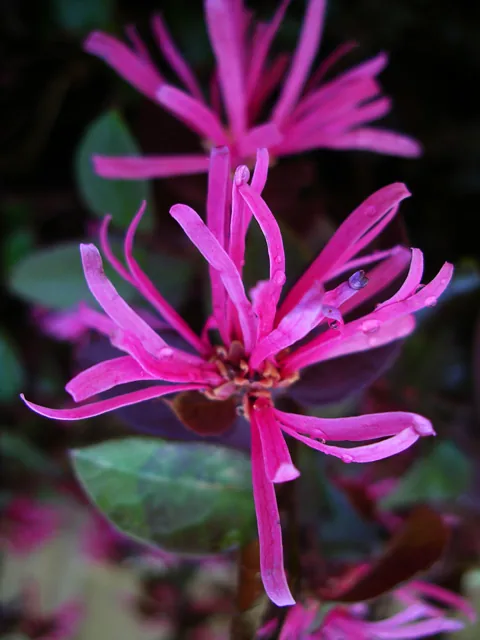
Loropetalum, the Chinese fringe flower, is an evergreen shrub whose draw is written on the plant itself: its colored foliage and the ragged, spidery flowers that break open in spring. On the popular forms the small, oval leaves run burgundy, deep plum, or near-black, and they keep that pigment through every month rather than greening up, while the plain green-leaved kinds stay flat and ordinary by comparison. The flowers hang in loose clusters of narrow, strap-thin petals, like little tassels, in pink, red, or white.
Up close the plant is all dense, fine-twigged branching, the small leaves set thickly along it and holding their color the year round. It takes drought once established, sits in full sun or part shade, and needs no more than a trim once the flowering passes. The one thing it holds out for is acidic soil, and where the leaves lose their depth the trouble almost always runs back to ground gone too alkaline.
Size is the surprise the plant keeps. Those small leaves and the tidy young shape read as a compact thing, yet many push far larger than the cultivar names let on, and a vigorous form thickens its stems toward small-tree size within a few years. Match the variety to the space and the plant keeps its proportion with little cutting.
Care
The short version: full sun to part shade, rich acidic soil that drains freely, steady water while the roots take hold and much less after, and a light prune as soon as the spring bloom fades.
Light
The leaf color and the flowering both run deepest in full sun, where the dark forms hold their pigment hardest; the shrub still takes partial sun or partial shade in stride. Sunk into deep shade, the dark leaves lighten and dull and the fringed blooms come thin.
Water
While the roots take hold, water it steadily, about once a week and more when the heat is fierce. Once settled it turns drought tolerant and wants little; let the top inch or so of soil dry between waterings, and lay mulch to keep the moisture in the ground.
Soil
The soil under it decides everything. Loropetalum wants rich, moist, well-drained soil on the acidic side, ideally a pH between 5.0 and 6.5, worked full of organic matter. Neutral or alkaline ground binds up iron and drains the color from the leaves to yellow.
Temperature
It stands a wide swing of temperature, holding through lows near 5°F (-15°C) and heat to about 100°F (38°C), the span of USDA zones 7 through 9 where it stays outdoors all year.
Humidity
Plain outdoor humidity is enough, so there is no figure to chase. What tells on the plant far more is standing water at the roots, the start of its worst troubles.
Feeding
One feeding in spring of an acidic, azalea- or camellia-type fertilizer suits it, at a medium dose. That same acidic feed helps keep the ground on the sour side the leaves need to hold their color.
Pruning
Pruning is light and infrequent. Since the buds set mostly on old wood, the cut comes right after the spring bloom, so shaping the twiggy growth never strips next year's flowers.
Repotting
A potted plant seldom needs shifting. Repot only when roots coil round or push from the drainage holes, water sheets straight through, or the new growth at the tips stalls.
Size & spacing
Look for a shrub near 6 to 8 feet (183 to 244 cm) tall and about as broad, with vigorous forms stretching well past. Give each plant its full spread so air moves through the dense branching and its size stays in hand.
When to plant
Loropetalum is a woody shrub set once and grown on for years, so the timing that counts is the planting itself. New plants go into the ground in spring or fall, once frost danger has passed, and the main flush of threadlike, fringed flowers opens from late March into April, with scattered blooms breaking again through the warmer months.
Northern hemisphere
Southern hemisphere
Typical months for a temperate climate: start earlier in warm zones, later where spring frosts linger.
- Plant: Spring or fall after frost danger passes
- Harvest: Late March to April with sporadic rebloom into fall
Hardiness
USDA hardiness zones: 7–9
Temperature: down to -18°C
Troubleshooting
Given the acidic soil it wants, loropetalum holds its color and vigor, so most faults are soil faults showing in the leaves and roots. The plant tells you early, in a paled leaf or a softened root. Match what you see below and correct the cause rather than the surface sign.
Limp, sagging growth above roots turned dark and slick
Leaves droop and whole branches brown and stiffen even while the soil around the base stays dark and wet, the mark of root rot in ground that never drains. Lift the soil and the roots come up blackened and slick, soft enough to smear between your fingers rather than snap. Cut the water, open the drainage, and shift sound survivors into a raised, free-draining bed, while a root mass gone to mush is pulled and replaced.
Fix:
- Improve drainage and reduce watering
- Remove and discard severely rotted plants
- Replant in raised, well-drained beds amended with organic matter
Hard, corky knots bulging from the wood, with dead growth above them
Hard, rough-surfaced swellings bulge from the branch joints like corky knots, and the wood beyond each one browns and dies back; together they read as bacterial gall disease. Cut each carrying branch well below its swelling, down into clean wood, and burn or bin the pieces, wiping the blades with disinfectant between cuts so nothing rides along. A shrub studded with galls throughout is pulled entirely.
Fix:
- Prune out and destroy galled branches well below the gall
- Disinfect pruning tools between cuts
- Remove and replace severely infected plants
Leaf surfaces bleaching to yellow around a web of still-green veins
When the blade of a leaf pales to yellow while the fine veins running through it stay green, that split-tone pattern is chlorosis, and it means the soil has turned too alkaline for the roots to draw up iron. The newest leaves at the shoot tips wear it first. A soil test names the pH, elemental sulfur or an acidic feed brings it down, and chelated iron floods the color back while the ground slowly corrects.
Fix:
- Acidify soil with elemental sulfur or an acidic fertilizer
- Apply chelated iron as a temporary correction
- Mulch with organic matter to lower pH over time
Toxicity
For homes with pets or children, loropetalum is not toxic. It sits in neither the major poison databases nor the ASPCA list, and the bitter tannins packed into the leaves turn most animals away after a bite or two. Nothing about the leaves, stems, or flowers poses a poisoning risk.
Safe for
People · Cats · Dogs · Horses · Rabbits · Livestock · Birds
Cats None
A cat can press its face into the leaves or bite one clean through without harm. The tannins give the foliage a bitter edge that usually stops it well short of a real mouthful.
Dogs None
A dog stripping the bark or leaves off a low branch takes no poison from it. The worst a big, fibrous mouthful is likely to do is leave a tender stomach churning for a while.
Horses Safe
Horses can crop the leaves and stems within reach without concern, since the shrub holds no compound that would poison them.
Rabbits Safe
Neither the leathery leaves nor the fringed flowers put a rabbit at risk, and the bitter tannins in the foliage tend to cut its nibbling short.
Livestock Safe
Cattle, goats, and sheep can browse the foliage safely, with nothing in the leaves or wood known to poison them.
Birds Safe
Small birds work through the dense, twiggy branches to perch and forage with no harm at all.
People Safe
The plant is safe around children, since no leaf, flower, or stem is poisonous, and a curious taste does no harm.
No special handling needed; foliage contains bitter tannins that discourage browsing.
Varieties
These are named mostly for the color of their leaves and the shape they take rather than their flowers. Here are the cultivars you are most likely to meet.
Ruby (var. rubrum 'Ruby')
Each new leaf pushes out a deep burgundy-red, and the hot-pink fringe flowers stand out in sharp contrast against that dark ground.
Purple Pixie
A low, weeping dwarf whose purple leaves and pink blooms drape from arching stems, spilling from a container or over a wall as readily as it mats across the ground.
Plum Delight
Its leaves hold a reddish-purple cast that deepens the ground behind the bright pink flowers.
Ever Red (Chang Nian Hong)
The darkest of the group, its foliage a near-black red, hung with red blooms and given to flowering a second time later in the season.
Zhuzhou
A vigorous purple-leaved form whose stems lengthen and thicken until, unchecked, it stands at tree-like size.
Companions
Loropetalum pairs naturally with the other acid-loving shrubs, which want the same rich, well-drained ground and gentle shade it does.
How to propagate
Loropetalum is easy to multiply at home from the plant's own wood, either by rooting a cut length of stem or by pinning a low branch into the soil until roots form along it.
Stem cuttingsModerate
Late spring through summer · Roots in roughly 15 days to several months depending on cultivar and warmth
From late spring through summer, cut lengths of semi-hardwood shoot, the wood that has stiffened past soft and green but not yet gone brown and rigid. Warmth around 75°F (24°C) at the base coaxes roots out, and they break from the cut ends anywhere from about 15 days to a few months on, by cultivar and how warm the setting stays.
LayeringEasy
Spring to summer · Several months to root
The easiest route is layering through spring or summer. Draw a low, pliable branch down to the ground, pin it so a length of stem presses into the soil, and leave it fed by the parent while roots form along that buried wood over several months before it is cut away as its own plant.
Myths
The fringed blooms and dark leaves of Loropetalum are poisonous to pets.
The plant turns up in neither the toxic-plant databases nor the ASPCA list. Loropetalum is treated as non-toxic to pets, so an animal that bites through a leaf takes no harm from it.
The compact dwarf Loropetalums hold their miniature shape forever.
Many labeled dwarf keep pushing new wood well past their stated size, and the species and vigorous forms stretch to 10 to 20 feet or more. Give each plant room for its true mature size, and read the cultivar closely before you fix its place.