Shrub · Hamamelidaceae
Dwarf Fothergilla
Fothergilla gardenii
White, honey-scented bottlebrush spikes and leaves that burn yellow, orange, and red on a compact native shrub.
Full sun
Every 5–10 days
USDA 5–8
2–6 ft · 0.5–1.8 m
Overview
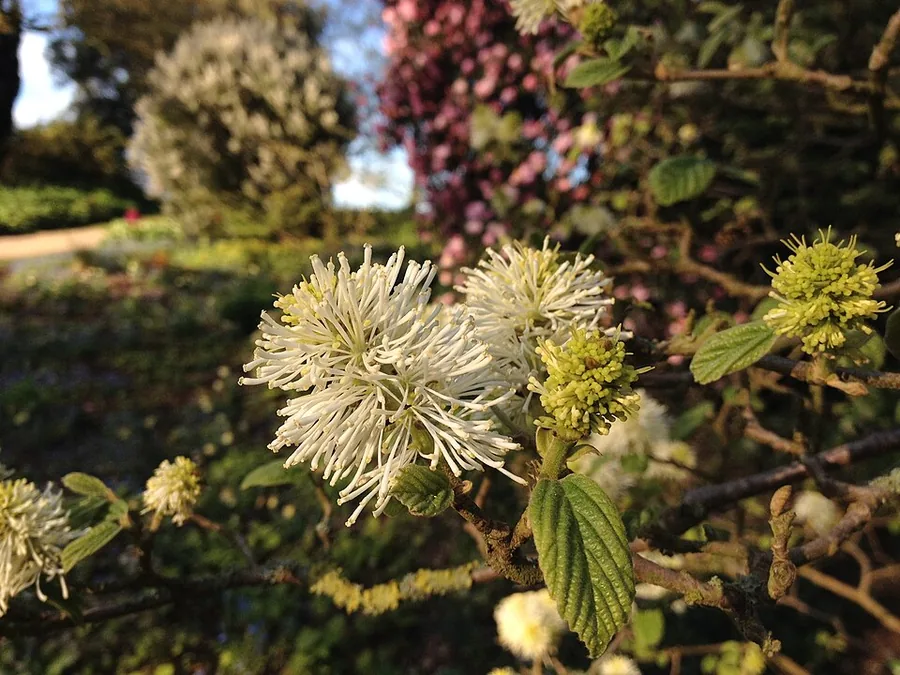
Dwarf fothergilla is a slow-growing native shrub of the southeastern United States, a witch hazel relative built on low, branching, rounded lines. In early spring, before any leaf shows, its bare twigs sprout white bottlebrush flower spikes, dense brushes of fine stamens with no true petals, breathing a faint honey scent. It stays compact at 1.5 to 6 feet (46 to 183 cm) tall, a low mound of crooked stems.
Its leaves carry the second act. Rounded and ribbed through the green of summer, they ignite in fall to yellow, orange, and red, the three colors often flaring across a single leaf and a single plant at once. The shrub stays clean and unblemished, with no serious pests marking the foliage, and deer leave the leaves untouched.
What sits underneath shapes everything above it. Fothergilla needs acidic, moist, well-drained ground and pales to a sickly, washed cast on limed or alkaline sites, but rooted in the right soil and bathed in sun it holds its full, saturated color.
Care
The short version: give it acidic, moist, well-drained soil and full sun for the fullest white spikes and the most saturated fall leaves, water it through establishment, mulch to keep moisture and acidity steady, and prune only right after the flowers fade.
Light
In full sun, fothergilla packs its twigs with the most white spikes and pushes its fall leaves to the deepest yellow, orange, and red. Partial sun or light shade is tolerated, but deep shade thins the flowering and bleaches the autumn color to a flat, muted tone. In hot climates, a little afternoon shade keeps the foliage from scorching.
Water
The soil holds best consistently moist, above all while the roots take hold and through hot, dry spells, since dry stress dulls both the spikes and the leaves. Watering runs about weekly that first season, roughly every 5 to 10 days. Established plants endure some drought, but steady moisture deepens the flowers and the fall color alike.
Soil
The soil decides whether the colors come true. Fothergilla wants acidic, rich, well-drained loam or sandy loam at a pH of 5.0 to 6.0, and it will not abide limed or alkaline ground that drains its leaves pale. Worked through with organic matter, and kept clear of any limed spot, the soil holds the plant deep green and vivid in fall.
Temperature
This is a hardy shrub in both extremes, its woody stems holding firm from -20°F to 95°F (-29°C to 35°C). That span covers zones 5 through 8 comfortably, so winter cold rarely marks the wood.
Humidity
Plain outdoor air suits the foliage, with no level to chase. Airflow counts more than moisture, because leaves left crowded and damp are the ones that spot and blotch.
Feeding
Fothergilla feeds lightly and colors well on little. A single spring dose of an acidic, slow-release shrub fertilizer is plenty, and even that is optional. Organic matter worked into the soil does more for the leaves than any heavy feeding.
Pruning
Pruning suits the moment right after the flower spikes fade in late spring, and only when the shrub needs shaping. The buds for next year's spikes set on old wood from the previous season, so cutting later strips those flowers away. Pulling the slim suckers keeps the low mound from creeping outward.
Repotting
Fothergilla seldom needs repotting and roots best out in open ground. Held in a container, roots circling the pot or water sliding straight through without wetting the rootball mark a plant that has outgrown its space.
Size & spacing
A mature plant builds a rounded mound 1.5 to 6 feet (46 to 183 cm) tall and 2 to 6 feet (61 to 183 cm) wide. Space each shrub to let that shape round out fully and to keep air slipping between the leaves, which holds leaf spot off.
When to plant
Across USDA zones 5 to 8, fothergilla settles in when planted in spring or fall, while the soil is cool and damp. Its flowers open early, in April and May, the creamy spikes appearing on bare twigs before a single leaf has unfolded.
Northern hemisphere
Southern hemisphere
Typical months for a temperate climate: start earlier in warm zones, later where spring frosts linger.
- Plant: Spring or fall
- Harvest: Early to mid spring (April to May), before leaves emerge
Hardiness
USDA hardiness zones: 5–8
Temperature: down to -29°C
Troubleshooting
Fothergilla rarely sickens, and when its leaves or flowers look off the trail usually leads back to the soil or the site. Match the marks and colors you see below to the cause, then correct the conditions rather than the surface symptom.
Leaf blades yellowing around green veins, growth at a crawl
A leaf gone yellow while its veins stay green is the signature of iron chlorosis, which sets in when alkaline soil locks the iron away from this acid-lover. A soil test points the way to lowering the pH with elemental sulfur or an acidic amendment, mulch of pine bark or leaf mold holds the soil sour, and lime stays well clear of the planting.
Fix:
- Test and lower soil pH using elemental sulfur or an acidic soil amendment
- Mulch with acidic organic matter such as pine bark or leaf mold
- Avoid liming the area around the plant
Brown patches bleeding across the leaf blades
Those darkening marks are Pseudocercospora leaf spot, a fungus that settles on leaves left wet on an already stressed plant, the small brown spots widening and merging across the blade. Fallen leaves, raked up and binned, cut the spores that carry over, drip or early watering dries the foliage fast, and wider spacing lets air move. A labeled fungicide earns its place only in a bad year.
Fix:
- Rake up and remove fallen infected foliage to reduce spore carryover
- Switch to drip irrigation or water early morning so leaves dry quickly
- Improve spacing and air movement around the plant
- If severe, apply a labeled fungicide such as chlorothalonil, myclobutanil, or propiconazole on the recommended interval
Few flowers and washed-out fall color
Two things usually thin the spikes and flatten the leaves: too much shade and pruning at the wrong time. The plant sets the most flowers and the brightest color in full sun, so a deeply shaded shrub does better moved into brighter light. The flower buds ride on old wood, so pruning belongs right after the spring spikes fade, since later cuts carry off next year's flowers.
Fix:
- Site or transplant where the shrub receives more sun, ideally full sun with some afternoon shade in hot climates
- Prune only immediately after flowering so flower buds on old wood are preserved
Toxicity
For all its bristling spikes and richly colored leaves, fothergilla is not toxic. It is absent from the ASPCA's list of harmful plants, and no poisoning is documented for animals or people. A pet that chews through a mouthful of the foliage may get a mild, passing stomachache, and nothing worse.
Safe for
People · Cats · Dogs · Horses · Rabbits · Livestock · Birds
Cats None
A cat that mouths one of the rounded leaves comes to no harm, since fothergilla appears nowhere on the ASPCA's toxic plant list. Chewing through a wad of foliage might still leave it drooling a little or briefly queasy.
Dogs None
No known toxin hides in the stems, leaves, or flower spikes, so dogs move safely around this shrub. One that gnaws off and gulps down plenty of foliage might end up with a short-lived bellyache.
Horses Safe
Horses take no documented harm from this plant, and the shrub can stand beside a paddock without worry. Like any plant a horse has never sampled, a big grazed helping could stir mild digestive trouble.
Rabbits Safe
Rabbits face no poisoning risk from fothergilla. The woody stems and leaves simply are not part of a healthy rabbit diet, so it is best kept as a treat rather than a staple.
Livestock Safe
Cattle, goats, and sheep can share a pasture with this shrub safely, as no livestock toxicity is on record. Heavy browsing of any single plant is never ideal, but there is no specific hazard here.
Birds Safe
The bristling spring spikes pull in pollinators, and nothing in the plant harms a bird. Chickens and other backyard fowl can pick around its base freely.
People Safe
The plant poses no poisoning risk to people, children included. It is not grown to be eaten, though, so there is no need to taste any part of it.
No special handling precautions for toxicity; as with any plant, discourage pets from chewing foliage to avoid mild stomach upset.
Varieties
A handful of named selections part ways in the look of their flowers, the color of their summer leaves, and the fire of their autumn foliage. These are the ones worth seeking by name.
'Mount Airy'
A vigorous hybrid that bears the most fragrant white bottlebrush flowers and turns a dependable yellow, orange, and red in fall.
'Blue Mist'
Grown for its unusual powdery blue-green summer leaves, it gives up some of the fiery autumn color other selections deliver.
'Jane Platt'
A compact plant whose narrow flower spikes carry a pink tint, finishing the year with rich, multicolored fall foliage.
'Suzanne'
A dwarf, tidy form that suits a small garden and lights up with strong orange-red color in autumn.
How to propagate
More of these spike-flowered shrubs come from cuttings, suckers, or layered stems, each quicker than the slow crawl of seed.
Stem cuttingsModerate
Early to mid summer (June to mid August) · Several weeks to root, then grow on for a season or more
Softwood cuttings are the most reliable way to make new plants, and June is the sweet spot. Dipped in rooting hormone and set into a moist 1:1 mix of peat and perlite, the cuttings root over several weeks before growing on for a season or more.
DivisionModerate
Late winter to early spring while dormant · One growing season to establish
Fothergilla gardenii spreads by suckers into a loose colony, throwing up slim new stems that make a ready supply of plants. While the shrub is dormant in late winter or early spring, a rooted sucker or root piece, lifted and replanted, settles in over one growing season.
SeedDemanding
Sow fresh; germination is slow · 9 to 15 months to germinate, plus further growing time
Seed is the least reliable route and the slowest by far. The seeds carry a deep double dormancy that needs warm then cold moist stratification, and even then they take 9 to 15 months to germinate before any real growing time begins.
LayeringModerate
Spring · One to two growing seasons
Layering works well because the shrub carries low, bendable stems close to the ground. In spring, a stem pinned down into moist acidic soil roots over one to two growing seasons before it is cut free from the parent.
Myths
New fothergillas spring up from sown seed as easily as any common shrub.
The seeds hold a deep double dormancy and creep through a slow 9 to 15 months before sprouting, even given the right warm-then-cold treatment. Most gardeners skip seed entirely and raise new plants from softwood cuttings or rooted suckers instead.
Plant a fothergilla in any patch of garden ground and it will flourish.
It needs acidic, moist, rich, well-drained ground and turns chlorotic and weak, its leaves pale, in alkaline or limed soil. Acid soil is not optional for this shrub, so test the site before planting and keep lime away from it.