Shrub · Fabaceae
Wisteria
Wisteria sinensis
Give it full sun, a heavy support, and two hard prunings a year, and wisteria drips with flowers each spring.
Full sun
Every 5–10 days
1095–2555 days
USDA 5–9
Overview
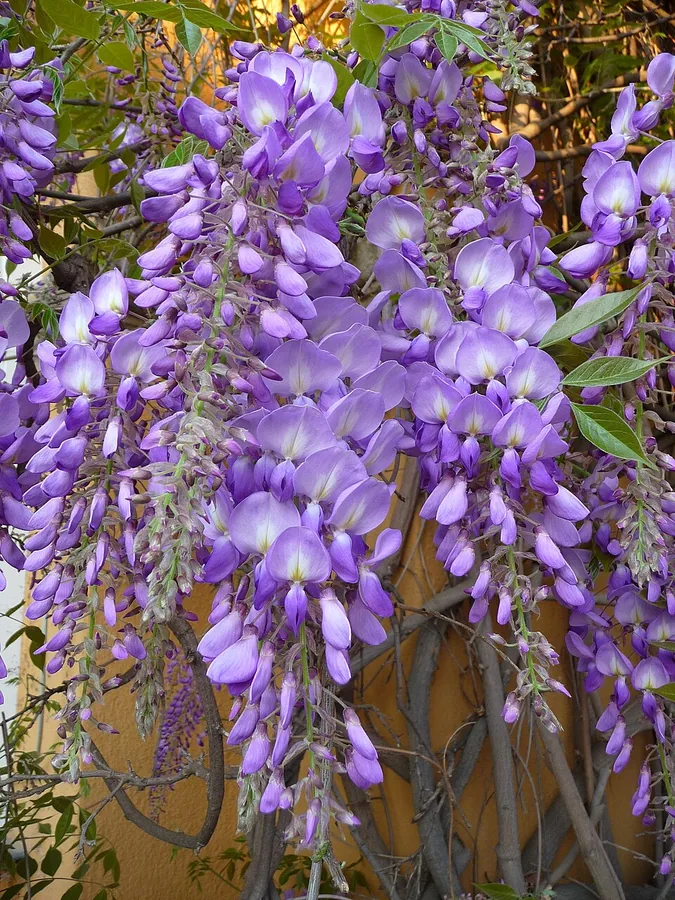
In full bloom a wisteria drops long racemes of blue-violet flowers straight down over an arbor, each spike a tight column of pea-shaped blooms shading from bud to open petal. It is a woody, twining member of the pea family, and the muscle behind that hanging display shows in the thick stems that carry it. A mature vine reads more like a small tree than a slender climber.
Two Asian species fill most gardens, and their stems twist in opposite directions. Chinese wisteria twines counterclockwise and opens nearly all its flowers at once in one dense sheet, while Japanese wisteria twines clockwise and unrolls its racemes slowly from base to tip into long trailing ribbons. Both are beautiful but invasive across much of the eastern US, which is why the native American and Kentucky wisterias are worth close attention.
The plant grows on patient, heavy wood. A young vine may carry only its ferny pinnate leaves for years before a single flower appears, and once the stems thicken they will coil around trees and gutters unchecked. Give it full sun, a strong dedicated support, and hard pruning twice a year, and those woody stems drip with flower for decades.
Care
The short version: wisteria wants full sun, a very strong support set well away from trees and the house, and lean soil with little or no feeding. Water it deeply while it roots in, then prune the woody stems hard in both summer and winter to hold them in bounds and draw out the flowers.
Light
Wisteria flowers best in full sun, and stems that bathe in direct light all day are the ones that hang thick with bloom. It will tolerate partial shade, but shade is one of the main reasons a leafy, healthy-looking plant never flowers.
Water
Keep the soil moist but well drained while the roots take hold, watering deeply during dry spells. Once established the vine shrugs off drought fairly well, so let the top inch or so dry between waterings rather than keeping it soggy.
Soil
Wisteria is not fussy about soil and takes clay, loam, or sand and either wet or dry ground. Aim for moist, well-drained loam at a pH between 6.0 and 7.0 and the vine settles in.
Temperature
This is a tough, cold-hardy vine that endures a wide range, roughly -20°F to 100°F (-29°C to 38°C). The main weather risk is a late spring frost, which can brown and kill the swelling flower buds just before they open.
Humidity
Ordinary outdoor humidity suits wisteria, so there is no level to manage. What matters far more is air and light reaching the stems, which means keeping the dense growth thinned.
Feeding
Feed very little, or not at all. Wisteria needs little, and excess nitrogen swells the leaves at the expense of flowers, so use only a low-nitrogen feed in spring if you feed at all.
Pruning
Prune the woody stems hard twice a year to hold the vine in check and bring on bloom. In summer cut the long whippy shoots back to five or six leaves, then in winter shorten those same shoots to two or three buds, cutting away anything girdling its support.
Repotting
Wisteria belongs in the ground rather than a pot, so it is not really repotted. On an established plant, root pruning can push a stubborn vine into flowering, and few or no blooms despite heavy leafy growth is the sign it may help.
Size & spacing
Give wisteria serious room, because it climbs 10 to 25 feet (3 to 7.5 m) tall and spreads anywhere from 4 to 30 feet (1.2 to 9 m) across. Set it on its own heavy support well clear of trees, walls, and other plants.
When to plant
Wisteria is a long-lived woody vine, so the timing that matters is planting rather than a yearly sowing. Set new plants out in spring or fall, then wait, because the flowers can take several years to form and, once they do, they open in mid-to-late spring.
Northern hemisphere
Southern hemisphere
Typical months for a temperate climate: start earlier in warm zones, later where spring frosts linger.
- Plant: Spring or fall
- Harvest: Mid-to-late spring (April-May)
Hardiness
USDA hardiness zones: 5–9
Temperature: down to -29°C
Troubleshooting
Most wisteria troubles trace to a vine that will not flower or one whose woody stems grow past what its space can hold. Read the symptom, weigh the plant's age and where it sits, then act before the stems take over. The three below are the ones gardeners meet most.
Thick corded stems coiling and crushing
The mature stems of wisteria thicken into heavy woody cords that can climb over 60 feet, twisting around anything within reach. Those coils tighten on a tree trunk until they bite into the bark and choke it, and the sheer mass bends or snaps trellises, gutters, and downspouts. A stout dedicated arbor set well away from the house, a hard prune twice a year, and cutting free every stem that grips where it should not keep the vine from overrunning its bounds.
Fix:
- Provide a very strong, sturdy dedicated support (heavy arbor or metal structure)
- Prune hard twice a year and cut away any stems twining around trees, gutters, or downspouts
- Remove the plant entirely if it is engulfing trees or buildings
Runners weaving into a woodland tangle
The Asian species are invasive across the eastern and southeastern US, throwing out seed, snaking runners, and stems that sink new roots wherever they press into the soil. That reach knots into dense thickets of tangled stems that shade out or drag down the native trees they cover. Cutting the escaped vines back to the root, clearing each flush of resprouts, and setting native American wisteria in their place keeps the tangle from spreading.
Fix:
- Cut vines close to the root and repeatedly remove resprouts through the season
- Apply an appropriate systemic herbicide to cut stems in spring or summer where permitted
- Replace with a native, non-invasive alternative such as American wisteria (Wisteria frutescens)
Green leaves everywhere, not a single flower
When a wisteria pushes out sheet after sheet of pinnate green leaves but not one hanging raceme, the vine is usually still too young, and a seedling can carry only foliage for 3 to 7 years or more before its first flowers form. Heavy nitrogen, shade, or a late spring frost that browns the swelling buds can stretch the wait. Full sun on the stems, no feeding, and a hard prune twice a year coax the short flowering spurs into being.
Fix:
- Be patient and let the plant mature; grafted or already-blooming nursery plants flower sooner than seedlings
- Stop applying nitrogen fertilizer
- Move or train the vine into a full-sun position
- Prune correctly twice a year (summer and winter) to build flowering spurs
Toxicity
Every part of wisteria is toxic, and the soft velvety seed pods and the hard bean-like seeds inside them are the most dangerous of all. They hold a lectin called wisterin along with toxic glycosides, and because the pods look so much like edible beans they have repeatedly poisoned children. Keep the seeds and pods away from pets, livestock, and kids, and clear fallen pods from the ground.
Toxic to
Cats · Dogs · Horses · Rabbits · Livestock · Birds · People
Cats Moderate
A cat that bites into the velvety pods or the hard round seeds inside tends to vomit, sometimes streaked with blood, then slides into diarrhea, low energy, and dehydration. Those pods and seeds carry the heaviest dose.
Dogs Moderate
Dogs go for the plump bean-like pods and pay for it with heavy vomiting that may show blood, loose stools, ropey drool, and a flat, dull mood. Dehydration creeps in as the stomach stays upset.
Horses Moderate
The toxin runs through every part of the plant, leaf and stem as well as seed, so a horse that grazes any of it goes off its feed and turns dull, with vomiting, diarrhea, and drooling.
Rabbits Toxic
Wisterin and the plant's glycosides load every part against rabbits, and a single nibble of leaf or pod can bring drooling, a painful gut, and runny droppings, so keep them clear of it entirely.
Livestock Toxic
Cattle, goats, and sheep that crop the foliage, pods, or seeds can drop into severe stomach upset, heavy drooling, and dehydration. Fence the plant well off from any pasture.
Birds Toxic
The seeds and pods are toxic to birds, and the pods hang there looking like the very beans a bird would peck. Vomiting, weakness, and dehydration follow if any is swallowed.
People Caution
The soft velvety pods mimic edible bean pods closely enough to have poisoned children who opened them for the seeds, and even a couple of those seeds can bring on severe vomiting, belly pain, bloody diarrhea, drooling, and dehydration, so keep children well clear of them.
The pods resemble edible beans and have poisoned children; keep seeds and pods away from kids and pets.
Helpline numbers

United States
ASPCA Animal Poison Control: (888) 426-4435 (fee applies)
Poison Control: (800) 222-1222



Canada
Poison Centres: 1-844-764-7669
Varieties
The choice in wisteria runs between the showy but invasive Asian species and the better-behaved natives. These four cover the plants you are most likely to find.
Wisteria sinensis (Chinese wisteria)
Its stems twine counterclockwise, and before the leaves unfurl it opens fragrant blue-violet to purple, pink, or white racemes 6 to 12 inches long almost all at once in a single dense cascade, though it is invasive across the eastern US.
Wisteria floribunda 'Macrobotrys' (Japanese wisteria)
Its stems twine clockwise and trail exceptionally long red-violet racemes, reported up to 2 to 4 feet, that open bloom by bloom from base to tip in a slow slender ribbon, and while cold hardy it is also invasive in the eastern US.
Wisteria frutescens 'Amethyst Falls' (American wisteria)
A native and far less aggressive vine bearing short, packed 4 to 6 inch lavender-purple racemes in May on new wood, so it often carries flowers while the plant is still young.
Wisteria macrostachya 'Blue Moon' (Kentucky wisteria)
A very cold-hardy native whose cool silvery-blue racemes can flush again through the season, a non-invasive choice for northern gardens.
How to propagate
Wisteria can be raised from a pinned stem, a summer cutting, or its hard round seeds, though only the first two give a plant that flowers like its parent.
LayeringEasy
Spring to summer · Several months to a year to root
Layering is the surest way to copy a wisteria. A low, whippy stem pinned down into the soil in spring or summer roots slowly along its buried length, taking several months to a full year. The new plant carries the exact flowering traits of its parent.
Stem cuttingsModerate
Summer (softwood/semi-ripe) · Several weeks to root
Soft green softwood or firmer semi-ripe cuttings taken from the current season's growth in summer strike roots in a few weeks. This route preserves the cultivar, so the plant you raise blooms just like the stem it came from.
SeedModerate
Spring · Many years to first bloom
The hard round seeds germinate easily in spring but make the worst route for a hurry, since seedlings vary and often take 7 or more years to flower. Those seeds are also toxic, so handle them with care and keep them away from children and pets.
Myths
Feeding wisteria plenty of fertilizer makes it bloom.
High-nitrogen fertilizer does the reverse, swelling the vine with leaf after leaf while the racemes never form, and most wisteria flowers better when it is left unfed. Full sun on the stems, correct twice-yearly pruning, and a little maturity are what actually draw out the flowers.
All wisterias are invasive, so none are worth planting.
Only the Asian species, W. sinensis and W. floribunda, run wild in the eastern US. Native American wisteria (W. frutescens) and Kentucky wisteria (W. macrostachya) are far better behaved, and they hang the same draping racemes without threatening the surrounding woodland.